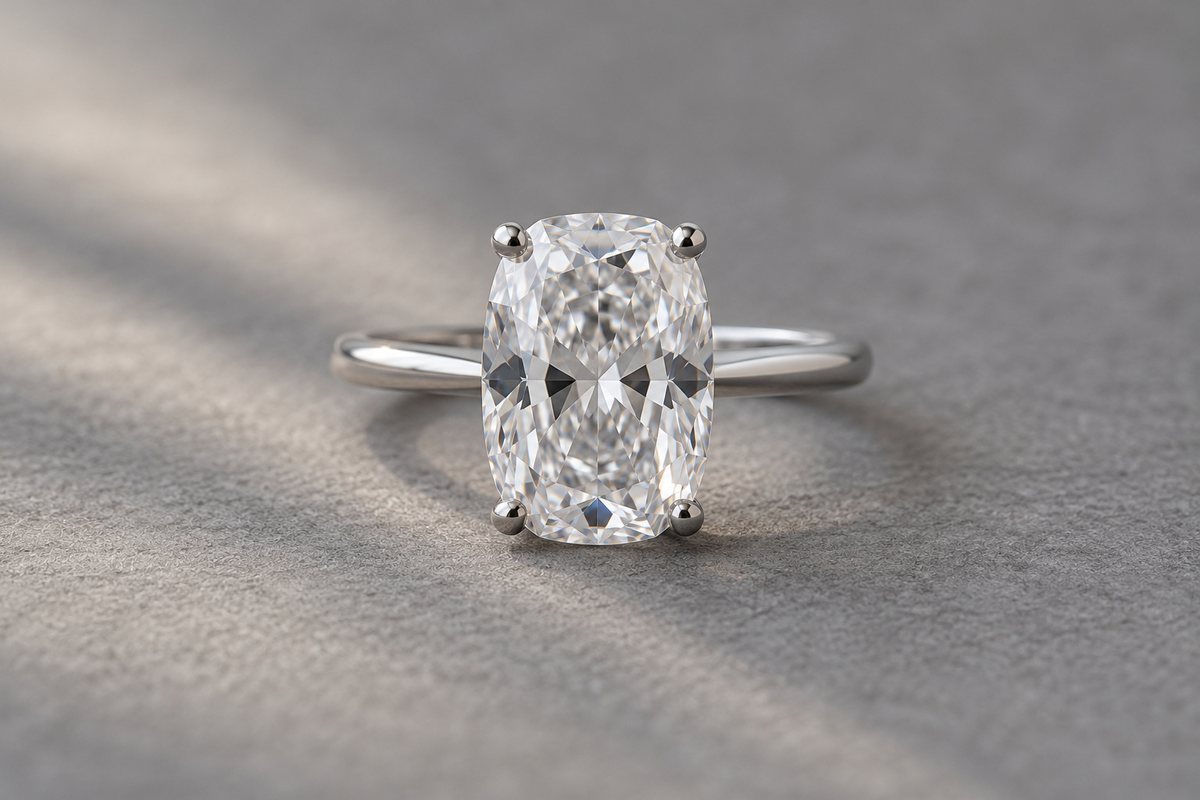
An elongated cushion cut is a cushion-shaped diamond, a square or rectangle with softly rounded corners, that is noticeably longer than it is wide, usually with a length-to-width ratio of about 1.20 or more. Square cushions sit at roughly 1.00 to 1.10. The longer outline makes the stone look slimmer on the finger and often a little larger face-up than a square cushion of the same weight.
This guide includes a few product links near the end. As an Amazon Associate, Diamond Taire earns from qualifying purchases, at no extra cost to you.
This guide explains what those ratio numbers actually mean, the difference between “crushed ice” and “chunky” faceting, how to spot a deep, heavy cushion that hides its weight, how cushions compare with round and oval diamonds for size and price, and how to choose an elongated cushion cut engagement ring that you will still love in twenty years.
At a glance
- Ratio bands: about 1.00-1.10 reads as square, 1.10-1.20 as slightly rectangular, and 1.20 or more as clearly elongated.
- No lab cut grade: GIA and AGS do not give cushion cuts an overall cut grade, so you have to judge the stone from its proportions, photos and video.
- Two looks: “crushed ice” cushions have many small, splintery flashes; “chunky” or antique-style cushions show bigger, bolder flashes.
- Watch the depth: cushions are often cut deep, which adds weight you pay for but cannot see.
- Value: cushions often cost less per carat than round brilliants, but may look smaller per carat than ovals.
What makes a cushion cut “elongated”?
Every fancy-shaped diamond has a length-to-width ratio (L:W): the length of the stone divided by its width, both measured on the grading report. A diamond measuring 7.20 mm by 6.00 mm has a ratio of 1.20. That one number decides whether a cushion looks square, gently rectangular or clearly elongated.
| L:W ratio | How it looks | Who it tends to suit |
|---|---|---|
| 1.00-1.05 | Square, pillow-like | People who love a classic, symmetrical cushion; halo designs |
| 1.05-1.10 | Very slightly rectangular; still reads square to most eyes | Those who want a square look with a touch of softness |
| 1.10-1.20 | Gently rectangular | A middle ground; looks elongated in some settings, square in others |
| 1.20-1.30 | Clearly elongated | The most popular elongated range; slims the finger without looking stretched |
| 1.30 and above | Long and slender, close to a rounded rectangle | Those who want a strong elongated look, like a softer radiant or emerald outline |
None of these ratios is “best”. Elongated cushions are popular because a longer outline draws the eye along the finger, which many people find flattering, especially on shorter fingers or wider hands. If you prefer a square stone, there is nothing wrong with that. What matters is that you choose the ratio deliberately, because two cushions of the same carat weight can look completely different on the hand.
A practical tip: ratios near 1.10 to 1.15 can look square from some angles and rectangular from others. If you want the stone to read unmistakably elongated, aim for 1.20 or above; if you want it to read unmistakably square, stay under about 1.05.
Crushed ice vs chunky: the faceting choice
Cushion cuts are not a single recipe. Most cushions on the market are listed on grading reports as “cushion modified brilliant”, a broad family that covers very different faceting styles. Broadly, you will see two looks.
Crushed ice
These cushions have extra facets, often a second row of pavilion facets, that break light into many small, sparkly points. The effect is glittery and lively, a bit like looking into shaved ice. Some people love it; others find it busy or slightly “fuzzy” from a distance. Crushed ice patterns can also hide small inclusions well.
Chunky, antique or “old mine” style
These have fewer, larger facets that produce broad, bold flashes of light and dark. The look is closer to an antique cushion or old mine cut, which was a forerunner of the modern round brilliant. Chunky stones show inclusions and colour more readily than crushed ice ones, because the bigger facets give your eye larger windows into the stone.
| Feature | Crushed ice | Chunky / antique-style |
|---|---|---|
| Sparkle type | Many small, glittering flashes | Fewer, larger, bolder flashes |
| Looks best | Up close, in bright light | At a distance and in soft or candle-like light |
| Hiding inclusions | Better | Less forgiving |
| Hiding colour | Better | Less forgiving |
| Style | Modern, glittery | Vintage, romantic |
| How to identify | Busy, mosaic-like pattern in video | Clear, defined “petal” or kite facets visible |
The grading report will not tell you which you are looking at, because both are usually labelled the same way. You have to judge from high-quality video, ideally rotating the stone, or by seeing it in person.
Why there is no cut grade, and what to check instead
For round brilliant diamonds, GIA assigns a cut grade from Excellent to Poor. For fancy shapes, including cushions, it does not. AGS also does not grade cushion cut quality in the same way. If a seller lists a cushion as “ideal” or “excellent cut”, that is the seller’s own description, not a laboratory grade. Our guide to reading a diamond grading report explains which parts of the report are lab-graded and which are not.
Instead of a cut grade, look at these measures on the report and in the video:
- Depth percentage: cushions are often cut deeper than other shapes. Many sit in the high 60s as a percentage; stones well above about 70% often carry a lot of hidden weight in the pavilion and can look small for their carat.
- Table percentage: very large tables can flatten the look and reduce fire; very small ones can make the stone look closed-in. Use it alongside the video, not alone.
- Polish and symmetry: these are graded on fancy shapes. Very Good or Excellent is a sensible minimum.
- Girdle: a very thick girdle hides weight in the edge; an extremely thin one can be vulnerable to chipping.
- Light performance in video: look for even brightness across the stone, without a large dark centre or a “window” where you can see straight through.
Spotting a deep, heavy cushion
The easiest way to overpay for a cushion is to buy weight that sits underneath the stone. Two cushions of 1.50 carats can have noticeably different face-up dimensions because one is cut shallower and spreads wider, while the other carries extra depth.
A worked example shows how to compare. Imagine two elongated cushions of the same carat weight:
- Stone A measures 7.6 mm by 6.3 mm, with 66% depth.
- Stone B measures 7.1 mm by 5.9 mm, with 72% depth.
Multiply length by width for a rough face-up area: Stone A is about 47.9 square millimetres, Stone B about 41.9. That is roughly 14% more visible area for Stone A at the same weight, which on the hand reads as a visibly larger stone. Stone B is not necessarily a bad diamond, but you are paying for weight you will not see. This simple length-times-width check is one of the most useful habits you can build when shopping for any fancy shape.
Cushion vs round vs oval: size and value per carat
Cushion cuts are often chosen as a value alternative to round brilliants, and price-per-carat for cushions is commonly lower than for rounds of similar quality, partly because more of the rough crystal can be kept when cutting them. But “cheaper per carat” is not the same as “looks bigger per carat”.
| Shape | Face-up size for its weight | Typical price per carat (relative) | Sparkle character |
|---|---|---|---|
| Round brilliant | Baseline | Highest | Maximum brilliance; the benchmark |
| Oval | Often larger-looking than a round of the same weight | Lower than round | Bright; can show a bow-tie |
| Square cushion | Often smaller-looking, as many are cut deep | Lower than round | Crushed ice or chunky |
| Elongated cushion | Looks longer and slimmer; can look larger than a square cushion of the same weight | Often similar to square cushion | Crushed ice or chunky; small bow-tie possible |
Exact prices change constantly and vary between natural and lab-grown stones, so compare stones of the same weight, colour and clarity from more than one seller at the time you buy. For more on how shape interacts with spread and price, see diamond shapes explained and round vs oval diamonds.
Bow-ties in elongated cushions
Like ovals, pears and marquises, elongated cushions can show a darker band across the centre, known as a bow-tie. It tends to be milder in cushions than in ovals, but it is worth checking in video. A faint bow-tie that shifts as the stone moves is normal; a dark, fixed band is not. Our guide to the bow-tie effect explains how to judge it.
Colour and clarity for cushion cuts
Cushions tend to hold colour a little more visibly than round brilliants, especially chunky ones and especially in the corners. If you are setting the stone in white metal and are sensitive to warmth, it can be worth going a grade higher in colour than you would for a round. In yellow or rose gold, a slightly warmer stone usually looks natural. See how to choose a diamond colour grade for how grades look in practice.
For clarity, crushed ice cushions often hide inclusions well, so an eye-clean SI1 or VS2 can look clean in many stones. Chunky cushions are less forgiving, so check the video carefully or move up a grade. Our diamond clarity guide explains what “eye-clean” really means.
Settings for elongated cushion cut engagement rings
- Four-prong solitaire: shows the most diamond and makes the outline clear. Prongs at the corners help protect them.
- Double prongs: add security and a slightly vintage look.
- Halo: makes the centre look larger and can disguise the ratio, so a cushion halo may look squarer or longer than the stone itself.
- Hidden halo: a row of small diamonds under the head, visible from the side; keeps the face-up outline clean.
- Three-stone: elongated cushions pair well with tapered baguettes, trapezoids or smaller cushions.
- Bezel: protects the corners and suits active lifestyles, at the cost of a little visible sparkle.
For a fuller comparison of these options, see ring settings explained.
Step by step: choosing an elongated cushion
- Decide your ratio band. Choose whether you want clearly elongated (about 1.20+) or a softer rectangle (1.10-1.20).
- Decide your faceting look. Crushed ice for glitter, chunky for bold flashes. Look at videos of both before you choose.
- Set your carat and budget range, then filter by ratio and grading report.
- Check depth and measurements. Compare length times width across stones of the same weight and avoid ones that carry extra depth.
- Watch rotating video. Look for even brightness, no large dark centre, and only a mild, shifting bow-tie.
- Confirm colour and clarity in the video, not just on paper, especially in the corners.
- Match the setting to the shape. Make sure the prongs protect the corners and the head suits the ratio.
- Check the report details. Confirm the stone’s measurements, grades and any laser inscription match the report.
Common mistakes
- Buying by carat alone. A heavy, deep cushion can look smaller than a lighter, better-spread one.
- Trusting a seller’s “ideal cut” label. Labs do not cut-grade cushions, so that label is opinion.
- Ignoring the 1.10-1.15 grey zone. These stones may not look as elongated as you expect.
- Not checking the faceting style. The report will not tell you whether a stone is crushed ice or chunky.
- Choosing a low colour for white metal. Cushions can show warmth in the corners.
- Letting a halo hide the shape. Check how the centre stone looks without it if the ratio matters to you.
If you are working to a set budget, our guide to the best value diamond combinations shows how to balance carat, colour and clarity.
Sources this guide draws on: GIA guidance on fancy-shape diamond grading and the cushion cut, AGS cut grading scope, published length-to-width and proportion data from diamond comparison databases, and standard diamond-buying education. Proportion ranges here are typical, not rules.
Useful tools for this guide
Practical picks for choosing, checking and caring for jewellery. As an Amazon Associate, Diamond Taire earns from qualifying purchases, at no extra cost to you. Prices and availability are set by Amazon and may vary by country.
- Foldable 30x Jeweller’s Loupe
Pocket magnifier for checking stones, settings and hallmarks up close.
View on Amazon - CONNOISSEURS Premium Jewellery Cleaner
Gentle dip cleaner with a brush and tray for diamonds, gold and platinum. Check the label for stones it should not be used on.
View on Amazon - Ring Sizer Measuring Tool Kit (27 pieces)
Sizing rings plus a mandrel, to check a size at home before you buy or resize.
View on Amazon
Frequently asked questions
What ratio is an elongated cushion cut?
An elongated cushion usually has a length-to-width ratio of 1.20 or more. Stones from about 1.10 to 1.20 look gently rectangular, and those under about 1.05 read as square.
Do elongated cushion cuts look bigger?
They often look a little larger than a square cushion of the same weight, because the longer outline spreads the stone along the finger. Depth matters more than shape, though, so always compare length and width in millimetres.
Is a cushion cut cheaper than a round diamond?
Cushion cuts are usually priced lower per carat than round brilliants of similar colour and clarity, partly because cutting them can save more of the rough crystal. Prices change, so compare stones side by side when you buy.
What is the difference between crushed ice and chunky cushions?
Crushed ice cushions have many small facets that create a glittery look; chunky cushions have fewer, larger facets with bold flashes. They are usually labelled the same on grading reports, so you need video or an in-person view to tell.
Do cushion cuts have a cut grade?
No. GIA gives an overall cut grade only to round brilliant diamonds, and cushion quality is not cut-graded by the major labs. Polish and symmetry are graded, and you judge the rest from proportions and video.
Are cushion cut engagement rings out of style?
Cushions have been popular for well over a century and remain a classic choice. Elongated cushions are a modern take on the shape. Choose it because you love it, not because of a trend.
Pick your ratio and faceting look first, then let the measurements and the video do the rest. An elongated cushion chosen this way will look beautiful for decades, not just in the listing photos.