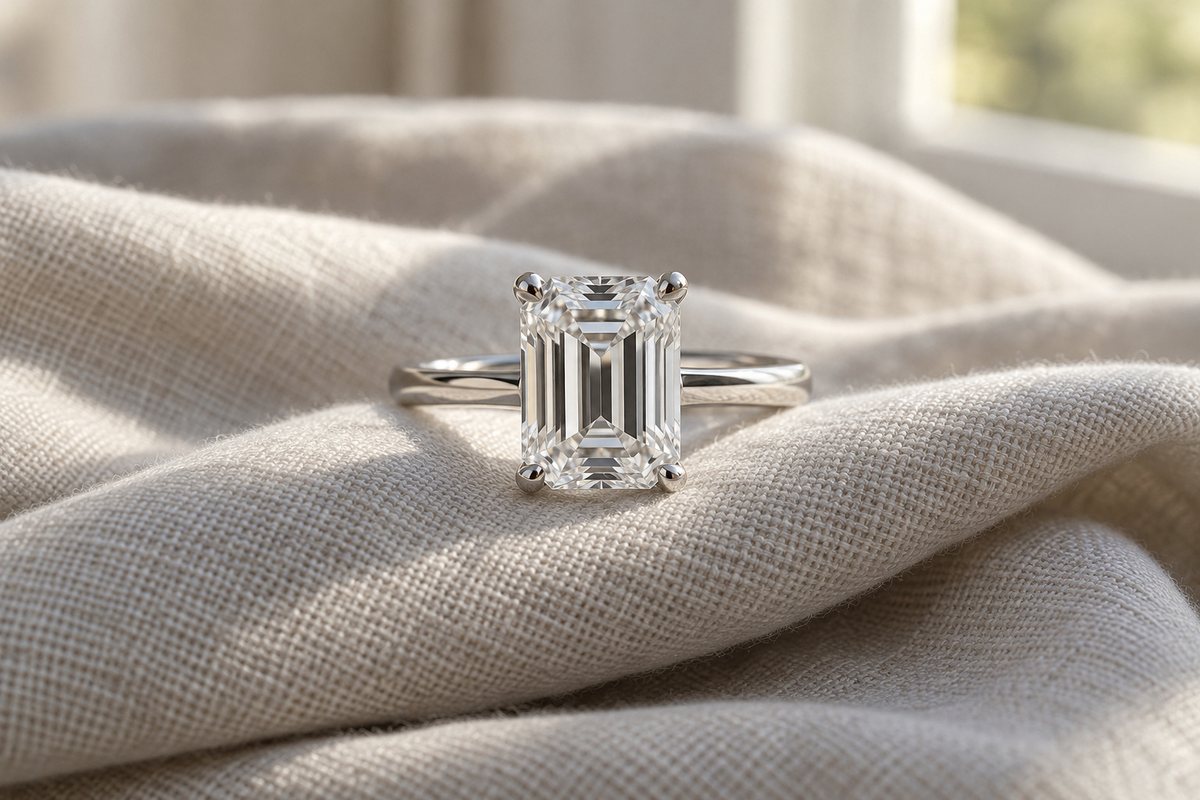
Emerald cut engagement rings suit people who love a clean, elegant, Art Deco look more than maximum sparkle. Because an emerald cut is a step cut with long, open facets, it shows inclusions and colour more clearly than a round brilliant, so it pays to choose clarity and colour more carefully, and to pick a length-to-width ratio and setting that flatter the stone. Done well, an emerald cut looks larger and more refined than its carat weight suggests.
This guide includes a few product links near the end. As an Amazon Associate, Diamond Taire earns from qualifying purchases, at no extra cost to you.
This guide explains what step cuts reveal, which grades are worth paying for, the ratios that look best, the “hall of mirrors” effect, settings that protect the corners, and how lab-grown and natural emerald cuts compare on value.
At a glance
- A step cut, not a brilliant. Rows of long, parallel facets create broad flashes of light and dark rather than pinpoint sparkle.
- Clarity matters more. GIA notes that the long facets make inclusions easier to see than in many other cuts.
- Colour shows more too. With less scintillation to mask it, any warmth in the stone is more noticeable.
- Ratio shapes the look. Around 1.30 to 1.50 is commonly cited as the classic range; higher numbers look longer and slimmer.
- The corners are cut for a reason. Bevelled corners make it less prone to chipping than sharp-cornered shapes, but a protective setting still helps.
- Per-carat value is often good. Emerald cuts are frequently priced below rounds of similar weight and grades, though higher grade requirements can eat into the saving.
What an emerald cut is, and why it looks different
An emerald cut is a rectangle with bevelled corners and concentric rows of step facets on both the crown (top) and the pavilion (underneath). The name comes from the coloured gemstone, which is often cut this way. Brilliant cuts, such as rounds and ovals, use many small triangular and kite-shaped facets to break light into lots of tiny flashes. Step cuts do the opposite: they create a larger, calmer pattern of light and dark planes that many people describe as a hall of mirrors.
That look is the whole point. An emerald cut is about clarity, symmetry and a glassy depth, not fire. If you want maximum sparkle, a round or oval will deliver more; our guide to diamond shapes compares all the main options side by side.
Emerald cut vs Asscher and radiant
| Shape | Outline | Facet style | Look | Inclusion visibility |
|---|---|---|---|---|
| Emerald cut | Rectangle, cut corners | Step cut | Long, sleek hall-of-mirrors effect | High |
| Asscher | Square, cut corners | Step cut | Deep, concentric “windmill” pattern | High |
| Radiant | Rectangle or square, cut corners | Brilliant faceting | Emerald-like outline with lively sparkle | Lower |
| Round brilliant | Circle | Brilliant | Maximum sparkle | Lowest |
If you love the outline but want more sparkle and more forgiveness on clarity, a radiant cut is the natural compromise.
Clarity: the grade to prioritise
GIA’s buying guidance for fancy shapes says emerald and square step cuts require higher clarity because inclusions may be easier to see. The open table and long facets work like a window, so a dark crystal or feather that would vanish in a round brilliant can sit in plain view.
Many buyers aim for a stone that is eye-clean, meaning no inclusions visible at normal viewing distance without magnification. With emerald cuts, that often means looking at higher clarity grades than you would for a round, and commonly cited advice is VS2 or better. Grades alone are not enough, though: the position and colour of an inclusion matter. A small white pinpoint near the edge can be harmless, while a dark inclusion under the table is not. Our diamond clarity guide explains how to read the plotting diagram on a report.
Colour: why warmth shows
GIA notes that emerald cuts have less scintillation, which makes a stone’s colour more prominent. A slightly warm stone that looks white as a round may show a faint tint as an emerald cut, especially in a larger size or at the corners. Commonly cited advice is to stay around G colour or better if you want a crisp white look in white metal; in yellow or rose gold, a warmer grade can look lovely and save money. Our diamond colour guide covers how metal colour changes what you see.
Length-to-width ratio: choosing the look
The length-to-width (L:W) ratio is the stone’s length divided by its width, and you can calculate it from the measurements on any grading report. There is no single correct ratio; it is a matter of taste. Commonly cited ranges for emerald cuts look like this:
| L:W ratio | Look | Suits |
|---|---|---|
| About 1.30 to 1.40 | Squarer rectangle | Those who like a compact, balanced shape |
| About 1.40 to 1.50 | Classic emerald proportions | Most buyers; a timeless, elegant outline |
| About 1.50 to 1.60 | Noticeably elongated | A slimming effect on the finger |
| Above 1.60 | Long and dramatic | A bold, fashion-forward look |
A longer stone of the same carat weight usually looks larger from above, because more of its weight is spread across its surface. See a few ratios on your own hand before deciding, as finger length and width change what looks best.
Cut quality: what to check without a cut grade
GIA does not give an overall cut grade to fancy shapes such as emerald cuts, so you need to judge cut quality in other ways:
- Check polish and symmetry. GIA suggests looking for Excellent or Very Good finish grades on the report.
- Look at the corners and sides. GIA advises avoiding uneven, narrow or missing corners and sides that are not parallel.
- Check for windowing. A see-through, washed-out patch in the middle of the stone means light is leaking out instead of returning. Look at it face-up against a patterned surface.
- Watch depth. GIA notes that a stone too shallow risks chipping and one too deep may look less bright. A deep stone can also look smaller for its weight.
- Judge the hall of mirrors. In a well-cut stone, you see a crisp, even pattern of light and dark steps, not a muddy or blank centre.
- Ask for a video or see it in person. Step cuts are easier to judge moving, under different light, than in a single still photo.
Our guide to reading a diamond grading report shows where to find polish, symmetry and measurements.
Settings that protect and flatter an emerald cut
An emerald cut’s corners are bevelled, which makes them less vulnerable than the sharp points of a princess or marquise. They are still the stone’s most exposed points, so most settings place prongs at or near the corners. Popular choices include:
- Four-prong solitaire: the classic, letting the step facets speak for themselves. Prongs sit at the corners.
- Bezel or half-bezel: metal around the edge gives the most protection, suits active hands and has a clean, modern look.
- Three-stone ring: often with tapered baguettes or trapezoid side stones that echo the step facets, or pear and round side stones for contrast.
- Hidden halo or halo: a ring of small diamonds that adds sparkle around a calm centre stone.
- East-west setting: the stone runs across the finger for a contemporary look; GIA notes emerald cuts can be set vertically or horizontally.
- Art Deco style: geometric mountings and milgrain detail that suit the shape’s 1920s associations.
Our guide to ring settings explains the trade-offs between security, sparkle and ease of cleaning.
Lab-grown vs natural emerald cuts: value
A lab-grown emerald cut diamond is a real diamond with the same physical and optical properties as a natural one, and laboratories such as GIA and IGI grade lab-grown stones. The practical difference is price: lab-grown diamonds cost far less than natural stones of similar size and grades, and their prices have fallen substantially in recent years. That can make the higher clarity and colour an emerald cut rewards much more affordable.
The trade-off is resale: lab-grown diamonds have very weak second-hand value, while natural diamonds have a resale market, though usually well below the retail price paid. Neither should be treated as an investment. Our lab-grown vs natural diamond comparison covers the decision in depth, and our guide to how much an engagement ring should cost helps set a budget.
On price, emerald cuts are often listed below rounds of similar carat weight and grades. The saving varies, and choosing higher clarity and colour can absorb some of it. Prices change, so compare emerald cuts with similar weight, grades and measurements at the time you buy.
Emerald cut buying checklist
- Independent grading report from an established laboratory, natural or lab-grown.
- Eye-clean in person or on a high-quality video, with no dark inclusions under the table.
- Colour that looks white enough in the metal you have chosen.
- An L:W ratio you have seen on a hand and liked.
- Polish and symmetry of Excellent or Very Good.
- Even, well-defined corners and straight, parallel sides.
- No obvious windowing in the centre.
- A setting that covers or guards the corners.
- Clear returns, resizing and warranty terms in writing.
If you are buying online, our checklist for buying a diamond online covers videos, returns and seller checks.
Common mistakes
- Buying on the certificate alone. Two stones with the same grades can look very different; inclusion placement and windowing matter.
- Using round-brilliant clarity rules. A clarity grade that is eye-clean in a round may not be in an emerald cut.
- Ignoring colour in larger stones. Warmth becomes more visible as size increases.
- Choosing the ratio from a photo. See the shape on a hand; ratios look different in real life.
- Expecting brilliant-cut sparkle. An emerald cut’s beauty is calm and glassy; if you want fire, consider a radiant.
- Leaving corners exposed in a delicate setting. Ask how the corners are protected, especially for daily wear.
- Treating a deep stone as a bargain. Extra depth can add weight without making the stone look bigger.
Sources this guide draws on: GIA’s emerald cut buying guide and fancy-shape buying guidance, GIA’s diamond clarity and grading education, and published length-to-width ratio and grade recommendations from jewellery educators and retailers.
Useful tools for this guide
Practical picks for choosing, checking and caring for jewellery. As an Amazon Associate, Diamond Taire earns from qualifying purchases, at no extra cost to you. Prices and availability are set by Amazon and may vary by country.
- Gemstones of the World by Walter Schumann (5th edition)
A classic illustrated reference to more than 1,900 gemstones.
View on Amazon - Foldable 30x Jeweller’s Loupe
Pocket magnifier for checking stones, settings and hallmarks up close.
View on Amazon - KElofoN Travel Jewellery Case
Compact case with ring rolls and earring slots so pieces do not scratch each other.
View on Amazon
Frequently asked questions
Are emerald cut diamonds less sparkly?
They show a different kind of sparkle: broad flashes of light and dark from step facets rather than the many small sparkles of a brilliant cut. Many people find the effect elegant, but if maximum sparkle is the priority, a round, oval or radiant will deliver more.
What clarity should I get for an emerald cut?
Aim for a stone that is eye-clean, which for emerald cuts commonly means VS2 or higher. Check where inclusions sit, because a dark inclusion under the table is more visible than a light one near the edge.
What is the best ratio for an emerald cut?
There is no single best ratio, but around 1.40 to 1.50 is widely seen as classic. Lower ratios look squarer and higher ratios look longer and slimmer on the finger.
Do emerald cut diamonds look bigger?
Often, yes. Their long, open table and rectangular outline usually give a larger face-up area than a round of the same carat weight, especially at higher ratios.
Are emerald cuts more likely to chip?
The bevelled corners make them less prone to chipping than sharp-cornered shapes, but the corners are still the most exposed points. Prongs at the corners or a bezel setting help protect them.
An emerald cut rewards patience: prioritise a clean, white-looking stone, pick a ratio you love on the hand, and protect the corners. Get those three right and the ring will look calm, clear and beautiful for a lifetime.