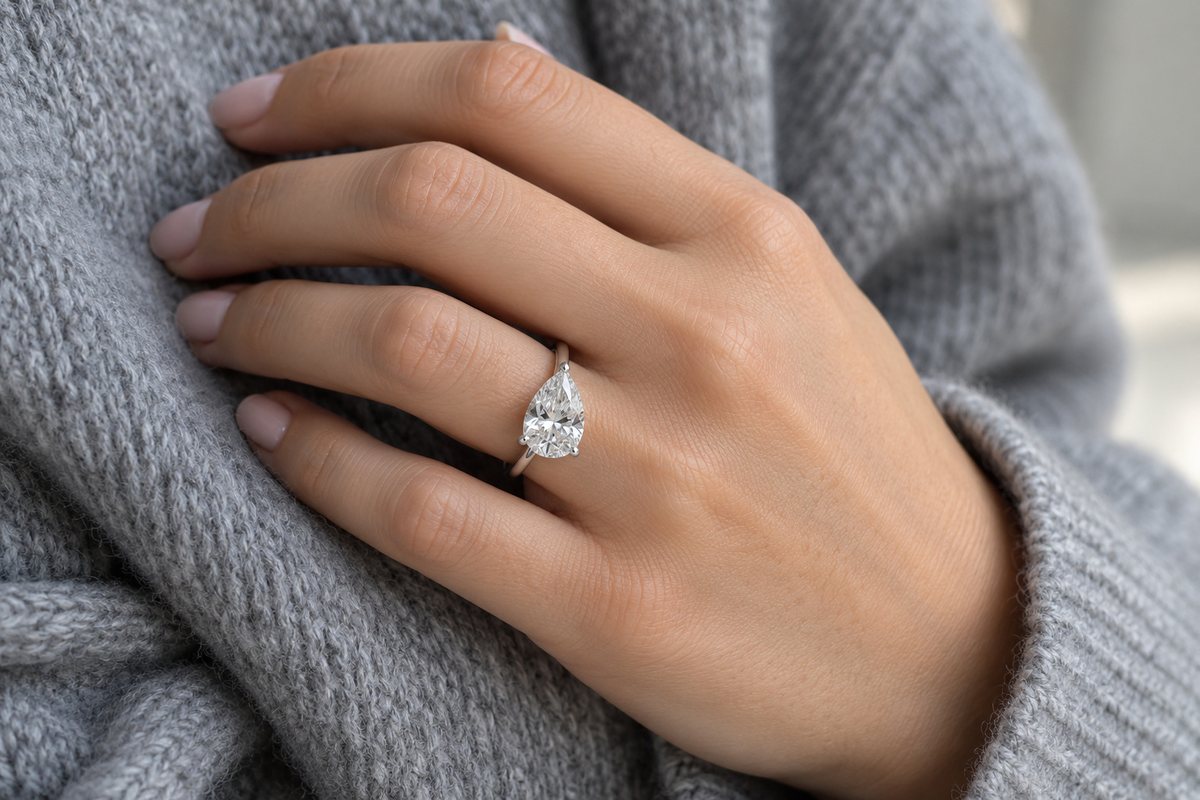
The best pear engagement rings combine a well-balanced stone, a length-to-width ratio of roughly 1.50 to 1.75, only a faint bow-tie, and a setting that protects the fragile point. Get those four things right and a pear shaped diamond ring can look larger than a round of the same weight while staying elegant and durable for life.
This guide includes a few product links near the end. As an Amazon Associate, Diamond Taire earns from qualifying purchases, at no extra cost to you.
This guide walks through how to judge a pear’s outline and symmetry, which ratios suit which hands, how to check the bow-tie, which way to wear the point, and which settings and bands work best. It finishes with a buying checklist, the most common mistakes and answers to the questions buyers ask most.
At a glance
- GIA suggests a length-to-width ratio of about 1.50 to 1.75 for pear shapes; taste decides where in that range you land.
- GIA does not give pear shapes an overall cut grade, so you must judge the stone’s look yourself, helped by the polish and symmetry grades.
- Look for a minimal bow-tie, rounded shoulders and wings that mirror each other, and a centred culet.
- The point is the most vulnerable part: protect it with a V-prong or a bezel.
- Traditionally the point faces away from the wearer, towards the fingertip, but it is a style choice, not a rule.
What makes the pear shape different
A pear, sometimes called a teardrop, is a brilliant-style fancy shape with one rounded end and one point. It blends the softness of a round with the length of a marquise. If you are still comparing outlines, our guide to diamond shapes sets the pear alongside the others.
Three features set the pear apart when you buy one:
- No overall cut grade. GIA grades the cut of round brilliants but does not grade the overall proportions of fancy shapes like the pear. A GIA report does give polish and symmetry grades. Words such as ideal or excellent cut on a pear are usually the seller’s own description.
- A built-in weak point. The tip is thin and can chip if knocked, so the setting matters more than with a round.
- A tendency to show a bow-tie. Like ovals and marquises, pears can show a dark band across their width.
Proportions: length-to-width ratio
The ratio is the length divided by the width, both of which appear in the measurements on a grading report. GIA’s fancy-shape guidance gives about 1.50 to 1.75 as the classic range for pears. Below that, a pear starts to look short and wide; above it, long and narrow. Neither is wrong if you love it, but the further you go from the classic range, the more important it is to see the stone before buying.
| Ratio | Look | Suits | Watch for |
|---|---|---|---|
| Under 1.50 | Short and wide, close to a heart or round | Buyers who want a softer, fuller teardrop | Can look stubby; check the shoulders are not too high |
| 1.50 to 1.60 | Balanced and classic | Most hands; a good default | Still check the bow-tie and wing shape |
| 1.60 to 1.75 | Slender and elongated | Longer or slimmer fingers, or anyone wanting a lengthening look | Point becomes finer and more exposed; bow-tie can strengthen |
| Over 1.75 | Very long, close to a marquise feel | Buyers who specifically want drama | May look stretched; extra point protection advised |
A useful trick: work out the ratio for every stone you shortlist and compare them in photos side by side. You will quickly see which look you prefer before you weigh up other factors.
Outline and symmetry checks
Because there is no cut grade to lean on, the outline is where your own eye matters most. GIA’s guidance on pear shapes describes a good outline as having gently rounded shoulders and wings that form attractive arches.
Shoulders and wings
The shoulders are the upper curves either side of the rounded end, and the wings are the sides that sweep down to the point. Flat wings make a stone look narrow and pinched; bulging wings make it look stubby. High shoulders give a squared-off look at the top.
The mirror test
Imagine a line running from the tip through the centre of the rounded end. The two halves should mirror each other in shoulders, bellies, wings and facets. Even small differences can look lopsided once the stone is set. The point should sit on that line, not off to one side.
Culet, keel and table
GIA also advises that the culet should sit an equal distance from both sides, any keel line should be centred, and the table should be centred on the line of symmetry. An off-centre table makes the crown facets look larger on one side.
The bow-tie: how to judge it
GIA describes the bow-tie as a dark area that looks like two triangles joined at the centre of the stone. Almost every pear shows some; what you want is a faint one that does not dominate. The effect tends to grow with more extreme proportions. Our article on the bow-tie effect in ovals goes deeper into why it happens, and the same principles apply to pears.
- Look at videos rather than single photos; a bow-tie can appear and vanish as the stone moves.
- Compare stones under the kind of lighting you will actually wear the ring in, as GIA recommends.
- Judge it face-up and at arm’s length too, not only magnified.
Colour and clarity for pear shapes
GIA notes that pear shapes tend to show more body colour than round brilliants, especially towards the point, so some buyers choose a slightly higher colour grade than they would for a round. Our diamond colour guide explains the scale.
For clarity, check the point carefully. An inclusion near the tip can weaken the most fragile part of the stone, and GIA also points out that a larger table can make inclusions easier to see. Our clarity guide covers where inclusions matter most.
Face-up size: pear vs round
Pears are often chosen because they tend to look larger face-up than round diamonds of the same carat weight, thanks to their elongated outline spreading across the finger. The exact difference depends on the individual stone’s depth and proportions, so compare the millimetre measurements on the report rather than relying on carat weight alone. A deep pear can carry weight below the girdle that you never see.
Which way should the point face?
Traditionally, a pear is worn with the point facing away from the wearer, towards the fingertip, which many people feel makes the finger look longer and slimmer. Some wearers prefer the point towards the wrist, a choice sometimes linked to sentiment about the heart, and some designers set pears sideways (east-west) for a modern look. There is no correct direction. Try photos of the ring both ways on the hand before the setting is finished, because the prong at the point is fixed once made.
Settings that protect the point
GIA recommends protecting a pear’s point with a V-shaped prong or by surrounding the whole stone with a bezel. Here is how the common choices compare. For the wider picture, see our guide to ring settings.
| Setting | Point protection | Look | Best for |
|---|---|---|---|
| Prong solitaire with V-prong at the tip | Good | Shows the most diamond; classic | Most wearers who want a clean look |
| Full bezel | Very good | Smooth, modern; slightly less light entry from the sides | Active hands and everyday wear |
| Halo | Good when paired with a V-prong | Adds sparkle and perceived size | Buyers wanting a bigger face-up look |
| Three-stone | Depends on the centre’s prongs | Balanced; side stones often pears or rounds | Those wanting symbolism or extra width |
| East-west set | Depends on prongs; tips sit at the sides | Contemporary, low-profile | Stackers and modern styles |
Ask the jeweller to show the prong at the tip under magnification. It should cover the very point, not sit just behind it.
Wedding bands for a pear shaped engagement ring
The rounded end and wings of a pear can leave an awkward gap against a straight band. Common solutions are a contoured or curved band that follows the outline, a slim straight band set slightly apart, or raising the centre stone so a straight band can sit flush underneath. Plan this when choosing the engagement ring, not afterwards. Our guide to matching and stacking wedding bands covers the options in more detail.
Pear engagement ring checklist
- Set your budget and preferred carat range using our engagement ring buying guide.
- Insist on an independent grading report and check its measurements, polish and symmetry.
- Calculate the length-to-width ratio and shortlist stones in the range you like, typically 1.50 to 1.75.
- Do the mirror test: shoulders, wings and point should line up on the centre line.
- Watch a video of each stone and judge the bow-tie in movement.
- Inspect the point for inclusions and for visible colour.
- Compare face-up measurements, not just carat weight.
- Decide the point’s direction before the setting is made.
- Choose a V-prong or bezel at the tip and check it under magnification.
- Plan the wedding band at the same time.
Common mistakes
- Trusting an ideal label. There is no GIA overall cut grade for pears; judge the stone itself.
- Buying from a single still photo. Bow-ties and asymmetry often only show in video.
- Ignoring the point. An inclusion or an unprotected tip invites chips.
- Chasing an extreme ratio unseen. Very long or very short pears can disappoint in person.
- Choosing colour as you would for a round. Pears can show more colour at the tip.
- Forgetting the band. A gap between a pear and a straight band is a common afterthought regret.
- Skipping maintenance. Have prongs checked regularly, especially the one at the point.
Pear vs oval vs marquise
If you are torn between elongated shapes, the main differences are softness and edge exposure. An oval has no point at all; a pear has one; a marquise has two. Ovals are generally the most forgiving for active hands, while pears and marquises need point protection. Our marquise diamond ring guide covers that shape’s own ratio range, which GIA puts at about 1.75 to 2.25.
Sources this guide draws on: GIA’s guidance on choosing a pear shaped diamond; GIA’s fancy-shape buying guidance, including recommended length-to-width ratios and its description of the bow-tie; GIA grading report practice for fancy shapes (polish and symmetry); widely used trade guidance on pear proportions and settings.
Useful tools for this guide
Practical picks for choosing, checking and caring for jewellery. As an Amazon Associate, Diamond Taire earns from qualifying purchases, at no extra cost to you. Prices and availability are set by Amazon and may vary by country.
- Gemstones of the World by Walter Schumann (5th edition)
A classic illustrated reference to more than 1,900 gemstones.
View on Amazon - Foldable 30x Jeweller’s Loupe
Pocket magnifier for checking stones, settings and hallmarks up close.
View on Amazon - KElofoN Travel Jewellery Case
Compact case with ring rolls and earring slots so pieces do not scratch each other.
View on Amazon
Frequently asked questions
What is the best ratio for a pear shaped diamond?
GIA suggests about 1.50 to 1.75 as the classic range. Around 1.55 to 1.65 gives a balanced teardrop that suits most hands, but personal taste matters more than any single number.
Which way should a pear engagement ring face?
The traditional direction is point towards the fingertip, which tends to lengthen the look of the finger. Point towards the wrist and sideways settings are both valid choices; decide before the setting is made.
Are pear diamonds more likely to chip?
The point is thinner than the rest of the stone and more exposed, so it is more vulnerable to knocks than a round. A V-prong or bezel at the tip greatly reduces that risk.
Does a pear diamond look bigger than a round?
Pears often look larger face-up than rounds of the same carat weight because of their elongated outline. Compare the millimetre measurements on the report, since depth varies from stone to stone.
Can a pear diamond have a cut grade?
GIA does not give pears an overall cut grade, though its reports grade polish and symmetry. Some other laboratories assess certain fancy shapes, but your own judgement of the outline, bow-tie and sparkle remains essential.
A pear engagement ring rewards patience. Choose a balanced outline, a soft bow-tie and a well-protected point, and you will have a graceful ring that looks generous on the hand and wears confidently for years.