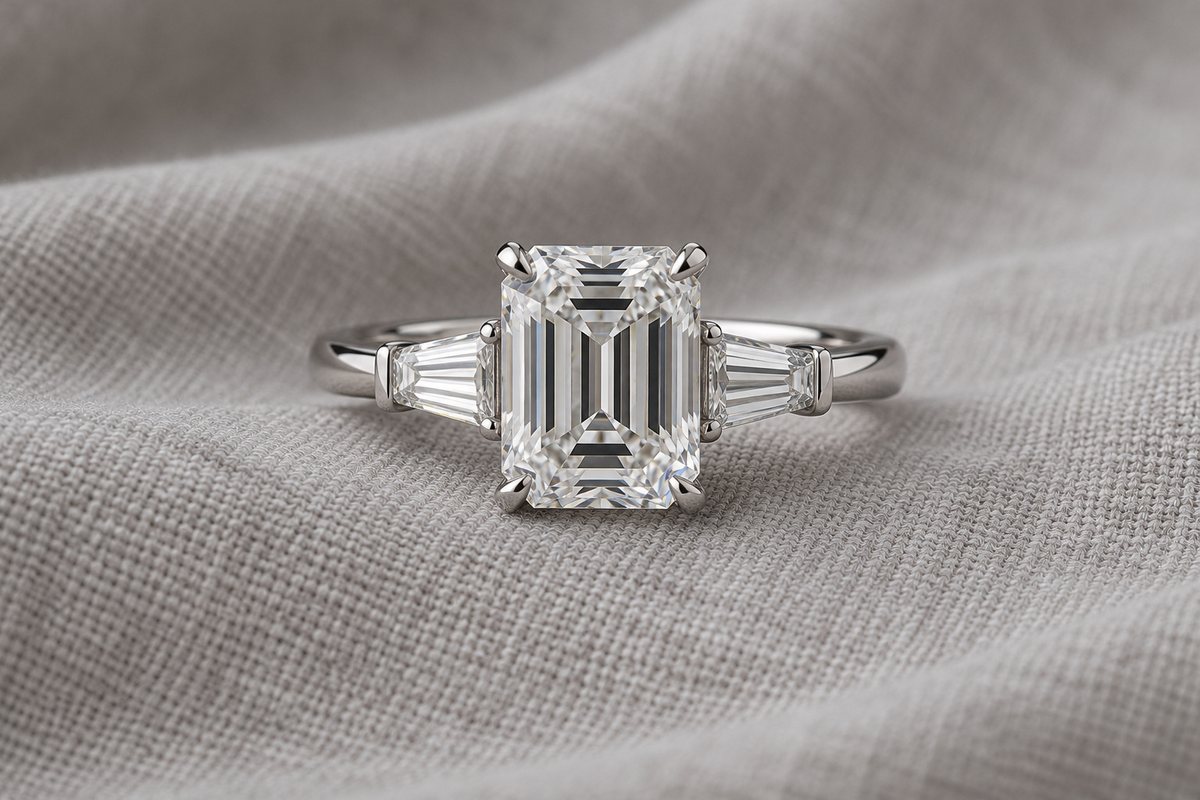
A baguette diamond is a small, long, rectangular diamond cut in the step-cut style, with rows of flat facets that run parallel to its edges like a staircase. Baguettes come in two main forms: straight (parallel sides) and tapered (the long sides angle inwards), and they are used mostly as side stones, in bands and in Art Deco-style settings rather than as centre stones.
This guide includes a few product links near the end. As an Amazon Associate, Diamond Taire earns from qualifying purchases, at no extra cost to you.
This guide explains how baguettes are built, why they show inclusions more than round diamonds, where each type works best, how they are matched and priced, what to check before you buy, and how lab-grown baguettes fit in. It is written for buyers who want clean, crisp lines without paying for the wrong things.
At a glance
- What it is: a small rectangular step-cut diamond with square (not clipped) corners, used mainly as an accent stone.
- Two shapes: straight baguettes have parallel sides; tapered baguettes narrow towards one end and suit curved or fanned layouts.
- Clarity matters more than usual: the long, open facets of a step cut make inclusions easier to see than in a round brilliant of the same grade.
- Matching is everything: baguettes are bought in sets, and their colour, clarity and exact millimetre dimensions should match each other and the centre stone.
- Natural, treated or lab-grown: all three exist in baguette sizes, and a seller should tell you which you are getting.
What is a baguette diamond?
According to GIA’s education material, baguettes are small, usually rectangular step-cut diamonds with straight or tapered edges. Some are nearly square, while others are very long and slim, with a length several times their width. The crown (top) facets sit in terrace-like rows parallel to the edges of the table, which gives the stone its calm, architectural look.
A baguette is not the same as an emerald cut, even though both are rectangular step cuts. GIA notes that emerald cuts have diagonal, clipped corners, while baguettes do not. Those square corners are part of the appeal, because a row of baguettes can sit edge to edge and form an unbroken line of light.
Where the name and style come from
GIA’s history notes say the word has been linked to the French for “rod” or “stick”, and an older dictionary use ties it to the diminutive of bague, the French word for ring. The cut is believed to have developed from the much older hogback cut. GIA credits Cartier with reintroducing the baguette style in 1912, and Art Deco designers of the following decades embraced its clean geometry. If you love that era, the guide to antique diamond jewellery periods and cuts shows where baguettes sit among other period cuts.
Brilliant baguettes and other relatives
You may also see “brilliant baguettes”. GIA describes these as mainly mixed cuts, with brilliant-style facets on the pavilion and step facets on the crown. They tend to sparkle more and hide inclusions slightly better, but they lose some of the clean mirror-like flash that makes a true step-cut baguette distinctive. Neither is better; they simply look different side by side.
Straight vs tapered baguettes
The single biggest choice is the outline. The table below compares the two in practical terms.
| Feature | Straight baguette | Tapered baguette |
|---|---|---|
| Outline | Rectangle with parallel long sides | Long sides angle inwards, narrower at one end |
| Typical use | Channel-set bands, rows, shoulders of a ring | Flanking a centre stone, fanned “ballerina” halos, earrings |
| Visual effect | Straight, continuous line of light | Leads the eye towards the centre stone |
| How sets are specified | Length and width, to 0.1 mm | Length plus the wide-end and narrow-end widths, to 0.1 mm |
| Best partner centre stones | Emerald, asscher, round, or as a band on its own | Round, oval, emerald and cushion centre stones |
| Main watch-out | Gaps between stones in a channel are obvious | Left and right stones must be a true mirror pair |
GIA notes that tapered baguettes are the stones of choice for the fanned “tutu” effect of a ballerina setting, where they surround the centre stone, and that a stronger taper creates a tighter curve.
Why baguettes show clarity and cut problems more
Round brilliants have many small, angled facets that break light into sparkle and help disguise small inclusions. Step cuts work differently. GIA’s clarity guidance explains that the long, rectangular facets of step cuts such as the emerald cut make clarity characteristics easier to see, and its baguette notes say inclusions are usually more visible in baguettes than in round brilliants.
The same openness exposes cutting. GIA points out that slight asymmetries in a baguette’s facets are usually visible to the naked eye and detract from the stone. In a row of six or ten baguettes, one wonky stone can catch the eye far more than one slightly weaker round diamond in a pavé band.
The good news is that baguettes are small, so you are looking at the overall effect of the set rather than examining one stone under a loupe. A clean, even look matters more than a high grade on paper. For a grounding in what the grades mean, see the guide to choosing the right diamond clarity.
Where baguettes work best
Side stones in engagement rings
A pair of tapered baguettes either side of a centre stone is a classic look, and it is one of the most common uses GIA lists. Baguettes give a ring a crisp, tailored feel compared with round side stones or trillions. If you are weighing up a three-stone design, the guide to choosing a three stone engagement ring covers proportions and balance.
Bands and eternity rings
Straight baguettes set in a channel make a sleek band that sits flat and catches light in long flashes. They pair naturally with step-cut engagement rings, such as an emerald cut engagement ring. If you are deciding how far the stones should go around the finger, the guide to full vs half eternity rings explains the comfort and resizing trade-offs.
Art Deco and vintage-style designs
Baguettes often appear in geometric Deco-inspired pieces alongside small rounds, calibré-cut coloured stones and milgrain detailing. When you look at antique pieces, expect older baguettes to vary more in size and finish than modern calibrated stones.
Earrings and pendants
GIA notes that channel-set tapered baguettes are also used in earrings. In jewellery that is not knocked about as much as a ring, baguettes can be a smart way to get a lot of visual length for modest total carat weight.
How baguettes are set
Most baguettes are channel set, held between two metal walls with no prongs between stones. GIA notes they are occasionally prong set in ballerina designs. Channel setting protects the long, thin edges and square corners, which are the most exposed parts of the stone. Tension, bar and bezel styles are also used. The guide to ring settings explained covers how each style protects stones.
One honest point: square corners are a weak spot in any cut, so a setting that covers the corners is a sensible choice for a ring you plan to wear daily.
How baguettes are matched and priced
Baguettes are rarely bought one at a time. GIA explains that they are sold in sets, that dimensions matter more than carat weight because you are buying multiples, and that a straight set should be specified by length and width to 0.1 mm, while a tapered set should be specified by length and the widths of both ends to 0.1 mm. GIA also notes that all the baguettes in a ring should be similar in colour and clarity and should match the centre stone; mismatches look unharmonious.
What drives the price of a set, in plain terms:
- Size of each stone: as with all diamonds, price per carat tends to rise as individual stone size rises, so two larger side stones can cost more per carat than ten tiny ones.
- Colour and clarity: higher grades cost more. GIA notes stones towards the top of the D-to-Z colour range are often prized.
- Precision of matching: sets cut and sorted to tight tolerances take more labour and rough, and cost more.
- Cut quality: crisp, symmetrical facets and sharp, intact corners are worth paying for in an open step cut.
- Origin: lab-grown baguettes are generally cheaper than natural ones of similar appearance.
- Labour: channel setting many small stones is skilled work, so setting cost is a real part of the total.
Prices vary by country, by seller and by quality, so compare like for like (same dimensions, colour and clarity range) rather than headline totals.
Natural, treated and lab-grown baguettes
GIA notes that baguettes can be treated, for example by HPHT processing to improve colour or by fracture filling to improve apparent clarity, and that synthetic (lab-grown) baguettes are available. Retailers are expected to disclose whether diamonds are natural, treated or synthetic.
Lab-grown baguettes can be a sensible choice when the centre stone is also lab-grown, because matching origin keeps the set consistent and the budget in proportion. If the centre stone is natural, there is no rule that side stones must be natural too, but you should know exactly what you are buying. The lab-grown diamond buying guide covers disclosure and reports in more detail.
Buying checklist for baguette diamonds
- Decide straight or tapered based on the layout: straight for rows and bands, tapered for flanking a centre stone or a fanned halo.
- Ask for exact dimensions of every stone, to 0.1 mm, not just the total carat weight.
- Ask for the colour and clarity range of the set, and how it compares with the centre stone.
- Confirm origin and treatment in writing: natural, lab-grown, HPHT-treated or fracture-filled.
- Look at the set face-up together, in daylight and indoor light, before it is set. Look for one stone that looks darker, cloudier or out of line.
- Check corners and edges under magnification for chips, especially on long, slim stones.
- Check facet symmetry: the step rows should look even and parallel from one end to the other.
- Confirm the setting protects the corners if the piece is a ring for daily wear.
- Ask about future repairs: whether a matching replacement stone could be sourced if one is lost or chipped.
Who baguettes suit, and who they may not
A good fit if you like clean, geometric lines; you are pairing them with a step-cut centre stone; you want a band that looks sleek rather than glittery; or you love Art Deco style.
Think twice if you want maximum sparkle (round side stones or pavé will twinkle more); you are hard on your hands and do not want a channel or bezel; or your budget forces a choice between a better centre stone and better side stones. In that last case, the centre stone usually deserves the money.
Common mistakes
- Buying on total carat weight. Two sets of the same weight can look very different. Dimensions and matching are what you see.
- Assuming a clarity grade means the same as in a round. An inclusion that hides in a brilliant can show in a step cut.
- Mixing whites. Side stones noticeably whiter or warmer than the centre stone make the centre look off-colour.
- Ignoring corners. Square corners are fragile. Choose a setting that protects them.
- Mixing natural and lab-grown without knowing. It is a legitimate choice, but it should be your choice, disclosed in writing.
- Using baguettes to fix a centre stone you do not love. Side stones frame; they do not rescue.
- Forgetting the matching band. A straight baguette shoulder can leave a gap against a plain band; plan the pair together, as the guide to matching and stacking wedding bands explains.
Sources this guide draws on: GIA 4Cs education articles on baguette diamonds and diamond clarity, and GIA guidance on diamond treatments and synthetic disclosure.
Baguette diamond FAQs
Are baguette diamonds real diamonds?
Yes. “Baguette” describes the cut, not the material. A baguette can be a natural diamond, a lab-grown diamond or a simulant cut in the same shape, so always ask which one you are buying.
Do baguette diamonds sparkle?
They sparkle differently. Step cuts give broad, mirror-like flashes rather than the fiery pinpoints of a round brilliant. Many people love that understated look, but if you want maximum twinkle, round or brilliant baguette side stones will suit you better.
What is the difference between a baguette and an emerald cut?
Both are rectangular step cuts. The emerald cut has clipped diagonal corners and is usually used as a larger centre stone, while the baguette has square corners and is usually small and used as an accent.
What clarity should baguette side stones be?
There is no single right grade. Because step cuts show inclusions more easily, aim for stones that look clean to the eye and match each other and the centre stone, and judge the set face-up rather than by the lowest grade on paper.
Are baguette diamonds durable enough for everyday wear?
Diamond itself is very hard, but sharp corners and thin edges can chip from a hard knock. A channel, bezel or other setting that protects the corners makes baguettes practical for daily rings.
Can a lost baguette be replaced?
Usually, yes, but finding an exact match in colour, clarity and millimetre dimensions can take time. Keeping a record of each stone’s measurements makes replacement much easier.
Baguettes reward careful matching more than big numbers. Choose the outline that suits your design, insist on exact dimensions, and judge the set together in real light, and you will have side stones that look calm, crisp and beautiful for years.
Useful tools for this guide
Practical picks for choosing, checking and caring for jewellery. As an Amazon Associate, Diamond Taire earns from qualifying purchases, at no extra cost to you. Prices and availability are set by Amazon and may vary by country.
- Foldable 30x Jeweller’s Loupe
Pocket magnifier for checking stones, settings and hallmarks up close.
View on Amazon - CONNOISSEURS Premium Jewellery Cleaner
Gentle dip cleaner with a brush and tray for diamonds, gold and platinum. Check the label for stones it should not be used on.
View on Amazon - Ring Sizer Measuring Tool Kit (27 pieces)
Sizing rings plus a mandrel, to check a size at home before you buy or resize.
View on Amazon