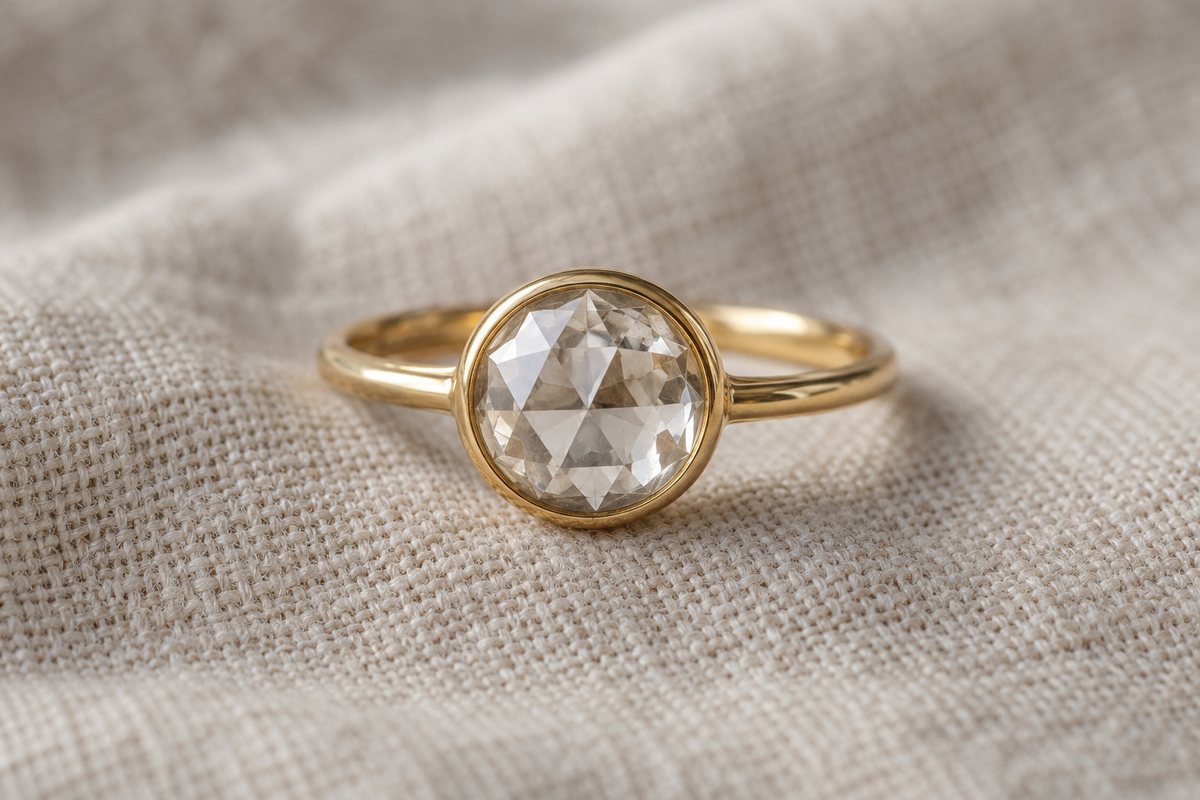
A rose cut diamond has a flat, unfaceted base and a domed top covered in triangular facets that rise to a point, a style that dates back to the 1500s. It looks wider than a modern round brilliant of the same carat weight and has a soft, glassy shimmer rather than bright sparkle. If you value a low, antique-looking stone and are happy to trade fireworks for glow, it can be a lovely, good-value choice.
This guide includes a few product links near the end. As an Amazon Associate, Diamond Taire earns from qualifying purchases, at no extra cost to you.
This guide explains what a rose cut actually is, what it looks like in real life, how its face-up size compares with a round brilliant, how to judge one when there is no cut grade to lean on, which settings protect it, and the mistakes buyers most often regret.
At a glance
- Shape: flat base, no pavilion, a domed crown of triangular facets, and usually no table on top.
- Look: gentle flashes and a see-through, glassy character, not the white sparkle and colour flashes of a brilliant.
- Size: spreads wider for its weight; two vendor size charts give about 7.5 mm across for a 1 carat rose cut, against about 6.5 mm for a 1 carat round brilliant.
- Grading: labs do not give rose cuts an overall cut grade, so you judge symmetry, transparency and condition yourself.
- Best settings: bezels and well-placed prongs that cover the thin edge; the low profile suits active hands.
What is a rose cut diamond?
GIA’s gem cutting definitions describe the rose cut as a flat bottom with a dome-shaped crown reaching an apex formed by three or more facets. There is no pointed pavilion underneath, which is the deep, cone-shaped lower half that a modern round brilliant uses to bounce light back up to your eye. Most rose cuts also have no table, the flat window on top of most modern diamonds.
The most common outline is round, but rose cuts are also cut as ovals, pears, marquises, cushions, hexagons and other shapes. Because the cutter is not chasing a deep pavilion, the style also lets flat or shallow pieces of rough be used well.
Where the rose cut came from
According to GIA’s research journal Gems & Gemology, simple table cuts developed from the fifteenth century, and rose cuts became a typical diamond cut of the sixteenth and seventeenth centuries. They were often made from a cleavage fragment of a diamond crystal, which naturally suited a flat-backed stone. GIA’s antique cuts overview notes that the style stayed in wide use through the Georgian and Victorian eras, and that rose cuts in old jewellery were often set closed-back with foil behind them to add brightness.
Rose cuts declined as the old mine cut and later the old European cut took over, then returned in modern design from around the turn of this century. Today you will find both genuinely antique stones and newly cut ones.
Facet patterns and names
The same Gems & Gemology article describes the standard structure as a central dome of six triangular facets with a further ring or rings of facets between the dome and the base. Historical names refer to how many facets sit in those rings:
| Pattern | Facet arrangement | What it looks like |
|---|---|---|
| Antwerp rose | 6 + 6 facets | Simple, fewer, larger flashes |
| Half-Dutch rose | 6 + 12 facets | More segmented, a little busier |
| Full-Dutch rose | 6 + 18 facets (24 in the crown) | The classic “rose petal” pattern most people picture |
| Simple modern rose | As few as 3 facets upwards | Minimal, very glassy, often used in contemporary designs |
Vendor descriptions vary on the exact facet count (you may see 24 or 25 quoted), because counts depend on the pattern and on whether the base is included. More facets is not automatically better; what matters is that they are even and well matched.
What does a rose cut diamond look like?
A rose cut looks calm and luminous. With no pavilion to return light, much of the light passes through the stone instead of being reflected back, so you can often see through it to the metal or your skin beneath. Under candlelight or soft daylight it gives broad, gentle flashes from its domed facets. Under strong spotlights it looks quieter than a brilliant, which is either its charm or a disappointment depending on what you expect.
That transparency has two practical effects. First, inclusions are easier to see, because there is no busy facet pattern to hide them. Second, anything behind the stone shows through, which is why some antique pieces were foil-backed and why cleanliness matters more than usual.
Rose cut vs round brilliant: size and sparkle
Because a rose cut puts its weight into width rather than depth, it faces up larger than a brilliant of the same weight. Two separate vendor size guides checked for this article give the same figures for 1 carat: about 7.5 mm across for a rose cut and about 6.5 mm for a round brilliant. One of them gives about 9 mm for a 1.5 carat rose cut against about 7.3 mm for a 1.5 carat brilliant. Treat these as typical rather than fixed, because rose cuts vary a lot in thickness, and a thicker dome means a smaller spread.
| Feature | Rose cut | Modern round brilliant |
|---|---|---|
| Base | Flat, unfaceted | Deep, pointed pavilion |
| Top | Domed, usually no table | Flat table with crown facets |
| Typical facets | 3 to about 24 | 57 or 58 |
| Face-up width at 1 ct (typical) | About 7.5 mm | About 6.5 mm |
| Light effect | Soft, glassy flashes; see-through | Bright white sparkle and coloured fire |
| Height in a ring | Very low | Taller, needs more setting height |
| Inclusions | Easier to see | Better hidden by facet pattern |
| Lab cut grade | None | Yes (for standard rounds) |
The honest summary: you get more visible size per carat, and you give up sparkle. If brilliance is your main reason for wanting a diamond, a rose cut is probably the wrong shape for you. Our guide to diamond shapes compares other options if you are still deciding.
Antique, modern and lab-grown rose cuts
Antique rose cuts were cut by hand, so expect slight asymmetry, uneven facets and a warmer body colour. Many collectors love exactly that. Modern rose cuts are usually more symmetrical and can be cut from natural or lab-grown diamond, and the same style is also cut in other gems and simulants.
| Type | What to expect | Watch for |
|---|---|---|
| Antique natural | Hand-cut character, often warmer colour, history | Old chips, worn facet edges, cracks, foil backing hiding colour |
| Modern natural | Better symmetry, wider choice of shapes | Very thin stones, visible inclusions |
| Lab-grown | Same diamond material, usually lower price, clearer stones easier to find | Disclosure; ask for a lab report stating it is laboratory-grown |
| Simulants (moissanite, glass, quartz) | Similar shape, different material | Being sold as diamond; ask what the stone is in writing |
If the antique angle appeals, our guide to antique diamond jewellery periods and cuts explains how to date a piece. For the natural or lab-grown decision itself, see lab-grown vs natural diamonds.
How to judge a rose cut without a cut grade
GIA’s buying guidance for fancy shapes explains that it does not grade the overall proportions of fancy cut diamonds; its reports still assess finish, meaning polish and symmetry. In practice that means a rose cut can come with colour and clarity grades and a finish assessment, but no single “Excellent” cut grade to rely on. You need to look at the stone yourself, or through clear video.
Clarity and transparency
This is where rose cuts differ most from brilliants. Because you can see into the stone so easily, a dark crystal or a cloudy patch that would vanish in a brilliant can sit right in the middle of a rose cut’s dome. Look for a stone that is transparent and lively rather than milky or grey. If you want to understand what the clarity grades mean, our diamond clarity guide covers inclusion types.
Colour
Rose cuts tend to hide body colour reasonably well across the broad top facets, and many antique stones were never colourless to begin with. Warm tones suit yellow and rose gold, and plenty of buyers choose a warmer stone on purpose. Decide whether you want an icy look or an antique glow before you start comparing.
Symmetry and thickness
Look at the stone face-up and from the side. The apex should sit near the centre, the facets should form an even pattern, and the outline should be balanced. From the side, the dome should rise smoothly. A very thin stone gives the biggest spread but has the most exposed, fragile edge. A very thick one spreads less and costs more per visible millimetre.
Durability and the right setting
A diamond is a diamond in hardness, but shape affects how vulnerable a stone is to knocks. A rose cut’s thin, flat edge is the part most likely to chip if struck, and an antique stone may already have small nicks along it. The low profile helps, because a stone that sits close to the finger catches on less.
- Bezel: a metal rim around the whole edge gives the most protection and the lowest profile. Best for everyday rings.
- Prongs: four, six or eight prongs show more of the stone. Ask for prongs placed at points and edges, and check they grip without stress.
- Closed back or open back: an open back lets light in and makes cleaning easier; a closed back can hide colour or damage, so ask what is behind the stone.
- Halo: a ring of small stones around a rose cut can add sparkle it does not make itself, and helps guard the edge.
Our ring settings guide goes deeper on bezel and prong choices.
Who a rose cut suits, and who it doesn’t
It suits you if you like antique or understated jewellery, want a low ring that will not snag gloves or knitting, want more face-up width for your budget, or are choosing a stone mainly for its shape and character.
It may not suit you if you want maximum sparkle, plan to rely on a lab report to judge quality, want a stone that hides inclusions, or expect the strong resale market that standard round brilliants have.
Rose cut buying checklist
- Ask what the stone is: natural diamond, lab-grown diamond or another gem, and get it in writing.
- Ask for a grading report, or an independent appraisal for antique pieces without one.
- Ask for the face-up measurements in millimetres and the depth, not just the carat weight.
- View a video in daylight and indoor light, face-up and side-on.
- Check the apex is roughly central and the facets form an even pattern.
- Look for visible inclusions in the centre of the dome and any milky or grey look.
- Check the edge for chips, especially on antique stones, and ask if the jeweller saw any.
- Ask what is behind the stone in a closed-back setting.
- Choose a setting that covers or guards the edge if you will wear it daily.
- Confirm the return policy before you pay.
Common mistakes
- Expecting brilliant-cut sparkle. A rose cut glows; it does not blaze. Seeing one in person or on video avoids disappointment.
- Buying on carat weight alone. Two 1 carat rose cuts can differ noticeably in width because of thickness. Compare millimetres.
- Ignoring inclusions. What is “eye-clean” in a brilliant may not be in a rose cut.
- Putting a thin stone in exposed prongs for daily wear. A bezel or protective setting costs little extra compared with replacing a chipped stone.
- Not asking about closed backs. Foil or a closed setting can change how a stone looks and hide damage.
- Assuming “rose cut” means diamond. The term describes a cut, not a material.
Caring for a rose cut
Because you can see through a rose cut, hand cream, soap and skin oils show up quickly underneath it and dull the look. Clean it gently with warm water, mild soap and a soft brush, and check the setting regularly. Be more cautious with ultrasonic cleaners for antique pieces or stones with visible feathers, and ask a jeweller if unsure. Our guide on how to clean diamonds safely has the full routine.
Sources this guide draws on: GIA gem cutting style definitions; GIA Gems & Gemology research on Baroque-era rose cuts; GIA guidance on antique diamond cuts and on how fancy shapes are graded; Encyclopaedia Britannica on the rose cut; published size charts from two jewellery vendors for face-up measurements.
Rose cut diamond FAQs
Are rose cut diamonds real diamonds?
They can be. “Rose cut” describes the faceting style, not the material, so the stone could be a natural diamond, a lab-grown diamond or another gem. Ask the seller to state the material in writing and back it with a report.
Do rose cut diamonds sparkle?
They flash rather than sparkle. Without a pavilion to reflect light back up, they give soft, broad flashes and a see-through look. Many people love this in candlelight and daylight, but it is much less bright than a round brilliant.
Is a rose cut diamond good for an engagement ring?
Yes, if you like the look and choose a protective setting. The low profile is practical for daily wear, and a bezel or well-designed prong setting guards the thin edge. It is less suitable if maximum sparkle matters most to you.
Are rose cut diamonds cheaper?
They are often described as costing less per carat than brilliants, partly because demand is smaller and there is no cut grade to command a premium. Prices vary widely with colour, clarity, age and whether the stone is natural or lab-grown, so compare like for like.
Why does a rose cut look bigger?
Its weight sits in width rather than depth. With no deep pavilion, more of the carat weight shows face-up, so a 1 carat rose cut typically measures about a millimetre wider across than a 1 carat round brilliant.
Is a rose cut right for you?
A rose cut is a cut for people who want character, a low profile and soft light more than dazzle. Judge it with your own eyes, compare millimetres rather than carats, look hard at clarity and the edge, and give it a setting that protects it. Do that, and it can be a beautiful piece that wears well for decades.
Useful tools for this guide
Practical picks for choosing, checking and caring for jewellery. As an Amazon Associate, Diamond Taire earns from qualifying purchases, at no extra cost to you. Prices and availability are set by Amazon and may vary by country.
- Foldable 30x Jeweller’s Loupe
Pocket magnifier for checking stones, settings and hallmarks up close.
View on Amazon - CONNOISSEURS Premium Jewellery Cleaner
Gentle dip cleaner with a brush and tray for diamonds, gold and platinum. Check the label for stones it should not be used on.
View on Amazon - Ring Sizer Measuring Tool Kit (27 pieces)
Sizing rings plus a mandrel, to check a size at home before you buy or resize.
View on Amazon