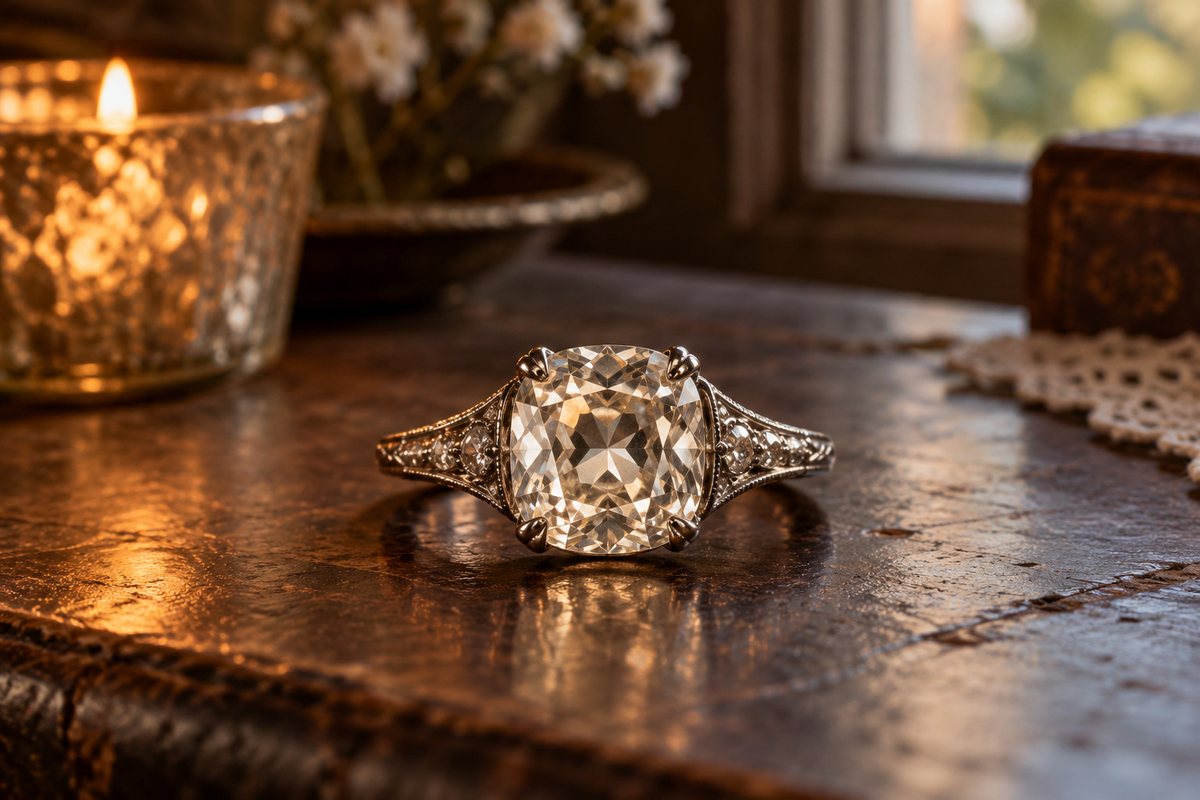
An old mine cut diamond is an antique, hand-cut diamond with a soft, squarish cushion outline, a small table, a high crown, a deep pavilion and a large culet that often shows as a small circle in the centre. According to GIA, the style was common from the early 1700s to the late 1800s, which is why it turns up most in Georgian and Victorian jewellery, and it gives broad, colourful flashes rather than the fine, bright sparkle of a modern brilliant.
This guide includes a few product links near the end. As an Amazon Associate, Diamond Taire earns from qualifying purchases, at no extra cost to you.
This guide focuses on recognising a genuine old mine cut, telling it apart from old European cuts, modern cushions and new “antique-style” stones, understanding how these diamonds are graded, and weighing an original antique against a newly cut one. For the history of each jewellery period, see the separate guide to antique diamond jewellery periods and cuts.
At a glance
- Shape: a soft, squarish cushion outline with rounded corners, never perfectly symmetrical when original.
- Proportions: small table, high crown, deep pavilion, short lower facets and a large culet.
- Look: less brilliance and more fire than a modern round, with chunky flashes that GIA says were designed to sparkle in candlelight.
- Grading: reports grade colour and clarity, but cushion shapes do not get a GIA cut grade, so you must judge the look yourself.
- Antique or new: originals carry history and hand-cut character; new old mine style cuts, natural or lab-grown, are more consistent and easier to match.
What is an old mine cut diamond?
GIA explains that the name probably came into use in the late 1800s, when production from Africa overtook the “old mines” of Brazil and India. At first the term described any squarish, brilliant-style colourless or near-colourless diamond from those older sources. Over time it came to mean squarish stones cut with the faceting patterns developed from the early 1700s.
An old mine cut usually has 58 facets, the same number as a modern round brilliant, but they are arranged in different proportions. Cutters of the time worked by hand and by eye, and they were trying to keep as much weight as possible from the rough crystal. The result was a stone with a tall crown, a deep body and a flat facet at the bottom (the culet) that is large enough to see. Because the girdle, the thin edge around the stone, is often very thin in places, GIA warns that old mine cuts can be vulnerable to chipping.
How to recognise a genuine old mine cut
No single feature proves a stone is an original. Look for several of these together, ideally with a 10x loupe and someone experienced beside you.
- A cushion outline that is slightly irregular. Hand-cut stones often have sides of slightly different lengths, gently uneven corners or a girdle that wanders. GIA notes that modern replicas usually have more consistent cutting.
- A small table. The flat top facet is noticeably smaller in relation to the stone’s width than on a modern diamond.
- A high crown. Viewed from the side, the upper part of the stone rises steeply above the girdle.
- A large, visible culet. Look straight down through the table. A small octagon or circle in the centre, sometimes described as an open culet, is a classic sign.
- Short lower facets and a deep pavilion. The facets below the girdle are short and the stone is deep, which shapes its chunky flash pattern.
- Bold, colourful flashes. Under a single light, such as a candle or a spotlight, the stone breaks light into larger, slower flashes of colour.
- Wear consistent with age. Tiny nicks along facet junctions or a slightly worn girdle are common on stones that have been worn for a century or more. Wear alone does not prove age, but perfect, crisp facets on a supposedly 200-year-old stone deserve questions.
- A setting that agrees with the stone. In an original piece, the mount, construction and stone should tell the same story. The antique jewellery guide covers how to read construction and hallmarks.
Old mine cut vs old European cut vs modern cushion
These three are often confused, and sellers do not always use the terms carefully. The outline is the quickest separator: old mine cuts are squarish, old European cuts are round.
| Feature | Old mine cut | Old European cut | Modern cushion | New “old mine style” |
|---|---|---|---|---|
| Outline | Soft, squarish cushion | Round | Square or rectangular with curved sides | Squarish cushion, usually very regular |
| Table | Small | Small | Medium to large | Small to medium |
| Crown | High | High | Moderate | Usually high |
| Culet | Large, often visible | Large, often visible | Pointed or very small | Often a visible culet to mimic the look |
| Cutting | Hand-cut, slightly irregular | Hand-finished, more symmetrical after bruting machines arrived | Machine-assisted, precise | Modern, precise; thicker girdle |
| Light | Broad, fiery flashes | Fiery, slightly more even pattern | Bright, often with “crushed ice” or chunky patterns | Antique-style flashes with more brightness and consistency |
| Typical era | Early 1700s to late 1800s (GIA) | Overlaps the later old mine period and continues into the early 1900s | Today | Today |
A transitional cut sits between the old European and the modern round. GIA notes that the arrival of the bruting machine in the late nineteenth century improved symmetry and proportions, which is one reason later antique stones look more regular. If you are comparing modern cushions, our guide to the elongated cushion cut explains how today’s versions differ.
How old mine cut diamonds are graded
A grading report from a recognised laboratory records an old mine cut’s carat weight, colour, clarity, measurements and proportions in the same way as any other diamond. Reports usually describe the shape in technical terms, for example a cushion brilliant variant, rather than using the trade name “old mine”, so read the plotting diagram and proportions rather than looking for the phrase.
The important difference is cut quality. GIA’s cut grade applies to standard round brilliants, so a cushion-shaped old mine cut receives no GIA cut grade. Even for round antique stones, GIA has a separate description for old European and circular brilliant cuts that does not include a cut grade, as National Jeweler reported in 2016. That means two old mine cuts with identical colour and clarity can look very different, and you have to judge the light performance with your own eyes, in person or on good-quality video.
Our guide to reading a diamond grading report explains each field. For colour, remember that grading is the same D-to-Z scale used for modern stones; see how to choose a diamond colour grade.
Antique original vs newly cut: an honest comparison
| Factor | Original antique old mine | New natural old mine style | Lab-grown old mine style |
|---|---|---|---|
| History | Cut by hand one to three centuries ago | Newly cut from mined rough | Newly grown and cut |
| Look | Most character; each stone unique | Antique feel, more even | Antique feel, more even |
| Matching pairs or sizes | Hard; a search can take time | Easier | Easiest |
| Durability concerns | Thin girdles, old chips; inspect carefully | Usually thicker girdles | Usually thicker girdles |
| Supply | Limited; no new originals can be made | Depends on cutters | Wide |
| Relative cost | Varies widely with colour, clarity, size and charm | Similar to other natural diamonds of the same grades | Usually much lower |
| Resale expectations | Depends on demand for antiques; never guaranteed | Like other natural diamonds, well below retail | Low |
Who each option suits
- An original antique suits buyers who value history, are happy to accept hand-cut irregularity, and want a stone that cannot be made again.
- A new natural old mine style stone suits buyers who want the look in a mined diamond with modern consistency and a sturdier girdle.
- A lab-grown old mine style stone suits buyers who want the antique look in a larger size for less money and do not mind low resale value. Our lab-grown diamonds buying guide covers what to check.
Price and value: what really drives the cost
Old mine cut prices do not follow the neat price lists used for modern rounds. Colour, clarity and carat still matter, but so do how attractive the individual stone looks, its condition, whether the outline is pleasing, and current demand for antique stones. A charming stone with a pleasing outline can sell for more than a technically higher grade with an awkward shape.
Two practical points help. First, because old mine cuts carry a lot of weight in the crown and pavilion, they can look smaller face-up than a modern diamond of the same carat weight, so compare measurements in millimetres, not just carats. Second, some old stones have been recut to modern proportions over the years, which removes weight and destroys the original character. If you buy an original, keep it original. For how value behaves after purchase, see whether fine diamonds hold their value.
Old mine cut engagement rings: setting advice
An old mine cut engagement ring needs a setting that protects that thin, uneven girdle. GIA recommends a secure setting that fully protects the girdle; a bezel, a half bezel or well-made claws with enough metal are all sensible choices, and the jeweller should measure the stone carefully because hand-cut outlines are not standard sizes. The high crown also means the stone may sit a little taller. The style works as a solitaire or with side stones. Our guide to ring settings compares the options.
Buying checklist
- Ask whether the stone is an original antique cut, a recut, or a newly cut old mine style stone, and get the answer on the receipt.
- Ask whether it is natural or lab-grown. Both exist in this style.
- Request a grading report from a recognised laboratory for any significant stone.
- Inspect the girdle all the way round for chips, and check facet junctions for wear.
- View the stone in daylight, under a single spotlight and in softer indoor light.
- Compare face-up measurements, not just carat weight.
- If the stone is in an antique mount, ask whether the stone is original to the piece.
- Get a clear returns policy, and an independent appraisal for insurance.
Common mistakes
- Calling every antique diamond an old mine cut. Round old stones are usually old European or transitional cuts.
- Expecting modern brilliance. An old mine cut is meant to look different. If you want maximum brightness, a modern cut suits you better.
- Looking for a cut grade. There is none on a GIA report for these stones, so a seller cannot prove “excellent” cutting with a grade.
- Ignoring the girdle. Old chips can grow with a knock, and resetting a stone with a damaged girdle needs care.
- Recutting an original to “improve” it. This loses weight, character and much of the antique appeal.
- Paying antique prices for a new stone. New and lab-grown old mine style stones are legitimate, but they should not be priced or described as antiques.
Sources this guide draws on: GIA 4Cs guide to old mine cut diamonds; GIA 4Cs article on cushion cut diamonds; GIA grading report guidance on cut grades for round brilliants; National Jeweler reporting on GIA’s old European and circular brilliant descriptions (2016).
Useful tools for this guide
Practical picks for choosing, checking and caring for jewellery. As an Amazon Associate, Diamond Taire earns from qualifying purchases, at no extra cost to you. Prices and availability are set by Amazon and may vary by country.
- Foldable 30x Jeweller’s Loupe
Pocket magnifier for checking stones, settings and hallmarks up close.
View on Amazon - CONNOISSEURS Premium Jewellery Cleaner
Gentle dip cleaner with a brush and tray for diamonds, gold and platinum. Check the label for stones it should not be used on.
View on Amazon - Ring Sizer Measuring Tool Kit (27 pieces)
Sizing rings plus a mandrel, to check a size at home before you buy or resize.
View on Amazon
Frequently asked questions
What is an old mine cut diamond?
It is an antique diamond cut with a soft, squarish cushion outline, a small table, a high crown, a deep pavilion and a large culet. GIA dates the style as common from the early 1700s to the late 1800s.
What is the difference between an old mine cut and an old European cut?
The outline. Old mine cuts are squarish cushions, while old European cuts are round. Both have small tables, high crowns and visible culets, and both give fiery, broad flashes.
Is an old mine cushion cut the same as a modern cushion?
No. Modern cushions were partly inspired by old mine cuts, but they have larger tables, smaller culets and more precise machine-assisted cutting, which gives more brilliance and consistency.
Can you get a lab-grown old mine cut diamond?
Yes. Lab-grown diamonds are cut in old mine style shapes, usually with more consistent proportions and thicker girdles than originals. They cost less but should not be described as antique.
Do old mine cut diamonds sparkle?
Yes, but differently. GIA describes them as having less brilliance and more fire than modern rounds, with bold flashes that look especially beautiful in candlelight and spot lighting.
Are old mine cut diamonds a good investment?
They are best bought for love of the stone, not as an investment. Antique demand can rise and fall, and selling any diamond usually returns well below the retail price.
An old mine cut is one of the most beautiful ways to own a piece of diamond history, as long as you know what you are looking at. Check the outline, culet and girdle, ask whether it is original, new or lab-grown, and judge the stone with your own eyes rather than chasing a cut grade that does not exist. For more on how cut shapes light, see the guide to diamond cut quality.