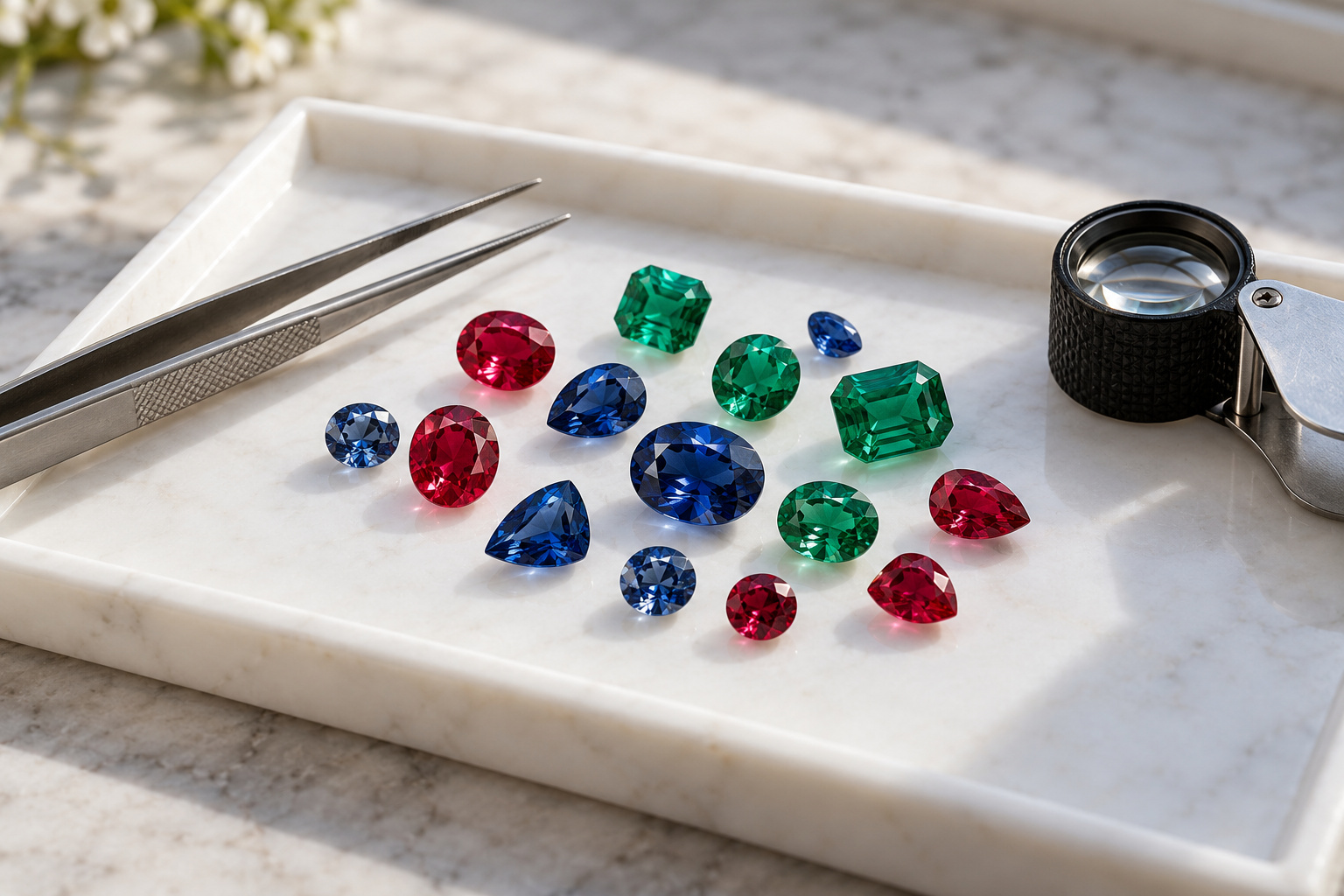
A lab grown sapphire is real sapphire: the same mineral, corundum, with the same chemistry, hardness and optical properties as a mined stone, made in a factory instead of found in the ground. It costs a fraction of a comparable natural stone, but lab sapphires are not all equal. The growth method decides how clean the stone looks, how much it costs and how easily a laboratory can identify it.
This guide includes a few product links near the end. As an Amazon Associate, Diamond Taire earns from qualifying purchases, at no extra cost to you.
This guide explains the four main ways lab-created sapphire, ruby and emerald are grown, how each method shows up in the finished stone, what the labels legally have to say, how laboratories tell lab from natural, and a checklist for buying lab grown sapphire jewellery or an engagement ring without paying for something you did not get.
At a glance
- Real, not fake. Lab grown sapphire is corundum, just like natural sapphire. A simulant (glass, cubic zirconia, or another material that only looks similar) is a different thing.
- Method matters. Flame fusion is the cheapest and most common method; flux and hydrothermal growth are slower and more expensive, and the stones look more like natural ones.
- Labels are not optional. In the US, the Federal Trade Commission’s Jewelry Guides say a lab-made stone’s name must be preceded, equally clearly, by a word such as “laboratory-grown”, “laboratory-created”, “manufacturer-created” or “synthetic”. Many other countries have similar rules.
- Same durability. Lab sapphire and lab ruby are about 9 on the Mohs scale with excellent toughness, so they suit everyday rings. Lab emerald is still emerald and needs more care.
- Buy to wear. Lab gems are made to order and are not rare, so treat them as beautiful, durable stones to enjoy, not as stores of value.
Are lab grown sapphires real?
Yes. GIA defines a synthetic gem material as one made in a laboratory that shares virtually all the chemical, optical and physical characteristics of its natural counterpart. A lab-created sapphire is aluminium oxide crystallised in the same structure as a mined sapphire, with trace elements added for colour. It scratches no more easily, it bends light the same way and, under ordinary conditions, it looks the same.
What it is not is natural. That difference is about origin, rarity and price, not about whether the stone is “genuine sapphire”. The confusion comes from three words that are often used loosely:
- Lab-grown, lab-created, synthetic, manufacturer-created: all mean the same thing, a man-made stone with the same properties as the natural gem.
- Simulant or imitation: a different material made to look like the gem, such as blue glass, or synthetic blue spinel, which GIA notes was first produced by accident while growing sapphire.
- Natural: mined, though it may still be treated (heating is very common in natural sapphire).
If you are comparing a lab sapphire with a lab diamond, the logic is the same: real material, made in a factory. Our lab-grown diamond buying guide covers the diamond side of that decision.
How lab grown sapphires are made: the four methods
GIA groups gem growth into two families. In melt methods, the starting material is melted and crystallises as it cools; in solution methods, the ingredients are dissolved in something else and the crystal grows slowly out of that solution onto a seed. Sapphire and ruby can be made by more processes than almost any other gem, which is why lab corundum exists at so many price levels.
Flame fusion (Verneuil)
Powdered aluminium oxide is dropped through a very hot flame and builds up, drop by drop, into a carrot-shaped crystal called a boule. Auguste Verneuil announced the process in 1902, and GIA describes it as the least expensive and most common way to make synthetic corundum. A large share of the lab sapphires and rubies on the market, from watch crystals to inexpensive jewellery, come from this method.
Because the crystal grows quickly, flame-fusion stones can show tiny gas bubbles and curved growth lines (curved striae or curved colour banding). Natural sapphire grows in straight, angular zones instead, so curved banding is a classic sign of flame fusion.
Crystal pulling (Czochralski)
The ingredients are melted in a crucible, a seed crystal is dipped in and slowly pulled upward while rotating, and the crystal grows on the seed. GIA dates the method to the early 1900s and lists corundum among the gems grown this way. Pulled crystals can be very clean, and GIA notes that pulled sapphires can be convincing substitutes for natural stones.
Flux growth
A solid flux is melted and used to dissolve the sapphire ingredients; as it cools very slowly, crystals form. GIA says flux growth can take up to a year and uses very expensive equipment, and that flux-grown sapphires have been available since the 1960s. Flux stones are prized because they grow slowly at lower temperatures, giving crystals whose inclusions can look more like those of natural stones.
Hydrothermal growth
Here the crystal grows in a hot, pressurised water solution inside a sealed vessel, imitating conditions deep in the earth. GIA describes it as slow and expensive. It is used for some ruby and sapphire, but it matters most for emerald.
Lab sapphire growth methods compared
| Method | Family | Relative cost | Typical look | Clues a lab looks for |
|---|---|---|---|---|
| Flame fusion (Verneuil) | Melt | Lowest | Very clean to the eye, sometimes overly uniform colour | Gas bubbles, curved striae or banding, Plato lines |
| Crystal pulling (Czochralski) | Melt | Low to moderate | Very clean | Growth features and trace-element chemistry |
| Flux | Solution | Higher | Can look much like natural, with fingerprint-like inclusions | Flux-filled “fingerprints”, platinum platelets from the crucible |
| Hydrothermal | Solution | Higher | Natural-looking | Distinctive growth patterns, seed remnants, chemistry |
“Relative cost” here is about how expensive the process is, as GIA describes it. Retail prices also depend on cutting quality, size, colour and the seller’s margin.
Lab ruby and lab emerald: the same idea, different gems
Lab grown ruby is red corundum, so everything above applies. GIA describes flame fusion as the first commercially successful growth method, and ruby was the gem Verneuil first made with it. Lab ruby is still widely made by flame fusion, flux and other methods. Our guide to red gemstones sets lab ruby alongside spinel, garnet and glass-filled ruby, and the July birthstone guide covers ruby buying in more depth.
Lab grown emerald is beryl, not corundum, and it cannot be grown from a simple melt. GIA notes that emerald is grown by flux and hydrothermal methods: a commercially viable flux-grown emerald appeared in the late 1930s, and hydrothermal emerald for jewellery in 1960. Both are slow, expensive processes, so lab emerald is not as cheap, relative to natural, as flame-fusion sapphire.
Two practical points about lab emerald. First, it is still emerald, with emerald’s lower hardness (around 7.5 to 8 on the Mohs scale) and sensitivity to knocks, so it needs a protective setting. Second, a lab emerald is often cleaner than a natural one, which many buyers like, but it should be clearly labelled. The green gemstones guide compares lab emerald with tsavorite, green sapphire and other alternatives.
Lab created sapphire vs natural sapphire
| Factor | Lab created sapphire | Natural sapphire |
|---|---|---|
| Material | Corundum | Corundum |
| Hardness and toughness | About 9 on Mohs; excellent toughness | About 9 on Mohs; excellent toughness |
| Rarity | Made to order | Fine colour in larger sizes is rare |
| Price | A fraction of comparable natural stones; varies with method and cutting | Rises steeply with colour, size, origin and lack of treatment |
| Treatment | Usually none needed | Heating is common; some stones are diffused or glass-filled |
| Inclusions | Depend on method; often very clean | Natural crystals, silk, fingerprints |
| Long-term value | Buy to wear | Better-documented market, but still not an investment for most buyers |
Durability is identical, and the best gemstones for engagement rings guide explains why corundum ranks just behind diamond for daily wear. The real differences are rarity, price and story. A natural sapphire’s appeal is that it formed in the earth; a lab sapphire’s appeal is that you can have a large, clean, vivid stone for much less.
This guide does not quote price ranges. Lab sapphire prices vary so widely by method, cut, size and seller that any single figure would mislead. A useful rule is to compare like with like: the same size, the same colour intensity and, ideally, the same growth method.
How laboratories identify lab grown sapphire
You usually cannot tell lab from natural with the eye or a basic loupe. Gemmological laboratories use a combination of tools, and GIA’s research describes the main clues:
- Flame fusion: gas bubbles, curved striae or curved colour banding, and Plato lines. GIA notes that curved banding becomes much easier to see under short-wave ultraviolet light.
- Flux: flux-filled “fingerprint” inclusions and tiny metallic platelets from the platinum-group crucibles. A GIA review notes these are considered proof of synthetic origin, though it also cautions that some natural stones healed with flux during treatment can show residue.
- Chemistry: trace elements measured with techniques such as X-ray fluorescence or laser ablation analysis. Lab corundum can lack the trace elements that natural stones pick up from their surroundings.
- Emerald: flux-grown emerald lacks a water-related signal that natural emerald shows on infrared spectroscopy; hydrothermal emerald can show chevron-shaped growth patterns, “nailhead” inclusions and seed remnants.
For an inexpensive stone, you will rarely need a report. For a stone sold as natural at a natural price, an independent laboratory report is the protection worth paying for. The blue gemstones guide shows where lab sapphire sits among topaz, tanzanite and spinel.
What the label has to say
The US Federal Trade Commission’s Guides for the Jewelry, Precious Metals and Pewter Industries (16 CFR Part 23) say it is unfair or deceptive to call a lab-made stone a “ruby”, “sapphire” or “emerald” unless the name is immediately preceded, with equal conspicuousness, by a word such as “laboratory-grown”, “laboratory-created”, “manufacturer-created” or “synthetic”. The Guides also say “faux” is not an adequate disclosure, and that “synthetic” or “lab-grown” may only be used for a product with essentially the same optical, physical and chemical properties as the natural stone. Blue glass, for example, cannot be sold as “lab sapphire”.
Rules outside the US differ in detail, but consumer and trade standards in many countries follow the same principle: a buyer should never be left thinking a lab stone is natural. If a listing says only “sapphire” at a price that seems too good, ask in writing.
Who lab grown sapphire suits, and who it doesn’t
It suits you if you want a durable coloured engagement ring on a modest budget, you prefer a very clean stone, you want a large or vivid colour that would be out of reach in natural, or you want to avoid the treatment questions that come with many natural sapphires.
It may not suit you if natural origin is part of the meaning for you, you hope the stone will hold its price, or you want a stone with the individual character that natural inclusions and colour zoning give.
Buying checklist: lab grown sapphire jewellery and engagement rings
- Confirm the material in writing. “Lab-grown sapphire” or “synthetic sapphire”, not just “sapphire”, and not “sapphire-coloured” or “simulated”.
- Ask the growth method. Flame fusion is fine for fashion jewellery; for an heirloom-style ring, many buyers prefer flux or pulled stones. A seller who cannot answer is telling you something.
- Judge the cut, not just the colour. A lab stone can be cut quickly to keep costs down. Look for even sparkle, no large dead or see-through window in the centre, and symmetrical outlines.
- Check colour in daylight. Some lab sapphires are very saturated and can look dark indoors; view them in natural light and under warm indoor lighting.
- Compare like with like. Same size, same colour, same method. Do not compare a flame-fusion stone’s price with a flux stone’s.
- Get the return policy. Make sure you can return the stone if an independent check finds it is not what was described.
- Choose a sensible setting. Sapphire is tough, but a protective setting still helps with emerald, and with pointed shapes.
- Keep the paperwork. Description, method and receipt help with insurance and any future resale.
Common mistakes
- Thinking “lab” means “fake”. A lab sapphire is genuine corundum. The fake is glass or another material pretending to be sapphire.
- Assuming all lab sapphires are the same. A flame-fusion stone and a flux-grown stone can look different under magnification and differ a lot in price.
- Paying natural prices for a lab stone. If the price is close to natural, ask for an independent report.
- Buying for resale. Lab gems can be made in any quantity; enjoy them as jewellery, not as an asset.
- Ignoring the setting with lab emerald. Lab emerald has emerald’s hardness and still needs protection from knocks.
- Using harsh cleaning on treated natural stones. Lab sapphire is usually untreated and easy to clean; GIA advises only a damp cloth for fracture-filled, cavity-filled or dyed sapphire.
Caring for lab sapphire, ruby and emerald
GIA’s sapphire care guidance says warm, soapy water is always safe for corundum, and that ultrasonic and steam cleaners are usually safe for untreated and heat-treated stones. Lab sapphire and lab ruby can be cleaned the same way. Lab emerald should be treated like natural emerald: warm, soapy water and a soft brush, and ask a jeweller before using any machine cleaner. For any ring, check that the stone is secure before ultrasonic cleaning.
If you are still learning how lab-made stones differ from mined ones, how diamonds are made, earth versus lab explains the same idea for diamonds.
Sources this guide draws on: GIA, An Introduction to Synthetic Gem Materials; GIA Gems and Gemology research on curved banding in flame-fusion synthetic sapphire and on the history and identification of synthetic coloured stones; GIA Sapphire Care and Cleaning Guide; US Federal Trade Commission, Guides for the Jewelry, Precious Metals and Pewter Industries (16 CFR Part 23).
Useful tools for this guide
Practical picks for choosing, checking and caring for jewellery. As an Amazon Associate, Diamond Taire earns from qualifying purchases, at no extra cost to you. Prices and availability are set by Amazon and may vary by country.
- Gemstones of the World by Walter Schumann (5th edition)
A classic illustrated reference to more than 1,900 gemstones.
View on Amazon - Foldable 30x Jeweller’s Loupe
Pocket magnifier for checking stones, settings and hallmarks up close.
View on Amazon - KElofoN Travel Jewellery Case
Compact case with ring rolls and earring slots so pieces do not scratch each other.
View on Amazon
Frequently asked questions
Are lab grown sapphires real sapphires?
Yes. They are corundum with the same chemical, physical and optical properties as natural sapphire. They are real but not natural, and they must be described as lab-grown, lab-created or synthetic.
Are all lab sapphires the same?
No. Flame-fusion stones are the cheapest and can show curved growth lines and bubbles under magnification. Flux, pulled and hydrothermal stones cost more to grow and can look much more like natural sapphire. Cutting quality also varies.
Is a lab grown sapphire good for an engagement ring?
Yes. At about 9 on the Mohs scale with excellent toughness and no cleavage, sapphire suits everyday wear. Choose a well-cut stone and a secure setting, and have the prongs checked from time to time.
Can a jeweller tell if a sapphire is lab grown?
Sometimes, with a microscope, if the stone shows curved banding or gas bubbles. Many lab stones need laboratory tests such as trace-element analysis to be identified with confidence, so ask for an independent report on any stone sold as natural.
Do lab grown sapphires hold their value?
Not in the way rare natural stones can. Lab gems can be produced to order, so expect little resale value and buy one because you love wearing it.
Is lab emerald cheaper than natural emerald?
Generally yes, but the gap is usually smaller than with sapphire, because emerald can only be grown by slow, expensive flux and hydrothermal methods.
A lab grown sapphire can be a smart, beautiful choice when you know what you are buying. Get the material and method in writing, judge the cut with your own eyes, and pay a lab price for a lab stone.