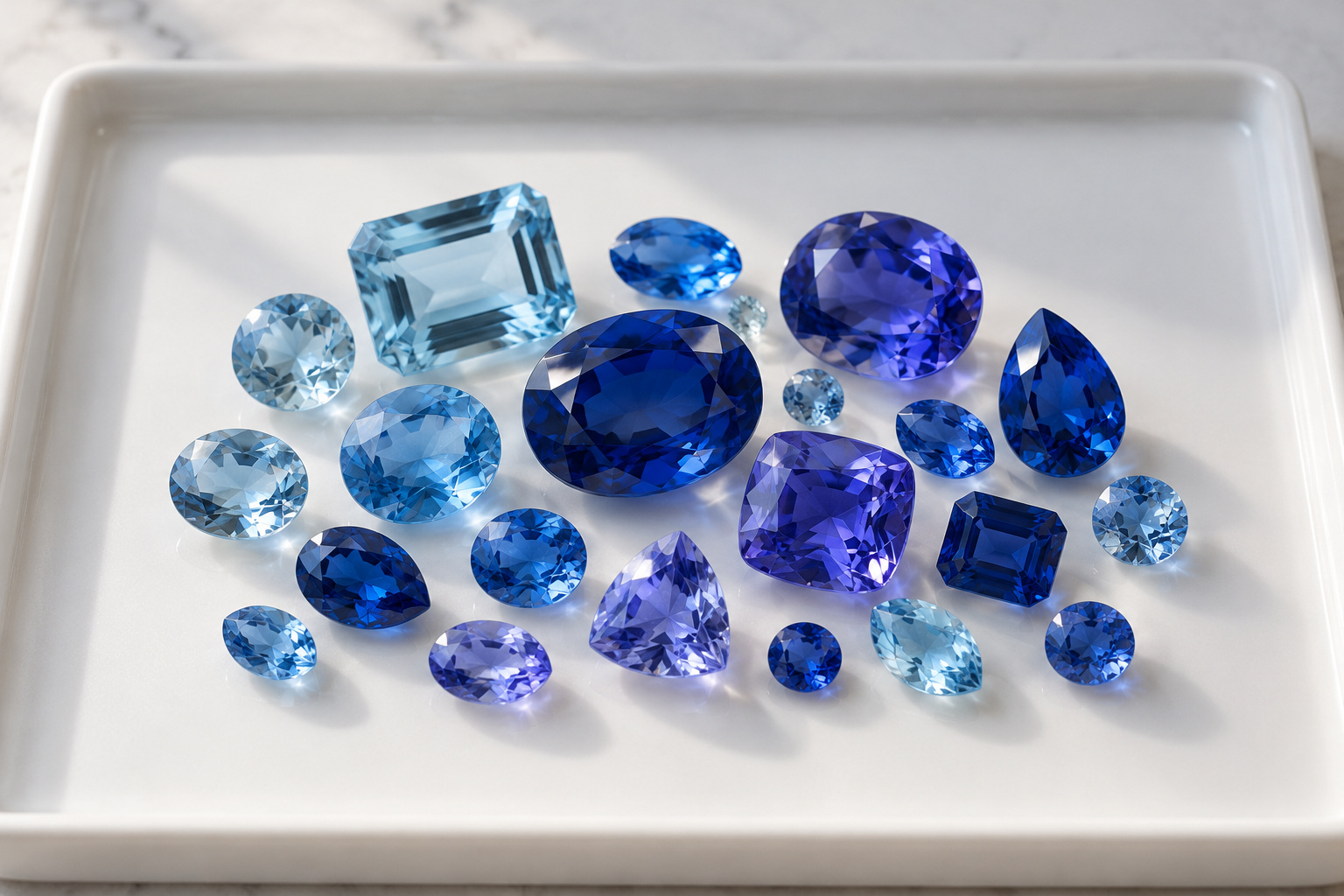
The best-known blue gemstones are sapphire, aquamarine, blue topaz, tanzanite, blue spinel, blue zircon, lapis lazuli and turquoise, with blue diamond as the rarest. For everyday rings, sapphire is the most durable choice; aquamarine, blue topaz and spinel are also hard enough for regular wear, while tanzanite, zircon, lapis and turquoise are better kept for earrings, pendants or occasional rings.
This guide includes a few product links near the end. As an Amazon Associate, Diamond Taire earns from qualifying purchases, at no extra cost to you.
This guide ranks blue gemstones by how well they stand up to everyday wear, explains which are routinely heated, irradiated or diffused, notes which can fade, and shows how to tell blue topaz from aquamarine. It is written for buyers, not sellers, so it covers the drawbacks as well as the beauty.
At a glance
- Sapphire (9 on the Mohs scale) is the most practical blue gemstone for engagement and everyday rings.
- Most blue gemstones on the market are treated in some way. Heat is the most common; blue topaz is usually irradiated; some sapphires are diffusion treated. Ask for disclosure in writing.
- Tanzanite looks spectacular but is softer and less tough, and it should never go in an ultrasonic or steam cleaner.
- Blue topaz and aquamarine can look similar; the reliable way to tell them apart is a gemmologist’s test.
- Lab-grown blue sapphire is real sapphire made in a laboratory, and should always be described as such.
What makes a gemstone blue?
Blue colour comes from trace elements or structural features in the crystal. In sapphire it comes mainly from iron and titanium; in aquamarine from iron; in some spinel from cobalt. Lapis lazuli and turquoise are not single crystals but rocks or mineral aggregates, which is why they are opaque. These differences matter to buyers, because they affect how a stone looks under different lights, how it responds to treatment and how durable it is.
Blue gemstones ranked for everyday wear
The table ranks the main blue gemstones from most to least suited to everyday wear. Hardness uses the Mohs scale, which measures scratch resistance. Toughness, which is resistance to chipping and breaking, matters just as much and is noted separately.
| Gemstone | Mohs hardness | Toughness and weak points | Common treatments | Best uses | Relative price |
|---|---|---|---|---|---|
| Blue diamond | 10 | Good, but can chip along cleavage | Natural colour is very rare; colour treatment and lab-grown blue diamonds exist | Any jewellery | Very high (natural) |
| Sapphire | 9 | Excellent; no cleavage | Heat (very common); diffusion (less common, must be disclosed) | Engagement rings, everyday rings, all jewellery | Moderate to very high |
| Spinel | 8 | Good | Usually untreated | Rings, earrings, pendants | Moderate to high; cobalt blue is rare |
| Topaz (blue) | 8 | Perfect cleavage; can split from a hard knock | Almost always irradiated and heated to create blue | Earrings, pendants, protective-set rings | Low |
| Aquamarine | 7.5 to 8 | Good | Often heated to remove green tones | Rings with care, earrings, pendants | Moderate |
| Blue zircon | 6.5 to 7.5 | Brittle; facet edges chip easily | Almost always heated; some stones can fade in strong light | Earrings, pendants | Low to moderate |
| Tanzanite | 6 to 7 | Fair to poor toughness; has cleavage | Heat (routine) | Earrings, pendants, occasional rings | Moderate to high |
| Turquoise | 5 to 6 | Porous; absorbs oils and chemicals | Often stabilised or dyed | Pendants, earrings, beads | Low to high, depending on quality |
| Lapis lazuli | 5 to 5.5 | Soft; scratches easily | Sometimes dyed or waxed | Pendants, beads, cufflinks | Low to moderate |
Prices change and vary widely with size, colour and quality, so the price column is relative rather than a figure. A top-quality example of a “low” stone can still cost more than a poor example of a “high” one.
The main blue gemstones in detail
Sapphire
Blue sapphire is the variety of the mineral corundum and the classic blue gemstone. Its hardness and lack of cleavage make it the most practical blue stone for engagement rings; our guide to the best gemstones for engagement rings compares it with other choices. Most sapphires on the market are heated to improve colour and clarity, which GIA research on sapphires from the trade has confirmed. Heat treatment is accepted and stable. Diffusion treatment, in which elements such as beryllium or titanium are introduced into the stone at high temperature, changes colour more significantly and should always be disclosed. Ask for a report from a respected laboratory on any significant sapphire.
Aquamarine
Aquamarine is the blue to greenish-blue variety of beryl and the March birthstone. It is hard enough for rings with sensible care, and it tends to be clean and bright. Many aquamarines are gently heated to remove greenish tones and give a purer blue. Our guide to the March birthstone covers aquamarine in more detail.
Blue topaz
Natural blue topaz is pale and uncommon. Almost all blue topaz on the market starts as colourless topaz that is irradiated and then heated to produce the blue. Trade names describe the shade, from light sky blue to brighter Swiss blue to darker, greyer London blue. The treatment is considered stable, and in some countries, including the United States, regulators require irradiated gems to meet limits on residual radioactivity before they are sold. Topaz is hard but has perfect cleavage, so a sharp knock can split it; protective settings help in rings.
Tanzanite
Tanzanite is the blue to violet variety of zoisite, found commercially in one small area of Tanzania. According to GIA’s care guidance, it is 6 to 7 on the Mohs scale with fair to poor toughness, and heat treatment, which turns it from brownish to blue-violet, is routine and stable. GIA advises that ultrasonic and steam cleaners are never recommended for tanzanite; warm, soapy water is safe. It is a beautiful choice for earrings and pendants, and needs care in a ring.
Spinel
Spinel is hard, tough and usually untreated, which makes it an underrated choice. Blue spinel ranges from greyish to vivid; spinel coloured by cobalt, with an intense blue, is rare and sought after. Synthetic spinel has been made for many years, so a laboratory report helps with valuable stones.
Blue zircon
Not to be confused with cubic zirconia, which is a different, man-made material, zircon is a natural mineral with strong fire. Blue zircon is almost always produced by heating brown zircon. Some heated blue stones can fade with long exposure to strong sunlight. Zircon is brittle and its facet edges chip easily, so it suits earrings and pendants better than everyday rings.
Lapis lazuli and turquoise
These opaque blue stones are traditionally used for beads, cabochons, inlays and signet-style pieces. Both are relatively soft and porous. Lapis lazuli can be dyed or waxed; turquoise is often stabilised with resin to make it more durable. Keep them away from perfume, cosmetics and harsh chemicals.
Blue diamond
Natural blue diamonds, coloured by boron, are among the rarest and most expensive gems. Blue diamonds can also be created by treatment or grown in a laboratory. Disclosure and a report from a respected laboratory are essential. Our guide to pink diamond rings covers how coloured diamonds are graded, and our lab-grown diamond guide explains how lab-grown stones are described.
Light blue gemstones
If you are looking for a light blue gemstone, the main choices are aquamarine, sky blue topaz, light blue spinel, pale sapphire and blue zircon. Aquamarine and sky blue topaz are the most widely available; pale sapphire is the most durable. Light blue stones show inclusions and cut quality clearly, so look for a bright, lively stone without obvious windows (dull patches where light passes straight through).
How to tell blue topaz from aquamarine
Blue topaz and aquamarine can look very similar, especially in light shades, and the difference in value can be significant. There are clues, but no reliable home test:
- Colour: aquamarine often has a slightly greenish or greyish tint; treated blue topaz tends to be a more uniform, saturated blue.
- Price: a large, bright blue stone at a very low price is more likely to be topaz.
- Weight: topaz is denser, so a topaz looks slightly smaller than an aquamarine of the same carat weight. This is hard to judge by eye.
- Testing: a gemmologist can separate them quickly with standard instruments such as a refractometer.
For anything valuable, ask for the stone to be identified in writing, or buy with a laboratory report.
Lab-grown blue sapphire and imitations
Lab-grown (synthetic) sapphire has the same chemical composition and properties as natural sapphire and has been produced for more than a century. It is genuine sapphire, much less expensive than natural, and should always be described as lab-grown, created or synthetic. Imitations are different: blue glass, coated stones or other materials made to look like a blue gem. A laboratory report is the most reliable way to know what you are buying.
Buying checklist for blue gemstones
- Decide how the piece will be worn. Daily rings need sapphire, spinel or diamond; earrings and pendants can use softer stones.
- Ask what the stone is, in writing: natural or lab-grown, and the exact gem name.
- Ask about treatment. Heat, irradiation, diffusion, dyeing, coating or stabilisation should all be disclosed.
- Look at the stone in different light. Some blue stones look darker indoors or change tone between daylight and warm lighting.
- Check the setting. Softer or cleavage-prone stones are safer in bezels or protective claws.
- Get a laboratory report for valuable sapphires, spinels and blue diamonds.
- Confirm care instructions, especially for tanzanite, zircon, turquoise and lapis.
For silver settings, our guide to sterling silver gemstone jewellery explains how to choose pieces that last.
Common mistakes
- Choosing tanzanite or zircon for an everyday ring without understanding how easily they chip.
- Assuming a stone is untreated. Most blue gemstones are treated; the question is which treatment and whether it is stable.
- Cleaning every stone the same way. Ultrasonic and steam cleaning can damage tanzanite, zircon, turquoise and lapis. Warm, soapy water is the safe default; our jewellery cleaning guide covers the details.
- Confusing zircon with cubic zirconia. They are entirely different materials.
- Buying “blue sapphire” without asking if it is lab-grown. Both are sapphire, but their prices are very different.
- Judging colour under shop lighting only. Look in daylight too.
Related guide: Lab Grown Sapphire: How to Buy the Right One Without Regret.
Sources this guide draws on: GIA’s tanzanite care and cleaning guidance, GIA Gem Encyclopedia entries on sapphire, aquamarine, topaz, spinel, zircon and lapis lazuli, GIA laboratory research on beryllium diffusion in blue sapphire, and University of Texas gemmology course notes on zircon.
Useful tools for this guide
Practical picks for choosing, checking and caring for jewellery. As an Amazon Associate, Diamond Taire earns from qualifying purchases, at no extra cost to you. Prices and availability are set by Amazon and may vary by country.
- Gemstones of the World by Walter Schumann (5th edition)
A classic illustrated reference to more than 1,900 gemstones.
View on Amazon - Foldable 30x Jeweller’s Loupe
Pocket magnifier for checking stones, settings and hallmarks up close.
View on Amazon - KElofoN Travel Jewellery Case
Compact case with ring rolls and earring slots so pieces do not scratch each other.
View on Amazon
Frequently asked questions
What is the most popular blue gemstone?
Blue sapphire is the most famous and widely used blue gemstone in fine jewellery, valued for its colour and durability. Blue topaz is the most widely sold affordable blue stone.
What is the most durable blue gemstone?
Apart from blue diamond, sapphire is the most durable blue gemstone, at 9 on the Mohs scale with excellent toughness. Spinel is also a strong choice.
Which blue gemstone is best for an engagement ring?
Sapphire is the usual choice, because it is hard, tough and keeps its polish. Spinel and aquamarine can work with care, ideally in protective settings.
What are some blue gemstone names?
Common names include sapphire, aquamarine, blue topaz, tanzanite, spinel, zircon, lapis lazuli, turquoise, blue diamond, iolite and blue tourmaline (sometimes called indicolite).
Does blue topaz fade?
Treated blue topaz is generally considered stable under normal wear. Blue zircon is the blue stone most often noted for fading with long exposure to strong light.
Is tanzanite rarer than sapphire?
Tanzanite is commercially mined in only one small area of Tanzania, whereas sapphire comes from many countries. That makes its supply more limited, though rarity alone does not decide price.
The right blue gemstone is the one whose beauty and durability both suit how you will wear it. Choose sapphire or spinel for a ring you will never take off, enjoy tanzanite, zircon and lapis where they are protected, and always ask exactly what you are buying and how it has been treated.