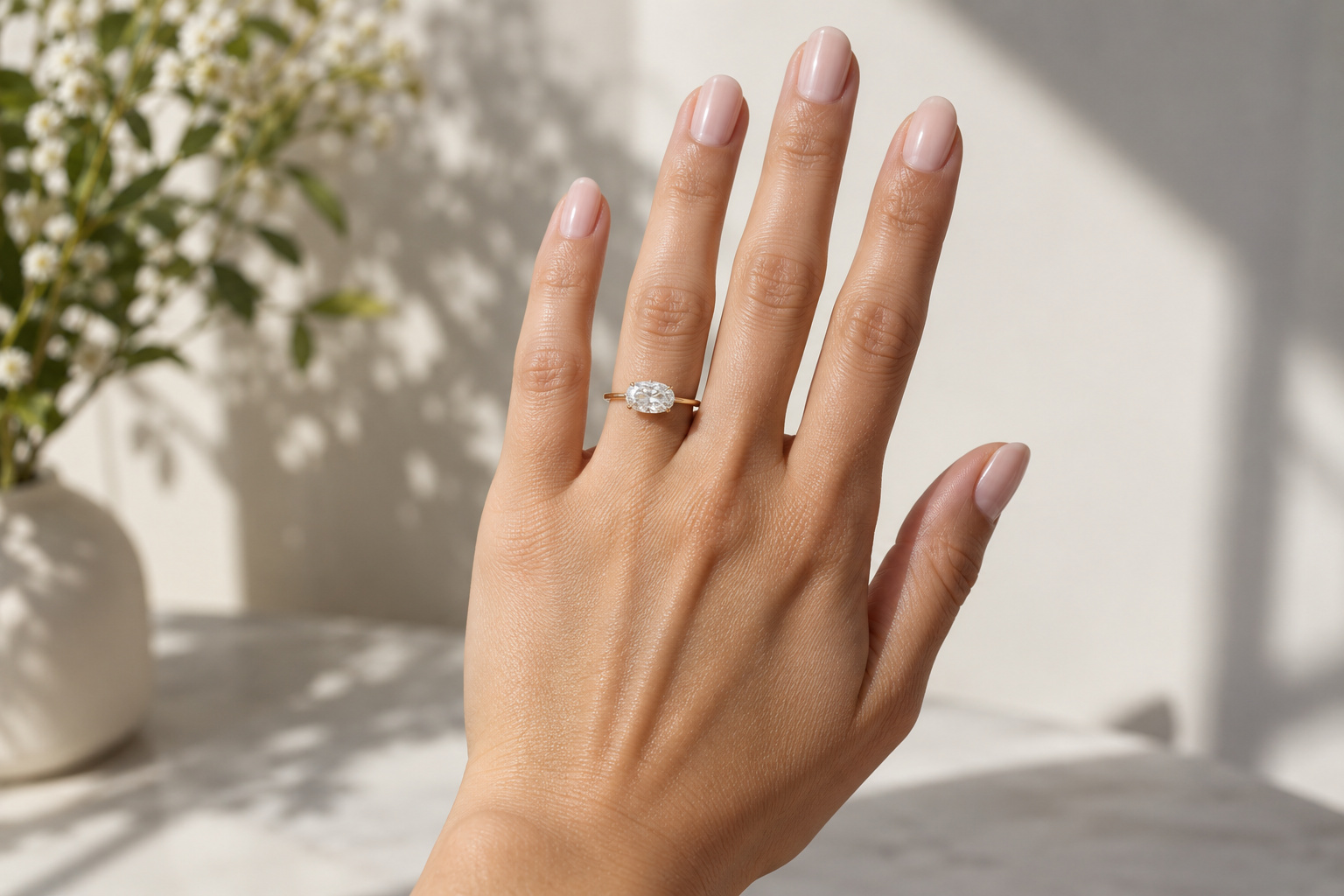
An east west engagement ring sets an elongated centre stone sideways, so its length runs across the finger instead of along it. Ovals, emerald cuts, marquises, pears, elongated radiants and elongated cushions all work; round and square stones look the same either way. Before you commit, check how far the stone spreads across the finger, how the points are protected and whether a wedding band will sit beside it.
This guide includes a few product links near the end. As an Amazon Associate, Diamond Taire earns from qualifying purchases, at no extra cost to you.
This guide explains which shapes suit an east-west setting and why, how big each one looks sideways, the setting details that matter for a horizontal stone, how to plan for a wedding band, and an honest view of whether the style will date.
At a glance
- Only elongated shapes change the look. Oval, emerald, marquise and pear show the biggest difference.
- Sideways stones span more of the finger. A 1 carat marquise set east-west covers more than half the width of an average finger.
- Points need extra protection because, set sideways, they face the neighbouring fingers.
- Plan the wedding band now, not after the ring is made; a low horizontal head can stop a straight band sitting flush.
- The style is old, not a fad. It has historical roots and has had a recent surge, so a simple design is the safest way to keep it timeless.
What an east west engagement ring is
“North-south” is the usual orientation: the long axis of an oval or emerald cut points along the finger toward the fingertip. “East-west” turns the stone 90 degrees. GIA’s oval buying guide describes it simply as an oval set horizontally across the finger instead of vertically, and notes that it can make even a modestly sized diamond appear larger and more distinctive.
The idea is far from new. A jewellery historian quoted by the trade magazine JCK traced east-west settings back to the 15th century and noted they had their biggest audience in the 1920s, when they suited the long lines of art deco design. The recent revival was helped by a widely photographed celebrity engagement ring with an east-west setting in January 2025; JCK also reported that searches for east-west rings on one large online marketplace rose 30% between December 2023 and December 2024.
Which shapes work east-west
The more elongated the shape, the more the orientation matters. Approximate sizes below are from one jeweller’s published millimetre-to-carat chart and will vary from stone to stone.
| Shape | Approx. size at 1 carat | Span across the finger when set east-west | What changes when turned sideways |
|---|---|---|---|
| Marquise | 10.5 x 5 mm | About 10.5 mm | The most dramatic change; two points face the neighbouring fingers |
| Pear | 9 x 5.5 mm | About 9 mm | Asymmetric; you choose which way the point faces |
| Oval | 8 x 5.5 mm | About 8 mm | Soft outline with no points; easy to wear |
| Emerald cut | 7 x 4.5 mm | About 7 mm | Clean, architectural, very art deco; corners are cut, so no points |
| Elongated radiant or cushion | Varies with ratio | Depends on how elongated the stone is | Works well if the stone is clearly rectangular, not nearly square |
| Round, princess, Asscher | Same both ways | No change | An east-west head makes no visible difference to a symmetrical stone |
Each shape has its own buying rules. Before choosing an orientation, read the shape guide first: marquise, pear and emerald cut.
Length-to-width ratio matters more sideways
A stone that is only slightly elongated looks almost round when set east-west, which defeats the purpose. GIA’s guides give useful reference points: for ovals it suggests ratios between about 1.30 and 1.50 to 1, and marquises between about 1.6 and 2.2 to 1. For an east-west ring, the middle-to-upper end of each range gives a clearer horizontal line. Very short stones can look stubby either way.
Ovals, pears and marquises can also show a bow-tie, a darker band across the middle. Turning the stone sideways does not remove it; it simply turns the bow-tie upright. Our guide to the oval bow-tie effect explains how to judge it.
How much of the finger will it cover? A worked example
Sizes are easier to picture against a real finger. A US size 7 ring (about UK and Australian size N to O) has an inside diameter of about 17.3 mm. Using the approximate sizes above:
- A 1 carat oval set east-west spans about 8 mm, a little under half the finger’s width.
- A 1 carat marquise spans about 10.5 mm, around 60% of the width.
- A 2 carat marquise, at about 13 x 6.5 mm, spans roughly 13 mm, about three-quarters of the width.
This is the main reason east-west rings look bigger: more of the finger’s visible width is covered by stone. It is also the main practical drawback, because a wide horizontal stone sits closer to the fingers on either side. On a smaller finger, a stone that looks balanced in a photo can feel crowded in daily wear. A ring size chart that lists inside diameters lets you run the same numbers for your own finger.
Setting details for a horizontal stone
Prongs and point protection
When a marquise or pear is set north-south, its points face the fingertip and the hand. Set east-west, the points face the neighbouring fingers, where they are more likely to be brushed or knocked. GIA notes that many settings use V-prongs to protect a marquise’s tips, and the same thinking applies to a pear’s point. Ovals, emerald cuts and radiants have no sharp points, so four or six claws, or double claws, are usually enough.
Make sure the head is designed for a horizontal stone. The claws should sit where the stone needs them, at the ends and sides of its new orientation, and the basket or gallery underneath should look intentional from the side, not like a vertical head that has been twisted.
Setting height and snagging
A lower setting snags less and sits closer to the neighbouring fingers without catching on them. A higher setting leaves more room for a band underneath but is more exposed. A bezel or half-bezel is a good option for active wearers, especially for marquise and pear points. Our guide to ring settings compares how each style wears.
Band width
A wide stone on a very thin band can look top-heavy and may twist on the finger. A slightly wider or tapered band balances a large horizontal stone and helps keep it upright. Thin bands suit smaller stones and lower settings.
Will a wedding band sit next to it?
This is the question most buyers forget. A horizontal stone extends along the line of the band, so if the head is set low, the stone or its claws can overhang where a straight wedding band wants to sit. You then have three options:
| Approach | How it works | Trade-off |
|---|---|---|
| Raise the head slightly | The stone sits above the band line so a straight band slides underneath | A taller ring that is more exposed to knocks |
| Curved or contoured band | The band bends around the stone | Usually made to match one engagement ring |
| Wear it alone or on another finger | The east-west ring serves as both rings, or bands go on the other hand | No stacked look |
Ask the jeweller to show the engagement ring with a straight band before it is finished. Our guide to matching and stacking wedding bands covers flush fit in more detail.
Who an east-west ring suits
| Suits you if | Think twice if |
|---|---|
| You want a classic shape with a less expected look | You want the ring to look exactly like most others |
| You like art deco or architectural designs | You have short or slim fingers and want a very large marquise or pear |
| You want more apparent size across the finger | You work with your hands and prefer stones with no exposed points |
| You are happy to plan the wedding band at the same time | You want any off-the-shelf straight band to sit flush |
Will an east-west ring look dated?
An honest answer: the orientation itself is unlikely to date, because it has existed for centuries and uses classic shapes. What dates is usually the styling around it. Very busy halos, extreme ratios or many trend elements combined can tie a ring to a particular year. A simple east-west solitaire or bezel in a classic metal is the lowest-risk version. If you are worried, choose a stone you would also love set north-south: a jeweller can usually reset a stone later, although that costs money and is not always simple. Our look at which engagement ring trends last uses the same test.
How to choose an east west engagement ring: step by step
- Pick an elongated shape you love in both orientations.
- Check the length-to-width ratio so the stone reads clearly as horizontal.
- Work out the span in millimetres against your finger’s inside diameter.
- Try the shape on if you can, turning a stone or mock-up both ways on your own hand.
- Choose point protection (V-prongs or bezel) for marquise and pear stones.
- Decide on setting height with the wedding band in mind.
- Ask to see the ring with a straight band, or agree a contoured band design at the start.
- Look at the side profile, not just the top, to check the head is built for a horizontal stone.
- Keep the design simple if you want it to feel timeless in twenty years.
Common mistakes
- Choosing a nearly round oval or nearly square cushion. The east-west effect almost disappears.
- Judging only from photos. Product photos are usually on long, slim fingers; your hand may show the stone differently.
- Leaving marquise or pear points exposed. Sideways, they take more knocks.
- Forgetting the wedding band. Discovering after the event that a straight band will not sit flush is an expensive problem.
- Going too big for the finger. A stone spanning most of the finger’s width can rub neighbouring fingers.
- Turning a vertical head sideways without redesigning it. The claws and gallery should suit the new orientation.
Sources this guide draws on: GIA’s 4Cs buying guides for oval and marquise diamonds; JCK trade reporting on the east-west style and its history; one jeweller’s published millimetre-to-carat chart; the US ring size standard for inside diameters.
Useful tools for this guide
Practical picks for choosing, checking and caring for jewellery. As an Amazon Associate, Diamond Taire earns from qualifying purchases, at no extra cost to you. Prices and availability are set by Amazon and may vary by country.
- Gemstones of the World by Walter Schumann (5th edition)
A classic illustrated reference to more than 1,900 gemstones.
View on Amazon - Foldable 30x Jeweller’s Loupe
Pocket magnifier for checking stones, settings and hallmarks up close.
View on Amazon - KElofoN Travel Jewellery Case
Compact case with ring rolls and earring slots so pieces do not scratch each other.
View on Amazon
Frequently asked questions
What does east west mean on an engagement ring?
It means the centre stone is set horizontally, with its long side running across the finger. The usual orientation, with the length running toward the fingertip, is called north-south.
Are east west engagement rings popular?
Yes, they have had a clear surge in interest since the mid-2020s, helped by high-profile celebrity rings. The style itself has a long history, with a particular peak in the art deco era of the 1920s.
Which shape is best for an east west ring?
Oval is the easiest to wear because it has no points. Emerald cut gives a clean art deco look, while marquise and pear give the most dramatic effect but need protection for their points. Round and square stones look the same either way.
Do east west rings snag more?
They can, because a sideways stone sits closer to the neighbouring fingers, and pointed shapes put their tips there. A lower setting, V-prongs or a bezel, and a sensible stone size keep the risk down.
Can you wear a wedding band with an east west engagement ring?
Yes, but plan it. A straight band will sit flush only if the head is high enough or the stone does not overhang the band line. Otherwise a contoured band, or wearing the band on its own finger, works well.
Can an existing ring be changed to east-west?
Often, yes. A jeweller can usually replace the head so the same stone sits horizontally, though it depends on the ring’s design and the stone’s shape. Ask for a quote and a drawing first, as costs vary.
An east-west ring is a small change with a big effect: the same classic stone, turned to look fresh. Choose an elongated shape, check the span against your finger, protect any points and settle the wedding band plan before the ring is made.