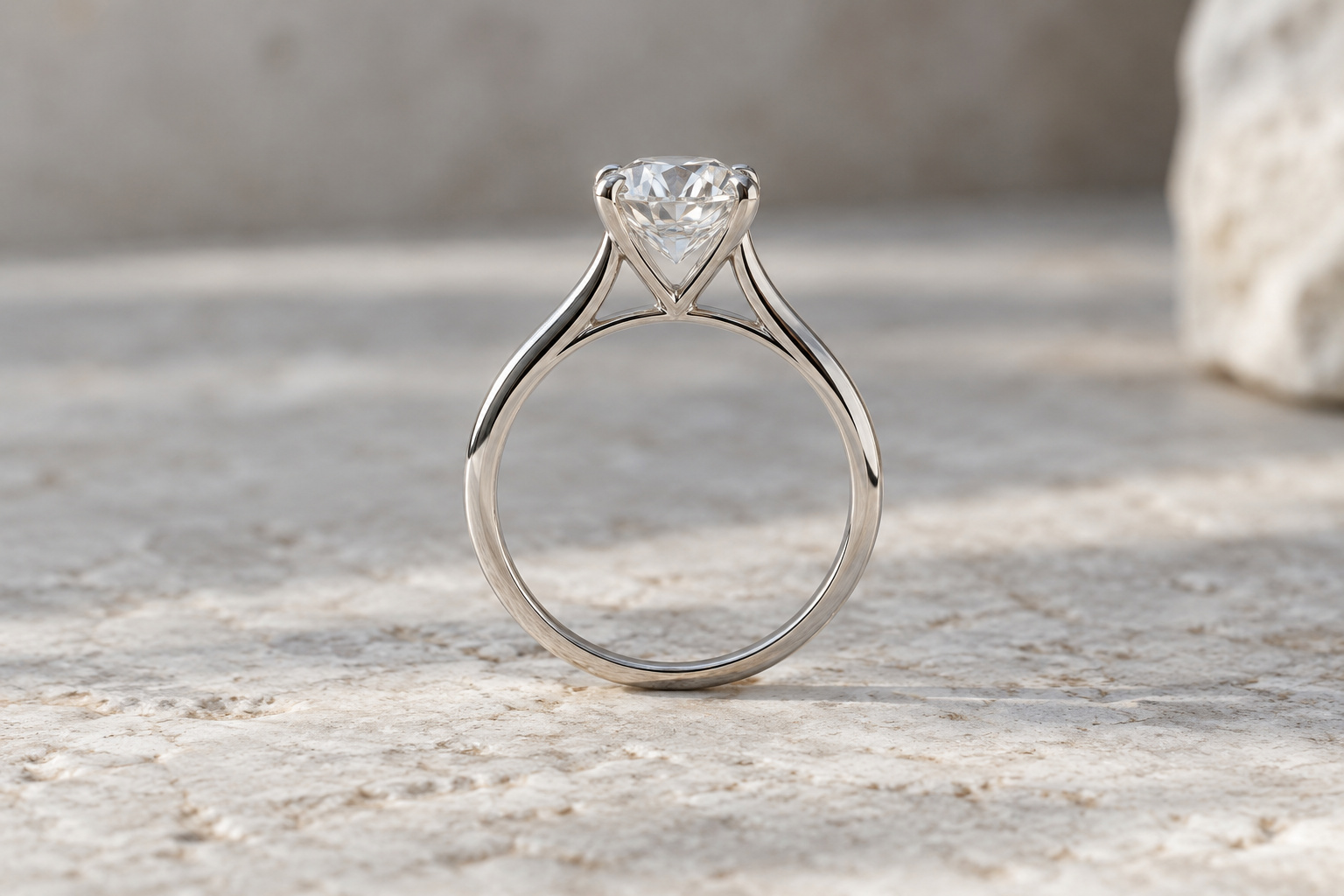
A cathedral setting is a ring design where arches of metal rise from the band on each side to support the centre stone, lifting it above the band. GIA’s guide to ring settings describes it in just those terms. The arches give the ring a tall, elegant profile and make the centre stone more prominent, but the extra height means more snagging, more knocks and more places for dirt to collect.
This guide includes a few product links near the end. As an Amazon Associate, Diamond Taire earns from qualifying purchases, at no extra cost to you.
This guide explains how a cathedral setting engagement ring is built, how it compares with low-set, basket, peg-head and bezel designs, how it affects wedding band fit, and the simple tests to do in the shop before you commit. If you are still choosing between broad setting types, start with our overview of ring settings: solitaire, halo, pavé and bezel and come back here for the detail on cathedrals.
At a glance
- What it is: the shoulders of the band sweep up into arches that meet and support the head holding the stone.
- Main benefit: the stone sits higher and looks more prominent, with an elegant, architectural side view.
- Main drawbacks: more height to catch on gloves, hair and knits, more exposure to knocks, and more nooks to clean.
- Wedding bands: because the head is lifted, a straight band can often sit close underneath, but it depends on the exact design. Always try them together.
- Best for: people who love a classic, raised look and do not work hard with their hands; less ideal for very active or hands-on lifestyles.
How a cathedral setting is built
A ring has a few named parts, and knowing them makes it easier to compare designs. GIA’s settings guide defines them like this:
- Head: the top part that holds the gem, made up of prongs or a bezel.
- Shoulders: the areas either side of the head, where the band rises towards the stone.
- Shank: the band that wraps around the finger.
- Prongs: narrow metal claws that rise from the base of the setting and bend over the edge of the stone.
In a cathedral, the shoulders are the star. Instead of the band running flat up to a head that sits on top, the band rises in two arches, one either side, which meet the head and hold it up. The name comes from the resemblance to the pointed arches of cathedral architecture. The head itself is usually a prong head, but cathedral arches can also support a bezel or a halo.
Common cathedral variations
- Plain cathedral: smooth metal arches, the cleanest and easiest to maintain.
- Pavé cathedral: small diamonds set along the arches and band. More sparkle, more upkeep, and GIA notes pavé bands can be difficult to resize.
- Hidden halo cathedral: a row of small stones circles the base of the head, below the centre stone, so it shows from the side but not face up. It adds a sparkle from the side view without changing the stone’s outline from above.
- Open or “airy” cathedral: the space under the arches is left open, letting light in from the side.
- Cathedral three-stone: arches support a centre stone with a side stone on each side; see our three-stone engagement ring guide for the stone choices.
Cathedral vs other settings
| Setting | How the stone is held | Height | Snag risk | Straight band fit | Cleaning |
|---|---|---|---|---|---|
| Cathedral | Arches rise from the shoulders to support the head | Higher | Higher | Often good, design-dependent | More nooks under the arches |
| Basket | Prongs joined by horizontal supports under the stone | Can be low or high | Lower when set low | Depends on how low it sits | Moderate |
| Low-set solitaire | Head sits as close to the finger as the stone’s depth allows | Lowest | Lowest | Often leaves a gap or needs a shaped band | Easier |
| Peg head (traditional solitaire) | A separate prong head mounted on top of a plain band | Medium to high | Medium to high | Often good | Easier |
| Bezel | A metal rim surrounds the stone | Low to medium | Low | Depends on rim size | Easy; dirt can sit at the base |
Read the table as a starting point. Height and band fit vary from ring to ring, which is why the try-on tests below matter more than any general rule.
Pros and cons of a cathedral setting
Why people choose it
- Presence. Lifting the stone makes it the clear focal point. Some retailers say it makes the stone look larger; the honest version is that it looks more prominent from the side, while the face-up size is the same.
- Support. The arches add metal under the head, which gives the head a visually solid base.
- A beautiful side view. The profile is the part people notice when the hand is relaxed, and cathedrals are designed to look good from that angle.
- Room underneath. The lifted head leaves space for a hidden halo, decorative gallery work or a wedding band to sit closer.
- Classic style. It suits round, oval and cushion shapes in particular, and works in vintage and modern designs.
What to weigh against it
- Snagging. A taller ring catches more on knitwear, gloves, hair and bedding.
- Knocks. The higher the stone, the more it is exposed to bumps on doors, desks and car doors. Diamond and sapphire cope well; softer stones such as emerald, opal or morganite are more at risk.
- Cleaning. The spaces under the arches collect soap and lotion, which dulls the stone from below.
- Practical activities. If you garden, lift weights, work with your hands or wear gloves often, a lower ring is usually easier to live with.
Cathedral settings and wedding bands
This is where cathedrals can surprise people, in a good way. Because the arches lift the head above the band, there is often room for a straight wedding band to slide in close underneath. With a very low-set solitaire, by contrast, the head can sit right on the finger and stop a straight band from touching the engagement ring, leaving a gap or needing a curved or notched band.
But “often” is the key word. A cathedral can still leave a gap if:
- the head is wide and sits low between the arches;
- the arches flare outward where they meet the band;
- there is a hidden halo or gallery detail sitting low under the stone;
- the centre stone is deep and its tip (the culet) hangs low.
The cure is simple: try the actual engagement ring with the actual wedding band, or a band of the same width and profile, before you buy either. Our guide to matching and stacking wedding bands covers flush fits, contour bands and spacing in more depth.
Try-on tests: do these in the shop
- The flush test. Slide a straight band of the width you want against the engagement ring. Look from the side: is there a gap? Can you live with it?
- The pocket test. Put your hand into a coat pocket and pull it out. A ring that catches here will catch every day.
- The hair and knit test. Run your fingers through your hair and over a knitted sleeve. Feel for any snag at the prongs or where the arches meet the head.
- The glove test. If you wear gloves for work or sport, try one on over the ring.
- The side-view check. Look at the ring at eye level with your hand relaxed. Do you love the profile? That is the view you will see most.
- The cleaning check. Look underneath. Could a soft toothbrush reach behind the arches and under the stone?
- The comfort check. Wear it for several minutes. Rest your hand flat on a table and close your fist; the shoulders should not press uncomfortably on the neighbouring fingers.
Who a cathedral setting suits, and who it doesn’t
It suits you if you want a classic, raised solitaire with an elegant side profile, your hands are not constantly busy with rough work, you would like room for a hidden halo or a closer-sitting wedding band, and you are happy to clean the ring regularly.
It may not suit you if you work in healthcare, hospitality, trades or anywhere gloves are part of daily life; you play sport or lift; you prefer something you can forget you are wearing; or you have chosen a softer gemstone that needs protection. A low-set solitaire, basket or bezel will usually be kinder in those cases. If you are still deciding what style the wearer will love, our guide on choosing an engagement ring style helps you read their taste.
Questions to ask the jeweller
- How high does the stone sit above the finger in this design, and is a lower version available?
- Will a straight wedding band sit flush, and can I try one now?
- Are the prongs part of the cathedral casting or a separate head? How easy are they to re-tip?
- Can this ring be resized, and does pavé on the arches limit that?
- What metal and finish do you recommend for this design, and why?
- How often should I bring it in for a prong check?
On metals, platinum and white gold behave differently over time in prongs and arches; our platinum vs white gold comparison explains the trade-offs.
Common mistakes
- Choosing from photos alone. Images are usually taken face up. Always ask for the side view and, ideally, try it on.
- Buying the engagement ring and wedding band separately without testing. Fit problems show up when it is too late to swap easily.
- Going taller than needed. Extra height adds snag risk without making the stone bigger face up.
- Pairing a cathedral with a fragile stone and an active lifestyle. The higher the stone, the more it gets knocked.
- Skipping maintenance. GIA notes prongs may need re-tipping and stones tightening over time. Have the ring checked regularly.
- Forgetting the underside when cleaning. Dirt under the arches dulls the stone. Warm water, mild soap and a soft brush, as GIA recommends, reach most of it; see our guide to cleaning diamonds safely.
Sources this guide draws on: GIA Guide to Engagement Ring Settings (definitions of head, shoulders, shank, prongs, cathedral and basket settings, and maintenance and resizing notes); general jewellery-trade terminology for ring parts.
Useful tools for this guide
Practical picks for choosing, checking and caring for jewellery. As an Amazon Associate, Diamond Taire earns from qualifying purchases, at no extra cost to you. Prices and availability are set by Amazon and may vary by country.
- Foldable 30x Jeweller’s Loupe
Pocket magnifier for checking stones, settings and hallmarks up close.
View on Amazon - CONNOISSEURS Premium Jewellery Cleaner
Gentle dip cleaner with a brush and tray for diamonds, gold and platinum. Check the label for stones it should not be used on.
View on Amazon - Ring Sizer Measuring Tool Kit (27 pieces)
Sizing rings plus a mandrel, to check a size at home before you buy or resize.
View on Amazon
Frequently asked questions
What is a cathedral setting ring?
It is a ring where metal arches rise from the band on each side to support the centre stone’s head, lifting the stone above the band. The arches resemble those in cathedral architecture, which is where the name comes from.
Do cathedral settings snag?
They can snag more than low-set designs because the stone and prongs sit higher. A smooth prong finish and a slightly lower head reduce the problem. Do the pocket and knit tests before buying.
Does a wedding band sit flush with a cathedral setting?
Often, because the raised head leaves room for a straight band underneath. It still depends on the head width, the arch shape and any hidden halo, so try the two rings together.
Are cathedral settings more secure?
The arches add support and metal under the head, but security depends mainly on the prongs, the workmanship and regular checks. A well-made cathedral is as secure as a well-made basket or peg head.
Does a cathedral setting make a diamond look bigger?
It makes the stone look more prominent, especially from the side, but the face-up size is set by the stone itself. A halo or a stone with a large face-up outline changes apparent size more. Our 1 carat diamond ring guide explains how size, shape and budget interact.
What is a hidden halo cathedral setting?
It is a cathedral where a row of small stones encircles the base of the head, under the centre stone. It shows from the side but not from above, so the centre stone keeps its clean outline.
A cathedral setting is a lovely, time-tested design. Choose it for the profile you love, test it against real daily life and the band it will live with, and keep the prongs checked, and it will serve you well.