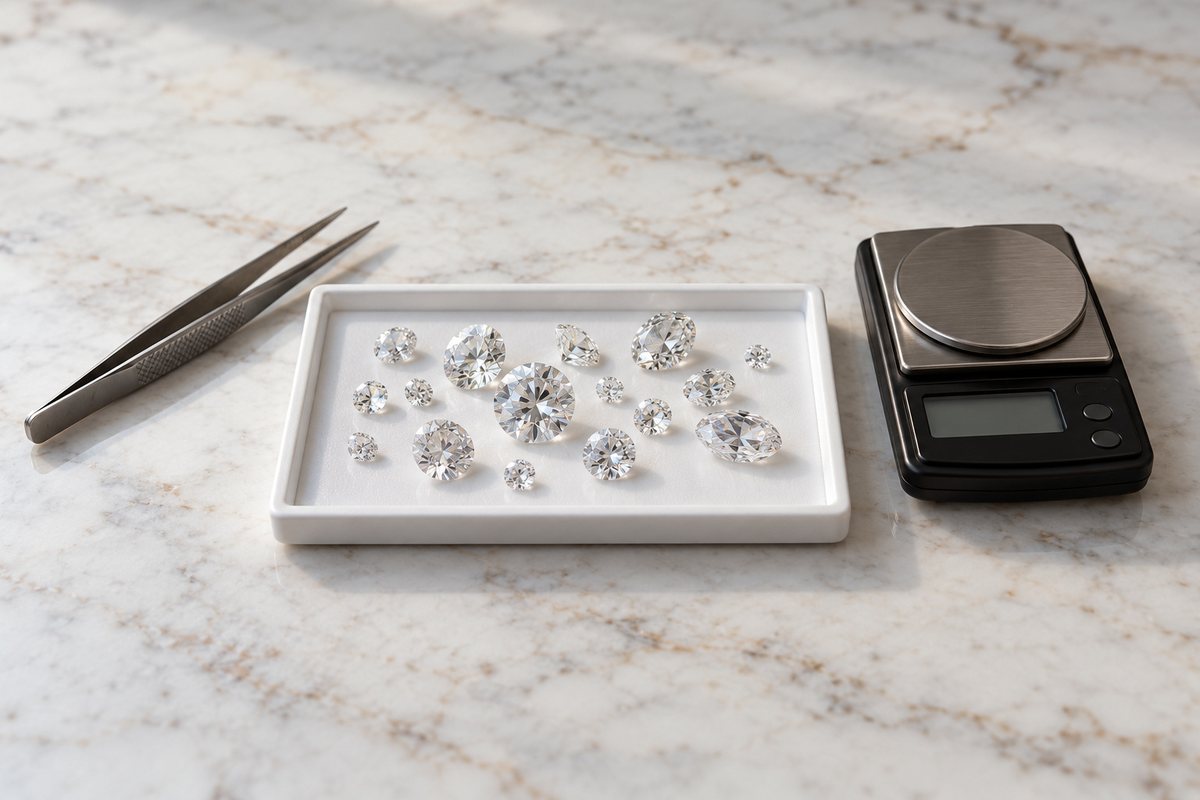
Carat weight measures how heavy a diamond is, not how big it looks. One carat equals 0.2 grams, and two diamonds of the same weight can face up at noticeably different sizes depending on their shape and how they were cut. Prices also tend to step up sharply at popular weights such as 0.50, 1.00 and 1.50 carats, so a stone sitting just below one of those “magic numbers” can look almost identical for considerably less money.
This guide explains what carat weight really is, how it relates to the size you actually see (the spread, measured in millimetres), how different shapes compare at the same weight, and how to use the price steps to your advantage without buying a poorly cut stone.
At a glance
- Carat is weight. One carat is 0.2 grams, divided into 100 points, so a 0.75 carat stone is often called a “75 pointer”.
- Size is spread. What you see from above is the face-up diameter or length and width in millimetres, and that depends on shape and cut as much as weight.
- Shape changes the look. Elongated shapes such as oval, pear and marquise tend to look larger face-up than a round or princess of the same weight.
- Magic numbers carry a premium. Prices often jump at round-number weights, so 0.90 to 0.99 carat stones can be a smart way to save money.
- Check the millimetres, not just the carats. A deep, heavy stone can carry extra weight that you pay for but never see.
What carat weight actually measures
The carat is a unit of mass used for gemstones, fixed at 200 milligrams (0.2 grams). GIA’s grading guidance explains that each carat is divided into 100 points, which is why you will see weights written to two decimal places on a grading report, such as 1.02 ct or 0.71 ct. The term comes from the carob seed, which was historically used as a counterweight on gem scales.
Weight matters because larger rough diamonds are rarer than small ones, so price per carat usually rises as weight rises. A 2 carat diamond is not simply double the price of a 1 carat diamond of the same quality; it is usually a good deal more than double, because finding a larger rough crystal of the same colour and clarity is harder. This guide on what really drives a diamond’s price covers how weight interacts with the other value factors.
Total carat weight versus centre stone weight
On jewellery with more than one diamond, sellers often quote total carat weight (often shown as “ct tw” or “TCW”). A ring described as “1 carat total weight” might have a 0.50 carat centre stone and 0.50 carats of small side stones. That ring will look and cost very differently from a ring with a single 1 carat centre. Always ask for the centre stone weight separately.
Carat weight versus visible size: why “spread” matters
When you look down at a ring, you see the top of the diamond, not its weight. Jewellers call this face-up size the spread. Two stones of identical weight can look different because some of the weight may be hidden in a deep pavilion (the lower half), a thick girdle (the outer edge) or a tall crown.
A well-proportioned round brilliant puts its weight where it helps both size and sparkle. A stone cut deep to save weight from the rough may face up smaller than expected and can also leak light, looking darker in the centre. That is why the cut grade and the measurements on the report matter as much as the carat figure. The site’s guide to diamond cut quality explains how to read proportions.
Typical face-up size of round diamonds
The figures below are approximate diameters for well-cut round brilliants, drawn from widely published carat-to-millimetre charts. Real stones vary by a few tenths of a millimetre either way, so always check the measurements printed on the grading report.
| Carat weight | Approximate diameter (round) | What to know |
|---|---|---|
| 0.50 ct | About 5.0 to 5.2 mm | Popular for earrings and petite solitaires |
| 1.00 ct | About 6.3 to 6.5 mm | The best-known benchmark; demand is high at this weight |
| 1.50 ct | About 7.3 to 7.5 mm | Noticeably larger on the hand than 1 carat |
| 2.00 ct | About 8.0 to 8.2 mm | Weight doubles from 1 carat, but diameter grows by under 2 mm |
| 3.00 ct | About 9.3 mm | A bold look; quality differences become easier to see |
Notice the pattern: doubling the weight from 1 to 2 carats does not double the visible width. Weight is spread across three dimensions (width, length and depth), so the face-up diameter grows much more slowly than the carat figure. For more on these two benchmark sizes, see the guides to the 1 carat diamond ring and the 3 carat diamond ring.
How shape changes the size you see
Shape has a big effect on spread. Elongated shapes stretch their weight over a longer outline, so they usually look larger from above than a round of the same weight. Square and step-cut shapes can carry more weight below the girdle and often look a little smaller.
| Shape (about 1 carat) | Typical face-up measurements | Looks larger or smaller than a round? |
|---|---|---|
| Round | About 6.3 to 6.5 mm across | The reference point |
| Oval | About 8 x 5.5 mm | Usually larger, thanks to its length |
| Pear | About 9 x 5.5 mm | Usually larger |
| Marquise | About 10 x 5 mm | Often the largest-looking of all |
| Emerald | About 7 x 4.5 to 5 mm | Similar or slightly larger; depends on proportions |
| Cushion | About 5.5 to 5.7 mm across | Often slightly smaller |
| Princess | About 5.5 mm across | Often smaller, as weight sits in the deep pavilion |
These are typical figures, not rules; length-to-width ratio and depth vary a lot between individual stones. If you are weighing shapes, the guide to diamond shapes and comparisons of round versus oval diamonds go deeper into the trade-offs, including the bow-tie shadow that some ovals show.
The “magic numbers” and price jumps
Diamond prices do not rise smoothly with weight. They tend to step up at weights that people like to buy and talk about: 0.50, 0.70, 0.90, 1.00, 1.50, 2.00 and 3.00 carats are common thresholds. Many price lists used in the trade are organised in weight bands, and demand bunches at the round numbers, so a 1.00 carat stone can cost noticeably more per carat than an otherwise similar 0.96 carat stone.
The visible difference is tiny. A 0.95 carat round and a 1.00 carat round of the same proportions differ by roughly a tenth of a millimetre in diameter, which nobody can see once the stone is set. Buying just below the threshold (sometimes called buying “shy”) is one of the simplest ways to save money without giving up anything you can see.
Where the steps usually fall
| If you want the look of | Consider weights around | Why it can save money |
|---|---|---|
| Half a carat | 0.45 to 0.49 ct | Avoids the 0.50 ct step |
| Three-quarters of a carat | 0.65 to 0.69 ct | Avoids the 0.70 ct step |
| One carat | 0.90 to 0.99 ct | Avoids the most heavily demanded threshold |
| One and a half carats | 1.40 to 1.49 ct | Avoids the 1.50 ct step |
| Two carats | 1.85 to 1.99 ct | Avoids the 2.00 ct step |
The size of each jump varies with colour, clarity, shape, market conditions and whether the stone is natural or lab-grown, so treat these as places to look rather than guaranteed savings. Prices change, and lab-grown pricing in particular has moved a lot in recent years. The site’s guide to the best value diamond combinations by budget shows how to balance weight against the other Cs.
The trade-off nobody mentions
If you buy a 0.98 carat stone, you will never be able to say it is “a carat”. For most people this does not matter, but some buyers care about the round number for personal reasons. Decide that before you shop. Equally, a stone sold as exactly 1.00 carat that faces up at only 6.2 mm may be carrying hidden weight in its depth; a well-cut 0.95 carat stone might actually look the same size or larger.
How to judge size properly: a step-by-step check
- Set a budget first. Know your ceiling before you fall for a weight. The guide on how much an engagement ring should cost can help you set a realistic range.
- Choose a shape. Shape decides how much spread you get per carat, so pick it before comparing weights.
- Read the measurements. On the grading report, note the diameter (for rounds) or length and width (for fancy shapes). Compare stones by millimetres, not only by carats.
- Check total depth and table. Very deep stones hide weight; very shallow stones may look large but lose brightness. Look for a sensible cut grade or, for fancy shapes, proportions within commonly recommended ranges.
- Look just under the threshold. If the round number is not important to you, search the 0.90 to 0.99 carat range (or the equivalent below other steps).
- Compare on the hand. Finger size changes perception: a 1 carat stone looks bigger on a slim finger than on a larger hand. If you can, try on similar sizes or use a printed millimetre guide.
- Consider the setting. A thin band, a halo or a bezel all change the perceived size. Each one frames a stone differently.
- Verify the paperwork. Make sure the stated carat weight matches an independent grading report, and that the report number matches the stone.
Who should prioritise carat weight, and who shouldn’t
Weight is worth prioritising if the look of a larger stone matters most to you, if the ring will be worn mainly at a distance (people see size before they see clarity), or if you prefer a simple solitaire where the centre stone carries the whole design.
Weight is less important if you value sparkle and brightness above size, if you are choosing a shape such as emerald that shows clarity and colour more openly, or if the ring has a halo or side stones that already add visual size. In those cases spending on cut quality first usually gives a better-looking result.
Common mistakes
- Comparing carats instead of millimetres. Two “1 carat” stones can differ in face-up size; the measurements tell the real story.
- Confusing total weight with centre stone weight. A “1 carat” ring with side stones can have a much smaller centre diamond.
- Paying for hidden weight. A deep or thick-girdled stone adds carats you cannot see and may look darker.
- Chasing a round number at any cost. Stretching to exactly 1.00 carat can mean giving up cut quality, which affects how the stone looks every day.
- Assuming bigger always means better value. Price per carat rises with weight, so a larger stone costs disproportionately more.
- Ignoring the grading report. Weight should be confirmed by an independent laboratory; see the guide to reading a diamond grading report.
A worked example
Imagine two round diamonds with the same colour and clarity. Stone A weighs 1.00 carat and measures 6.25 mm across because it is cut slightly deep. Stone B weighs 0.93 carats and measures 6.30 mm across thanks to better proportions. Stone B looks marginally larger face-up, will likely be brighter, and sits below the 1 carat price step. Unless the round number matters to you personally, Stone B is the better buy. Once set, nobody looking at the ring could tell which was which by weight alone.
Sources this guide draws on: GIA’s 4Cs grading guidance on carat weight and points; widely published carat-to-millimetre size charts from diamond grading and jewellery trade references; general trade practice on price bands and weight thresholds.
Frequently asked questions
How big is a 1 carat diamond in mm?
A well-cut 1 carat round brilliant usually measures about 6.3 to 6.5 mm across. Fancy shapes vary: a 1 carat oval is often around 8 x 5.5 mm, while a princess cut may be closer to 5.5 mm square. Always check the measurements on the grading report for the stone you are considering.
Does a higher carat always mean a bigger-looking diamond?
Not always. Face-up size depends on shape and cut proportions as well as weight. A deep stone can weigh more yet look the same size as, or smaller than, a lighter but better-proportioned diamond.
What are “magic numbers” in diamonds?
They are the popular weights, such as 0.50, 1.00 and 1.50 carats, where prices tend to step up because demand concentrates there. Stones just below these weights often cost noticeably less per carat while looking virtually the same once set.
Is a 0.90 carat diamond a good alternative to 1 carat?
For many buyers, yes. A 0.90 carat round is typically only a few tenths of a millimetre smaller than a 1 carat round, which is very hard to see on the hand. The main trade-off is that it is not a round “one carat”, which matters to some people.
What does “points” mean in diamond weight?
One carat is divided into 100 points. A 0.25 carat diamond is a 25 point stone, and a 1.10 carat diamond can be described as “one carat ten points”.
Do lab-grown diamonds use the same carat weight?
Yes. Carat is a unit of weight, so a 1 carat lab-grown diamond weighs exactly the same as a 1 carat natural diamond, and similar cuts give similar face-up sizes. Their prices are very different, though; lab-grown stones usually cost far less for the same weight.
Carat weight is the easiest of the 4Cs to understand and the easiest to overpay for. Compare stones by their millimetres, look just below the popular weights, and put cut quality ahead of a round number, and you will get the most visible diamond for your budget.