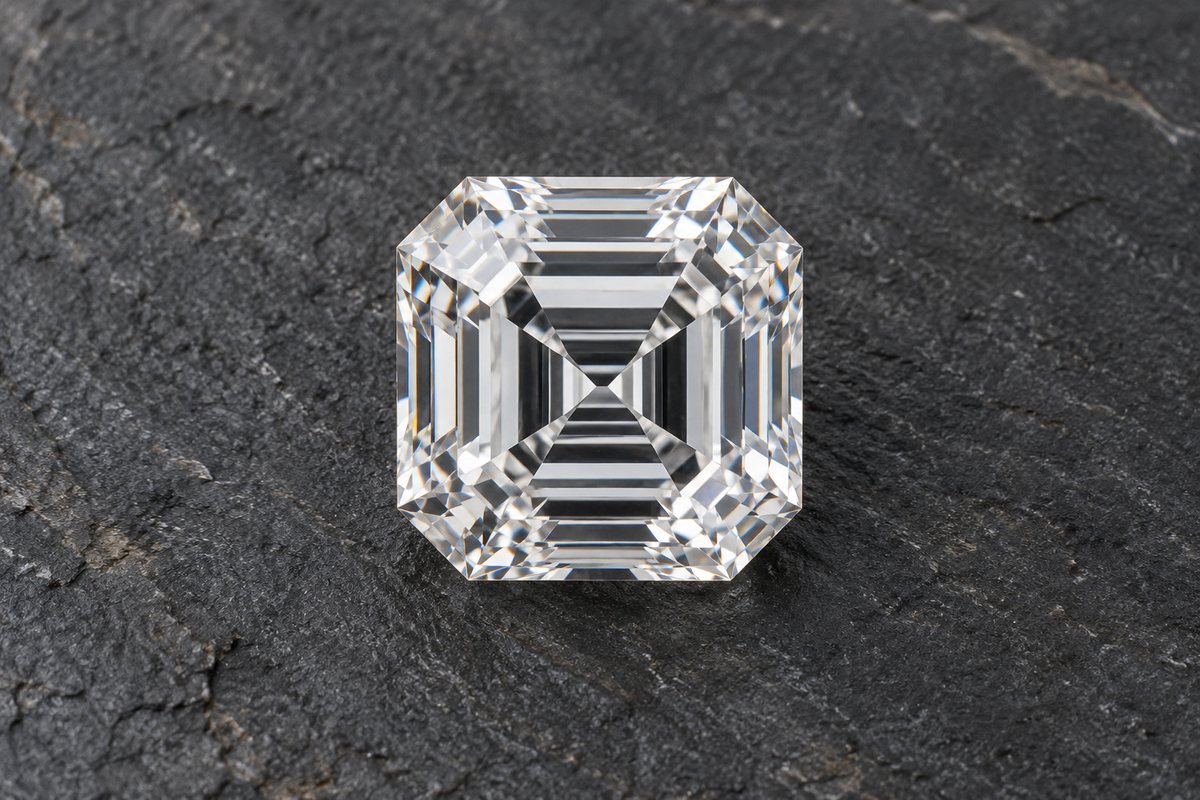
An asscher cut diamond is a square step-cut diamond with deeply cut corners, which give it a nearly octagonal outline and a pattern of concentric squares that many people describe as a “windmill” or “hall of mirrors”. It was first developed in 1902 by Joseph Asscher in Amsterdam and became a signature look of the Art Deco era.
This guide includes a few product links near the end. As an Amazon Associate, Diamond Taire earns from qualifying purchases, at no extra cost to you.
This guide explains how the asscher cut works, how it compares with the emerald cut, radiant cut and princess cut, what to look for in clarity, colour and proportions, the difference between a generic asscher and the trademarked Royal Asscher cut, and when lab-grown makes sense. It is buyer education, not a sales pitch.
At a glance
- What it is: a square step cut with large cut corners, giving an octagonal look and a deep, mirrored pattern.
- Clarity counts: step facets are long and open, so inclusions are easier to see than in brilliant cuts; many buyers aim for VS2 or better, checked face-up.
- Colour shows: step cuts hide body colour less than brilliants, so warmer grades are more noticeable.
- No official cut grade: GIA gives a cut grade only to standard round brilliants, so proportions and how the stone looks matter more than paperwork.
- Asscher vs Royal Asscher: “asscher” is a general style anyone can cut; the Royal Asscher cut is a patented version made only by the Royal Asscher company.
What is an asscher cut diamond?
According to GIA’s education material, the asscher cut was first developed in 1902 by Joseph Asscher. The original design has 58 facets arranged in three rows of steps on the crown and three on the pavilion, with larger, wider-set facets than a typical emerald cut, and a nearly octagonal outline. GIA notes that the design also used rough diamond crystals efficiently, keeping more weight than some other cutting styles of the time.
The look is quiet and geometric rather than glittery. Instead of hundreds of tiny sparkles, a well-cut asscher shows broad flashes of light and dark that move across the stone in rings of steps, drawing the eye down into the centre. The corners are cut away, which is why the stone looks octagonal from above even though it is classed as a square shape.
A short history worth knowing
GIA’s history notes connect the Asscher family to two of the most famous diamonds ever cut: Cullinan I and Cullinan II, both cut from the same enormous rough diamond and now part of the British Crown Jewels. The asscher cut itself became popular during the Art Deco movement after the First World War, which is why you will often find it in antique and vintage jewellery from the early twentieth century. If antique pieces interest you, the guide to antique diamond jewellery periods and cuts explains what to check.
The Royal Asscher cut
GIA explains that Edward Asscher, Joseph’s grandson, later developed a more brilliant version known as the Royal Asscher cut. It has 16 more facets than the original 58, added as two extra rows of eight on the pavilion, with narrower rows to keep the classic look. GIA notes that this version is protected by an international patent, that the Royal Asscher company limits the range of angles used, and that it is the only company allowed to cut a Royal Asscher stone.
In practice this means most asscher cut diamonds you see for sale are generic asscher-style cuts made by many different cutters, each deciding their own proportions and angles. That is not a bad thing, but it does mean quality varies more widely, and the name alone tells you little.
Asscher vs emerald vs radiant vs princess
The asscher is often confused with other square or rectangular cuts. The table below compares them side by side.
| Feature | Asscher | Emerald | Square radiant | Princess |
|---|---|---|---|---|
| Outline | Square with large cut corners (near octagonal) | Usually rectangular with cut corners | Square or rectangular with small cut corners | Square with sharp, pointed corners |
| Facet style | Step cut | Step cut | Mixed (brilliant-style facets) | Brilliant-style |
| Look | Concentric squares, mirrored depth | Long “hall of mirrors” flashes | Lively sparkle, crushed-ice to larger flashes | Bright, busy sparkle |
| Shows inclusions | Easily | Easily | Less easily | Less easily |
| Shows body colour | More | More | Less | Less |
| Corner vulnerability | Lower (corners cut away) | Lower (corners cut away) | Lower (corners trimmed) | Higher (sharp points) |
| Era feel | Art Deco, vintage | Classic, tailored | Modern | Modern |
If you like the step-cut look but want something longer on the finger, see the guide to emerald cut engagement rings. If you like the square outline but want more sparkle, a radiant cut or princess cut may suit you better. The overview of diamond shapes puts all of them in context.
Clarity: why it matters more for an asscher
GIA’s clarity guidance explains that clarity characteristics are typically easier to see in step cuts such as the emerald cut than in round brilliants, because the long, rectangular facets do not break up and disguise inclusions in the same way. The asscher shares that open, step-cut structure.
That is why many buyer guides suggest aiming for VS2 or better in an asscher, and looking very carefully at SI grades. Treat that as a starting point, not a rule. The real test is whether the stone looks clean face-up at a normal viewing distance, and where any inclusion sits. A small crystal near a corner may be invisible in a setting, while the same crystal in the centre of the table can be the first thing you notice. The guide to choosing the right diamond clarity explains the grades in more depth.
Colour: how white does it need to be?
Step cuts return light in broad flashes rather than scattering it, so they mask body colour less than brilliant cuts do. A grade that looks white in a round brilliant may show a little warmth in an asscher, especially in larger sizes and in white metal.
A sensible approach is to look at the stone next to others of different grades in the metal you plan to use. Warmer colour grades can look lovely in yellow or rose gold, which reflects some colour into the diamond anyway. For how the scale works, see how to choose a diamond colour grade.
Proportions and the windmill pattern
Because GIA does not give a cut grade to fancy shapes such as the asscher, you will not find an official “Excellent” cut grade on the report. You will find measurements, depth percentage, table percentage, polish and symmetry. GIA’s article stresses that angles and proportions are critical to the beauty of both the original and Royal Asscher versions.
Many retailer guides suggest roughly square outlines (length-to-width ratio close to 1.00, often up to about 1.05), with depth and table percentages in the low to high sixties and high fifties to mid sixties respectively. These ranges are trade conventions rather than an official standard, and they differ from source to source. Use them to rule out extremes, not to choose between two good stones.
What matters more is what you can see:
- A clear, centred pattern: the steps should form even, concentric squares, with the corner facets creating a crisp “X” or windmill effect.
- Good contrast: a mix of bright and dark flashes, without a large dull or glassy centre.
- Square outline: unless you prefer a slightly rectangular look, check that the ratio reads as square to your eye.
- Sensible spread: asschers tend to be cut fairly deep, so they can look smaller face-up than some other shapes of the same carat weight. Compare by millimetre size, not carat alone.
Natural or lab-grown asscher?
Asscher-style cuts are available in both natural and lab-grown diamond. Lab-grown diamonds are real diamonds with the same chemical and physical properties, and they are generally priced well below natural diamonds of similar appearance, which lets some buyers choose higher clarity and colour grades, which this cut rewards. Natural diamonds tend to hold more of their original price on resale, though resale of any diamond is usually well below retail. The guide to lab-grown vs natural diamonds explains the trade-offs honestly.
Asscher buying checklist
- Get an independent grading report and read it properly; the guide to reading a diamond report shows what each line means.
- Check the shape description on the report: labs may describe similar stones as asscher, square emerald or a cut-cornered square step cut. Judge the stone, not the label.
- Confirm the length-to-width ratio reads as square to you.
- Review clarity face-up with photos or video, not just the grade; locate any inclusion.
- Compare colour against other stones in the metal you plan to use.
- Look for the windmill pattern: even, concentric steps and a crisp X from corner to corner.
- Compare millimetre size, not just carat weight, because deep asschers can face up small.
- Ask whether it is a Royal Asscher or a generic asscher-style cut, and expect the description and paperwork to match.
- Confirm origin and treatment (natural, lab-grown, any treatment) in writing.
- Choose a setting that protects the corners, such as four double prongs, corner V-prongs or a bezel.
Who an asscher suits, and who it may not
A good fit if you love Art Deco and vintage design; prefer depth and calm, mirrored light over glitter; want a square stone with protected corners; or plan to pair it with baguettes or other step-cut side stones.
Think twice if maximum sparkle is your priority; you want the largest possible look for your carat weight; or your budget pushes you towards lower clarity grades, which are less forgiving in step cuts. A square radiant can give a similar outline with more sparkle and more forgiveness.
Common mistakes
- Buying on clarity grade alone. Two VS2 asschers can look very different depending on where the inclusions sit.
- Assuming “asscher” means Royal Asscher. The generic style and the patented cut are not the same.
- Comparing by carat weight. A deep asscher can face up smaller than you expect. Compare millimetre sizes.
- Ignoring colour in white metal. Warmth that hides in a round can show in a step cut.
- Treating trade proportion ranges as official grades. They are a guide, not a standard.
- Accepting a rectangular stone you did not want. A ratio above about 1.05 starts to look less square to many eyes.
- Choosing a setting that hides the shape. Heavy claws or a busy halo can blur the octagonal outline you paid for.
Sources this guide draws on: GIA 4Cs education articles on the asscher cut and on diamond clarity, GIA grading report guidance on cut grades, and published retailer proportion guides used only for general trade ranges.
Asscher cut diamond FAQs
Is an asscher cut the same as a square emerald cut?
They are close relatives, both square step cuts with cut corners. The asscher usually has larger corners, a more octagonal outline and a deeper pavilion that creates its concentric “windmill” look, while a square emerald cut often has smaller corners and a flatter appearance.
Do asscher cut diamonds sparkle?
They sparkle in broad flashes rather than many small sparkles. Many people describe the effect as looking into a hall of mirrors. If you want lots of fiery sparkle, a radiant or princess cut will give you more.
What clarity is best for an asscher cut?
Many buyers start at VS2 because step cuts show inclusions more readily. The better test is whether the stone looks clean to your eye face-up and where any inclusion is located.
Are asscher cut diamonds more expensive?
Not automatically. Price depends on carat, colour, clarity, cut quality and whether it is natural or lab-grown. A Royal Asscher stone may be priced differently from a generic asscher because it is a protected, branded cut. Prices change, so compare stones of similar size and grades.
Do asscher cuts look smaller than other shapes?
They can. Asschers are often cut quite deep, so more weight sits below the girdle and the stone may face up smaller than a round or princess of the same carat weight. Compare millimetre measurements.
An asscher rewards patience. Choose clean-looking clarity, colour that suits your metal and a crisp, even windmill pattern, and you will have a square diamond with real depth and a century of style behind it.
Useful tools for this guide
Practical picks for choosing, checking and caring for jewellery. As an Amazon Associate, Diamond Taire earns from qualifying purchases, at no extra cost to you. Prices and availability are set by Amazon and may vary by country.
- Foldable 30x Jeweller’s Loupe
Pocket magnifier for checking stones, settings and hallmarks up close.
View on Amazon - CONNOISSEURS Premium Jewellery Cleaner
Gentle dip cleaner with a brush and tray for diamonds, gold and platinum. Check the label for stones it should not be used on.
View on Amazon - Ring Sizer Measuring Tool Kit (27 pieces)
Sizing rings plus a mandrel, to check a size at home before you buy or resize.
View on Amazon