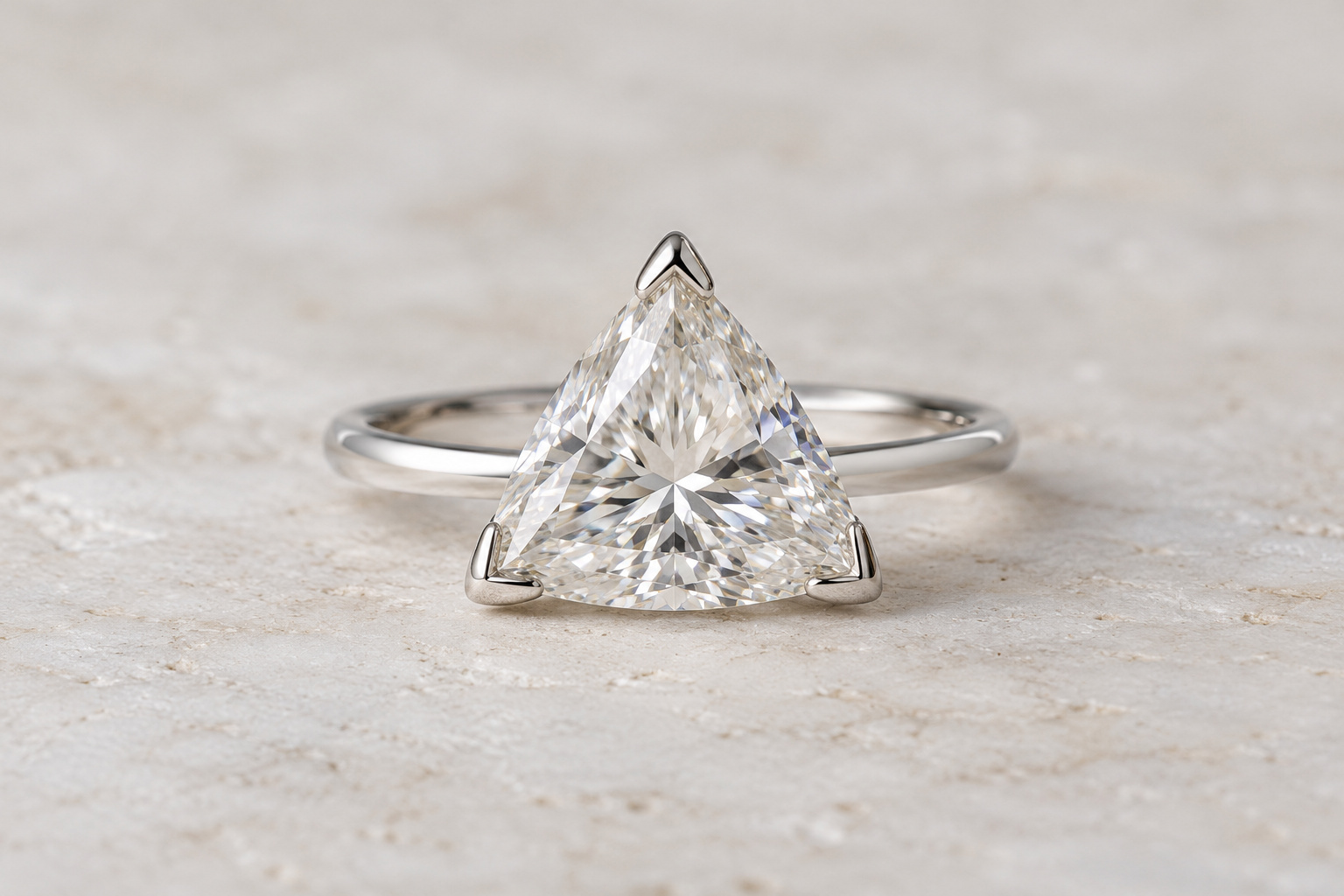
A trillion cut diamond is a triangular diamond, usually cut with brilliant-style facets, with three equal sides that are either straight or gently curved. Most trillions are used as side stones beside a larger centre diamond, but a well-cut curved trillion also makes a striking solitaire. Its sharp points are its weak spot, so the setting matters as much as the stone.
This guide includes a few product links near the end. As an Amazon Associate, Diamond Taire earns from qualifying purchases, at no extra cost to you.
This guide covers the names (trillion, trilliant, triangle), curved versus straight sides, how big a trillion really looks for its carat weight, the cut problems to watch for, the settings that protect the corners, and a step-by-step checklist for buying one as a centre stone or as a matched pair.
At a glance
- Trillion, trilliant and triangle are used loosely for the same family of triangular diamonds. Judge the actual stone, not the name.
- Curved sides suit centre stones; straight sides suit side stones that sit snugly against a centre diamond.
- Measure in millimetres, not carats. Published size charts disagree, and two stones of the same weight can look quite different.
- GIA gives no overall cut grade for triangles, so you have to judge brightness, depth and symmetry yourself.
- Protect the three points with V-prongs or a bezel, especially on a ring worn every day.
Trillion, trilliant or triangle: what the names mean
Triangular diamonds are not new. According to GIA, they first appeared in the 1500s. Brilliant-cut versions became popular in the 1960s with a variation called the trillion, and in 1978 a further variation called the trilliant arrived, developed as a triangular version of the radiant cut.
Today, sellers use trillion, trilliant and triangle more or less interchangeably. GIA notes that a triangle, trillion or trilliant can have flat sides (sometimes with cut-off corners) or curved sides, and may be faceted as a brilliant, a step cut or a mix of both. A grading report will describe the shape and cutting style; the name on a listing is just a label.
If you are still deciding on a shape, our guide to diamond shapes compares the ten most common ones.
Curved sides versus straight sides
The single biggest choice with a trillion is the outline. It changes how the stone looks, how it fits next to other stones and how much it costs to match.
| Feature | Curved (convex) trillion | Straight-sided trillion | Cut-corner triangle |
|---|---|---|---|
| Look | Fuller, softer triangle | Crisp, geometric, sharp | Triangle with small flat tips |
| Typical use | Centre stones and pendants | Side stones beside a centre diamond | Side stones and modern designs |
| Faceting | Usually brilliant | Brilliant, step or mixed | Brilliant, step or mixed |
| Corner risk | High at the three points | High at the three points | Lower, because the tips are blunted |
| Fit beside a centre stone | Can leave gaps against a straight edge | Sits flush against straight-edged centres | Depends on the design |
The International Gem Society notes that rounded sides are generally preferred for centre stones, while flat sides give a stronger geometric look. Curved sides also add a little visible area, which helps a centre trillion look full rather than spiky.
Trillion as a centre stone or as side stones
As side stones
This is where most trillions end up. A pair of straight-sided trillions points the eye toward the centre stone and makes the whole ring look wider. Triangles are a classic frame for marquise, oval, princess, round and emerald cut centres. Our three stone engagement ring guide covers how to balance centre and side-stone sizes, and compares toi et moi designs.
For side stones, the main job is matching. The two trillions should be close in millimetre size, colour, brightness and outline. A slight mismatch is far more visible in a pair than in a single stone, which is why matched pairs often cost more than two single stones of the same weight.
As a centre stone
A trillion solitaire is unusual, which is part of its appeal: it stands out without being fussy. It also asks more of the buyer. With the corners exposed and no cut grade to rely on, you need to see the stone, check the proportions and choose a protective setting. A curved trillion of a reasonable depth is usually the safer choice for a centre stone.
How big does a trillion look? Size in millimetres
Trillions are often described as looking large for their weight, because they are cut relatively shallow and the eye reads the distance from point to point. But the weight-to-size relationship is less predictable than for a round. The three published millimetre-to-carat charts checked for this guide, all from jewellery sellers, give noticeably different figures:
| Side length (mm) | Chart A (approx. carats) | Chart B (approx. carats) | Chart C (approx. carats) |
|---|---|---|---|
| 5 x 5 | 0.33 | 0.42 | Not listed |
| 6 x 6 | 0.50 | 0.70 | Not listed |
| 7 x 7 | 0.75 | 1.10 | About 1.00 |
| 8 x 8 | 1.00 | 1.75 | Not listed |
The spread comes mostly from depth: a deeper stone carries more hidden weight in the pavilion. Reasonable takeaways are that a 1 carat trillion usually measures somewhere around 7 to 8 mm a side, and that you should always ask for the actual measurements.
A worked example: trillion versus round
A 1 carat round brilliant is about 6.3 to 6.4 mm across. A 1 carat trillion of about 7 mm a side sounds bigger, and in one sense it is: its widest span is longer. But a triangle covers less area than a circle of similar width. An equilateral triangle 7 mm a side covers roughly 21 square millimetres, while a 6.4 mm circle covers roughly 32. So a trillion looks larger in outline and length, not in total surface. That is fine, as long as you know what you are comparing.
Cut quality: what to check when there is no cut grade
GIA issues an overall cut grade only for round brilliants, and most other laboratories do not grade cut on triangles either. On a trillion report you will see measurements, depth and table percentages, polish and symmetry, but no single verdict on how well it handles light. Words such as “ideal” or “excellent” on a listing for a triangle are the seller’s own description. Our guide to diamond cut quality explains why this matters for every fancy shape.
| What to check | Suggested range or sign | Problem it avoids |
|---|---|---|
| Total depth | About 32% to 48% (International Gem Society guidance) | Too shallow leaks light; too deep looks dark and small |
| Table | About 50% to 70% of width | Very large tables can look glassy |
| Length-to-width ratio | 1.00 to 1.10 | A lopsided or stretched triangle |
| Symmetry of outline | Three equal sides and angles; curves equally rounded | A visibly uneven shape, especially in pairs |
| Face-up appearance | Even sparkle across the stone, no dull centre | A “window”: a washed-out area you can see through |
A window is the most common trillion fault. Because these stones are cut shallow to gain face-up size, a poorly cut one can show a pale, see-through patch in the middle where light passes straight out of the bottom. Hold the stone (or watch a video) against a patterned background: if you can read the pattern through the centre, the window is real.
Colour and clarity
Brilliant-cut trillions are good at hiding small inclusions, so eye-clean stones in the SI range are common. Colour is a different story: shallow stones can show body colour more readily. As one gem education source suggests, H or better tends to look white in platinum or white gold, while J or better can work in yellow or rose gold. More detail is in our guides to clarity and colour grades.
One clarity point is specific to trillions: avoid inclusions or feathers that reach the points. A weak spot in the corner of a pointed stone raises the risk of a chip.
Protecting the corners: settings compared
Diamond is very hard but it can still chip, and a pointed corner concentrates any knock in one tiny area. Jewellers routinely protect trillion points, and the choice of setting changes both the look and the risk.
| Setting | How it holds the stone | Corner protection | Best for |
|---|---|---|---|
| V-prongs (chevron prongs) | A V-shaped claw wraps each point | Good | Centre stones and side stones where you want the outline visible |
| Full bezel | A metal rim surrounds the whole edge | Best | Active wearers and everyday rings |
| Three single prongs at the points | One small claw at each tip | Limited | Pendants and earrings that take fewer knocks |
| Shared or half bezel | Metal along two sides and the points | Good | Side stones that sit tight against the centre |
The International Gem Society recommends V-prongs or a bezel for trillions and notes that bezels also snag less on clothing. For more on how each setting style wears over time, see our guide to ring settings.
How to buy a trillion cut diamond: step by step
- Decide its job. Centre stone, matched pair of side stones, pendant or earrings.
- Choose curved or straight sides to suit that job and the shape of any centre stone.
- Set a size target in millimetres, not just carats, and ask for exact measurements for every stone you consider.
- Check depth, table and ratio against the ranges above, and ask for a video to look for a window.
- Look at the points under magnification for chips, feathers or inclusions.
- For pairs, compare side by side for size, colour, outline and brightness.
- Ask for an independent grading report on a centre stone; small side stones often come without one, so get the seller’s written description.
- Agree the setting before you buy and confirm the jeweller will use V-prongs or a bezel on every point.
- Read the return terms, since trillions are harder to swap than rounds.
Common mistakes
- Buying by carat weight alone. With trillions, two 1 carat stones can differ by a millimetre a side or more.
- Trusting “ideal cut” on a listing. GIA does not grade cut on triangles, so the phrase is the seller’s own opinion.
- Ignoring the window. A shallow trillion can look big in photos and lifeless in person.
- Leaving points exposed. Thin single prongs at the tips look delicate but protect little on a ring.
- Mismatched side stones. A slight size or colour difference between a pair is easy to see once set.
- Pairing curved trillions with a straight-edged centre without checking how the edges meet; gaps can look accidental.
Sources this guide draws on: GIA’s 4Cs articles on diamond shapes and gem cutting style definitions; the GIA Museum’s notes on trilliant gems; International Gem Society guidance on buying trillion cut diamonds; PriceScope’s trillion cut reference; published millimetre-to-carat charts from three jewellery sellers.
Useful tools for this guide
Practical picks for choosing, checking and caring for jewellery. As an Amazon Associate, Diamond Taire earns from qualifying purchases, at no extra cost to you. Prices and availability are set by Amazon and may vary by country.
- Foldable 30x Jeweller’s Loupe
Pocket magnifier for checking stones, settings and hallmarks up close.
View on Amazon - CONNOISSEURS Premium Jewellery Cleaner
Gentle dip cleaner with a brush and tray for diamonds, gold and platinum. Check the label for stones it should not be used on.
View on Amazon - Ring Sizer Measuring Tool Kit (27 pieces)
Sizing rings plus a mandrel, to check a size at home before you buy or resize.
View on Amazon
Frequently asked questions
What is the difference between a trillion and a trilliant cut?
According to GIA, the trillion was a 1960s brilliant-cut triangle and the trilliant arrived in 1978 as a triangular version of the radiant cut. In everyday selling the names are used interchangeably for triangular brilliants. Judge the outline, faceting and proportions of the actual stone.
Are trillion cut diamonds good for engagement rings?
Yes, if they are set well. As side stones they are a classic choice. As a centre stone, choose a curved trillion with sound proportions and protect all three points with V-prongs or a bezel.
Do trillion cut diamonds chip easily?
They are no softer than other diamonds, but their sharp points are more exposed to knocks, so they are more likely to chip than a round. A protective setting and avoiding inclusions near the points reduce the risk a great deal.
How big is a 1 carat trillion diamond?
Usually around 7 to 8 mm on each side, but published charts disagree because depth varies. Always ask for the actual measurements rather than relying on a chart.
How much is a trillion cut diamond worth?
Like any diamond, value depends on carat, colour, clarity, cut quality and whether it is natural or lab-grown. Matched pairs usually cost more than two unmatched stones because matching takes time and choice. Compare several listings of similar measurements and grades, as prices change.
Do trillion diamonds sparkle?
A well-cut brilliant trillion can be very lively. A poorly cut, overly shallow one may show a dull window in the centre, so check a video or view it in person before buying.
A trillion is a confident, geometric choice that works beautifully beside a centre stone and, with the right setting, on its own. Buy by millimetres, check for a window, and make sure every point is protected.