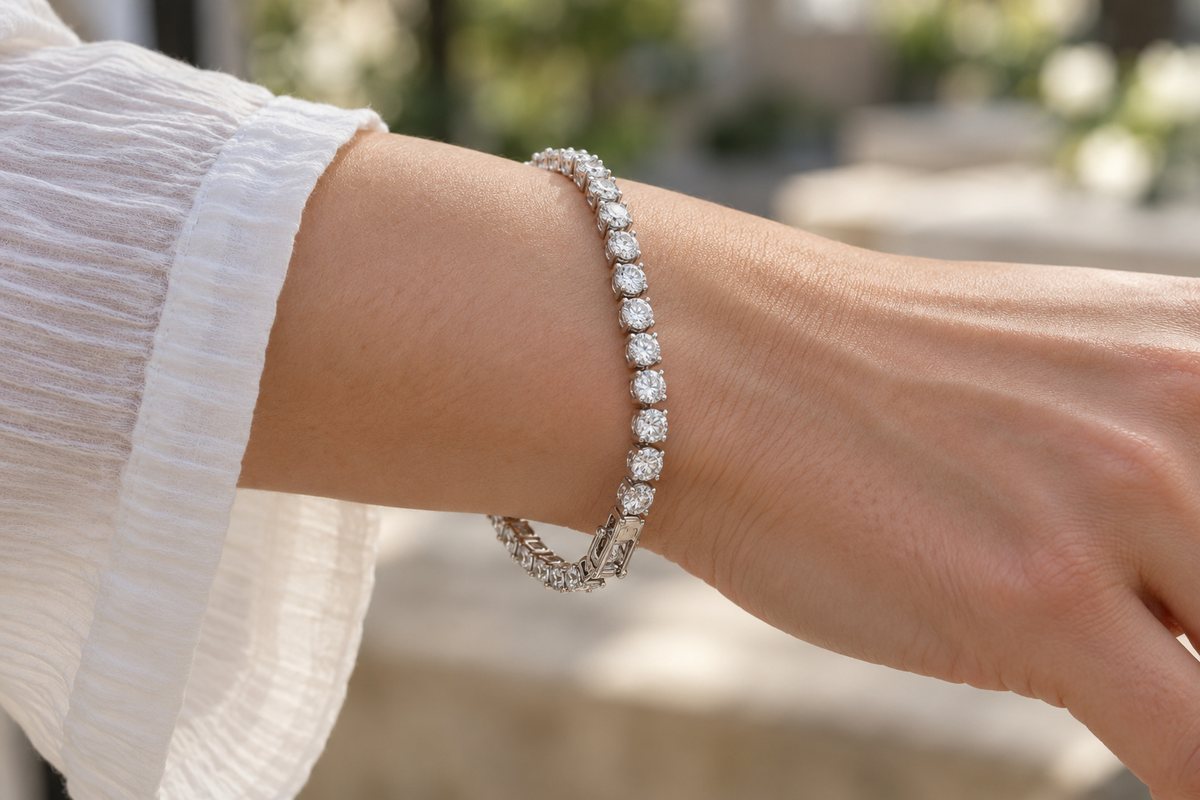
A tennis bracelet is a flexible line of individually set, usually matching diamonds or gemstones running all the way around the wrist. What makes a good one last is mostly not the stones: it is a secure clasp with at least one safety catch, well-made links that flex without gaps, and prongs or settings sized for the stones. Get those right, then choose total carat weight, stone quality and lab-grown or natural to suit your budget.
This guide explains each of those choices in plain terms, including clasp types, four-prong vs three-prong vs bezel settings, what “total carat weight” really means, how lab-grown and natural tennis bracelets compare, gold and platinum options, how to check flexibility and stone matching before you buy, and how tennis necklaces differ.
At a glance
- Security first: look for a box clasp plus at least one safety catch (a figure-eight or side latch); two independent catches is better.
- Total carat weight (ctw) is the combined weight of every stone, not the size of each one. The same ctw can mean many tiny stones or fewer bigger ones.
- Settings: four-prong “basket” links show the most sparkle; three-prong links look lighter; bezels are the most protective.
- Lab-grown vs natural: lab-grown diamond tennis bracelets usually cost far less for the same look; natural stones are rarer and hold more resale interest, though resale is never guaranteed.
- Check in hand: lay it flat, drape it over a finger and look along the line for gaps, kinks, tilted stones and colour mismatches.
What a tennis bracelet is, and where the name came from
Line bracelets of matching stones existed long before they had this name. The term “tennis bracelet” is commonly linked to tennis champion Chris Evert, whose slim diamond line bracelet came off during a US Open match, most likely in 1978, and who stopped play to find it. Research into newspaper archives suggests the phrase itself did not appear in print until the mid-1980s, so the story is better seen as popularising the style than inventing the name.
That story still carries a useful lesson: tennis bracelets are worn every day and move constantly, so the clasp and the links take far more strain than a ring’s setting does. A beautiful bracelet with a weak clasp is a loss waiting to happen.
Clasps and safety catches
The clasp is the single most important part of a tennis bracelet. Most good bracelets use a box clasp backed by one or more safety devices.
| Clasp or safety | How it works | Pros | Cons |
|---|---|---|---|
| Box clasp (tongue and box) | A folded metal tongue clicks into a hollow box | Neat, nearly invisible in the line of stones | Tongue can lose tension over time; never rely on it alone |
| Figure-eight safety | A small hinged loop flips over a post on the far side of the clasp | Simple, effective back-up; easy to check | Can be fiddly for some fingers |
| Side safety latch | One or two small hinged latches on the side of the box clasp | Discreet; two latches give double back-up | Small parts that need checking for wear |
| Lobster or spring-ring clasp | A spring-loaded hook on a ring | Common on lighter or fashion pieces | Less secure and less discreet for fine diamond bracelets |
A practical rule: a bracelet with a box clasp and two independent safety catches (for example, a figure-eight plus a side latch) gives you three things that would all have to fail before it falls off. Close every catch every time you put it on.
Link settings: four-prong, three-prong, bezel and more
Each stone sits in its own link, and the way it is held affects sparkle, comfort and durability.
| Setting | Look | Security | Best for |
|---|---|---|---|
| Four-prong (basket) | Classic; stones look square-framed and bright | Very good; four points of contact | Everyday wear and most budgets |
| Three-prong (often called martini or V-link) | Lighter, more continuous line of sparkle | Good when well made; fewer contact points | A delicate, “more diamond, less metal” look |
| Two-prong / shared prong | Stones sit close together | Lower; a bent prong can affect two stones | Careful wearers who want maximum sparkle |
| Bezel | Each stone ringed in metal; smooth | Highest; stones and edges protected | Active wearers and stacking with watches |
| Channel / illusion | Stones held between rails or set in reflective plates | Good (channel); varies (illusion) | Low-profile wear; illusion makes small stones look larger |
Whatever the setting, the prongs should be even, cover the edge of each stone without bulk, and not catch on knitwear. If a bracelet snags on a jumper in the shop, it will snag at home too.
Total carat weight vs stone size
Tennis bracelets are almost always sold by total carat weight (ctw or tw), which is the combined weight of all the stones. The same ctw can look very different depending on how many stones it is spread across.
A worked example: in a 7-inch (about 18 cm) bracelet, a 3 ctw design might use roughly 60 stones of about 0.05 carats each, while a 5 ctw design of the same length might use roughly 50 stones of about 0.10 carats. The second is not just “more carats”: each stone is twice the weight and visibly larger, so the look is much bolder. And a shorter bracelet with the same stones will have a lower ctw. That is why the ctw number alone tells you little.
When comparing bracelets, ask for:
- The number of stones and the approximate weight or millimetre size of each.
- The bracelet length, because the same stone size gives a higher ctw on a longer bracelet.
- Whether the ctw is exact or rounded. The US Federal Trade Commission’s guidance says that when a fractional weight is used, sellers should clearly disclose that it is not exact; in many countries a stated tolerance is normal.
Bracelet length and fit
Measure your wrist snugly with a soft tape, then add about 1 to 2 cm for a comfortable fit. Too loose and the bracelet slides over your hand and takes more knocks; too tight and the clasp is under constant strain. Many jewellers can add or remove a link to adjust the length.
Lab-grown vs natural tennis bracelets
Lab-grown diamonds are real diamonds with the same chemistry and physical properties as mined ones, and a lab-grown diamond tennis bracelet usually costs a fraction of a natural one with the same ctw and quality. Natural stones are rarer and more traditional, and some buyers value that. For an honest look at the trade-offs, see lab-grown vs natural diamonds.
| Factor | Lab-grown diamond tennis bracelet | Natural diamond tennis bracelet |
|---|---|---|
| Price for the same ctw and quality | Usually much lower | Higher |
| Stone matching | Often easier to match colour and clarity across many stones | Good matching takes more sorting and costs more |
| Disclosure | Should be clearly described as laboratory-grown or laboratory-created | Described as natural or simply diamond |
| Resale | Very limited resale market | Some resale interest, typically well below retail price |
| Certification | Bracelets usually come with a single report or appraisal for the whole piece, not per stone | Same; individual small stones are rarely graded separately |
Small melee stones in bracelets are rarely individually graded. Ask how the seller knows whether stones are natural or lab-grown and whether the piece comes with a report covering the whole bracelet. Our lab-grown diamond buyer’s guide covers disclosure and reports in more detail, and do diamonds hold their value? explains resale honestly.
Colour, clarity and matching
In a tennis bracelet you see the stones together, so consistency matters more than the grade of any one stone. A bracelet of evenly matched G-H stones often looks better than one mixing D and J stones.
- Colour: near-colourless grades (around G to I) look bright in white metal; slightly warmer stones blend well in yellow gold. See diamond colour explained.
- Clarity: with small stones, SI clarity is usually eye-clean, so paying for VVS rarely adds visible beauty.
- Cut: well-cut small stones make a big difference to sparkle; dull, poorly cut stones look grey from a distance.
Gold, platinum and silver tennis bracelets
A gold tennis bracelet in 14k or 18k is the most common choice. 14k is harder and more scratch-resistant; 18k has a richer colour and is softer. White gold is usually rhodium plated and may need re-plating over time. Platinum is heavy, naturally white and very secure for prongs, at a higher price. Sterling silver tennis bracelets are affordable and usually set with simulants or very small stones; they are softer and tarnish. Our guide to gold karats explains the difference between 9k, 14k and 18k.
Tennis necklaces
A tennis necklace is the same idea around the neck: a continuous line of set stones. Because it is longer, the ctw is much higher for the same stone size, so prices climb quickly. The same rules apply even more strongly: a secure clasp with safety catches, even links that lie flat without kinking, and well-matched stones. Some tennis necklaces graduate, with larger stones at the front, which can reduce cost compared with full-size stones all the way round.
Checklist: what to check before you buy
- Close and open the clasp several times. It should click firmly and the safety catches should hold without force.
- Lay the bracelet flat. It should form a smooth line with no gaps, kinks or stiff links.
- Drape it over a finger. It should fall like a fluid ribbon, not stay rigid.
- Look along the line. Stones should sit at the same height and angle, with none tilted.
- Check colour matching in daylight against a white surface.
- Run it over a cloth. It should not catch or snag.
- Ask for the stone count and size as well as the ctw, and whether the weight is exact.
- Confirm lab-grown or natural in writing, with any report or appraisal.
- Ask about servicing, including prong checks and clasp repair, and arrange insurance; see how to insure jewellery.
Common mistakes
- Relying on a box clasp alone. Without a safety catch, one worn tongue can mean a lost bracelet.
- Comparing ctw without stone count. Two “2 ctw” bracelets can look very different.
- Paying for top colour and clarity in tiny stones. Even matching and good cut matter more.
- Choosing two-prong links for heavy everyday wear. Shared prongs put two stones at risk.
- Buying too loose a fit. A loose bracelet takes more knocks and strains the clasp.
- Wearing it for gardening, the gym or sport. Impacts and snags loosen prongs; take it off.
- Skipping regular checks. Have a jeweller check prongs and the clasp periodically.
Sources this guide draws on: GIA education on diamond grading and total carat weight, the US Federal Trade Commission’s guidance on advertising diamond weights and describing laboratory-grown diamonds, published accounts of the history of the term “tennis bracelet”, and standard jewellers’ guidance on clasp and setting types.
Frequently asked questions
How many carats should a tennis bracelet be?
There is no standard. Delicate everyday bracelets are often around 1 to 2 ctw, while bolder statement pieces may be 3 ctw or more. Choose by the look of individual stone size on your wrist, not the ctw number alone.
Are lab-grown diamond tennis bracelets real diamonds?
Yes. Lab-grown diamonds have the same chemical and physical properties as mined diamonds. They should be clearly described as laboratory-grown or laboratory-created when sold.
Can you wear a tennis bracelet every day?
Yes, if it has a secure clasp, sturdy prongs or bezels and a good fit. Take it off for sport, heavy work and cleaning, and have it checked by a jeweller from time to time.
What is the most secure clasp for a tennis bracelet?
A box clasp with two independent safety catches, such as a figure-eight plus a side latch, is among the most secure common designs. Always close every catch.
How do I clean a diamond tennis bracelet?
Soak it briefly in warm water with a little mild washing-up liquid, brush gently with a soft brush, rinse and dry with a lint-free cloth. Our diamond cleaning guide covers what to avoid.
Choose the clasp and links first, then the stones. A tennis bracelet built that way will move with you every day and still be on your wrist years from now.