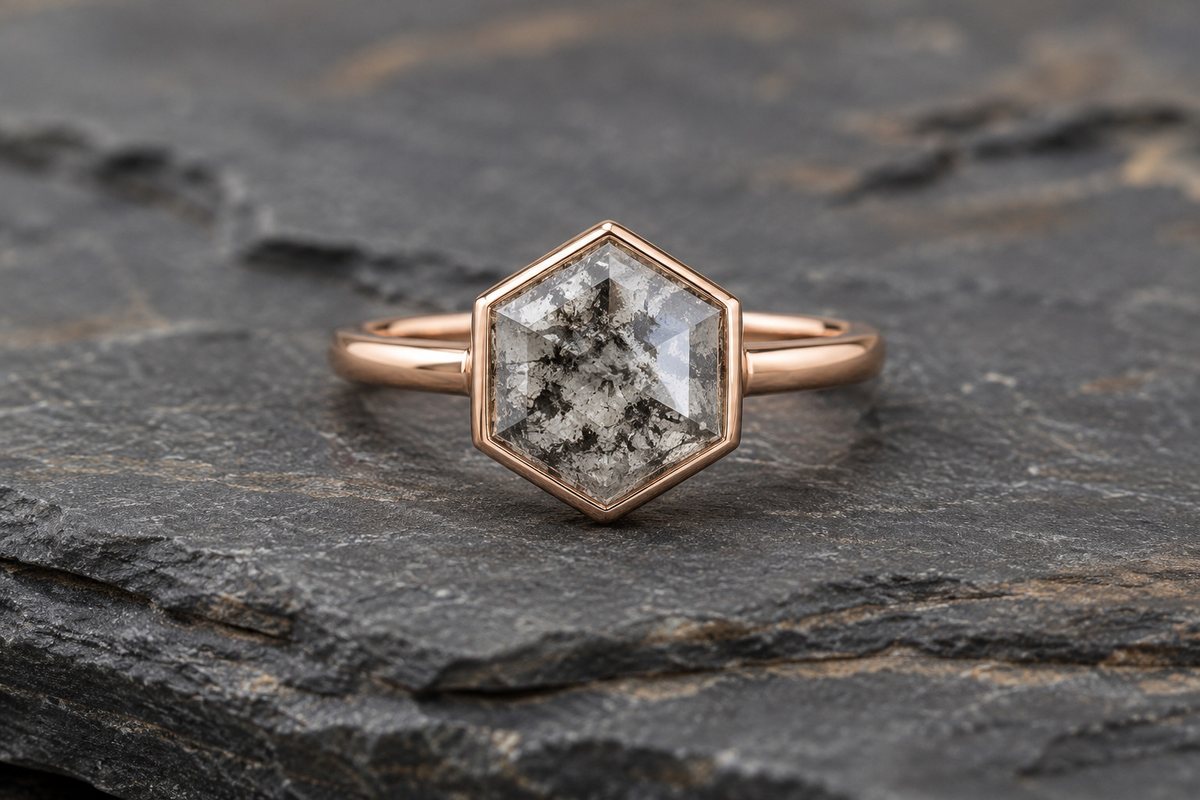
A salt and pepper diamond is a real diamond with lots of visible black and white inclusions, which give it a speckled grey look instead of the clear, white appearance of a traditional diamond. It is as hard as any other diamond, but some of its inclusions can make it more vulnerable to chipping, so the specific stone and the setting matter more than usual. Chosen carefully, it can be a beautiful, lower-cost and very individual option.
This guide includes a few product links near the end. As an Amazon Associate, Diamond Taire earns from qualifying purchases, at no extra cost to you.
This guide explains what the speckles actually are, which inclusions are harmless and which deserve caution, why these stones are not judged like ordinary diamonds, what to check in photos and videos, which settings protect them, and how prices compare. It also tackles the “will I regret it?” question honestly.
At a glance
- Real diamond: same material and hardness as a white diamond; the difference is the amount of inclusions.
- The speckles: dark spots are commonly graphite or other dark mineral inclusions; the white haze comes from clouds of tiny pinpoints.
- Durability: dots and clouds are mostly cosmetic; feathers (small fractures), especially near the edge or surface, are the ones to watch.
- Grading: the normal clarity scale rewards the absence of inclusions, so it tells you little about whether a salt and pepper stone is attractive. Judge the stone itself.
- Price: usually far less than a white diamond of the same weight, but prices vary hugely between stones and sellers.
What is a salt and pepper diamond?
Every natural diamond forms deep in the earth under heat and pressure, and most contain tiny traces of other material or small structural irregularities. These are called inclusions. In a traditional diamond, the aim is to have as few and as small as possible. A salt and pepper diamond is the opposite: it is heavily included, with enough dark and light inclusions that they become the look of the stone.
For a long time, diamonds this included were mostly used for industrial purposes rather than jewellery. In recent years they have become popular with people who want something less conventional, often in rose cuts, step cuts, hexagons and other shapes that show the inside of the stone well.
What the “salt” and the “pepper” actually are
GIA’s clarity education groups inclusions into types. The ones that create the salt and pepper look are mainly:
- Crystals (included minerals): other minerals, or even tiny diamond crystals, trapped as the diamond grew. Dark ones, often graphite or other dark minerals, are the “pepper”.
- Pinpoints and clouds: pinpoints are tiny dots; a cluster of them is a cloud. White pinpoints and clouds give the “salt”, plus a soft, misty or grey look when there are many.
- Feathers: small breaks or fractures inside the stone. They can look white or glittery. These are the inclusion type most linked to durability questions.
- Needles and knots: long thin crystals, or included crystals that reach the surface.
Are salt and pepper diamonds real?
Yes. A natural salt and pepper diamond is mined diamond, just with a lot of natural inclusions. It is not a simulant and it is not a treated or “fake” diamond. As with any stone, ask the seller to state in writing what it is, and ask whether any treatment has been applied.
Do the inclusions make them less durable?
This is the core worry behind most online “regret” threads, and the honest answer is: it depends on which inclusions a particular stone has and where they sit.
Hardness is not the issue. Diamond is 10 on the Mohs scale whatever its clarity, so a salt and pepper diamond resists scratching just as well as a white one. Toughness, meaning resistance to chipping and breaking, is different. Diamonds can split along natural planes in their crystal structure (cleavage), and inclusions such as feathers, knots and some crystals interrupt that structure. Standard clarity guidance notes that, depending on their position, these features can pose a moderate risk of further breakage, especially when they reach the girdle (the edge) or the surface.
| Inclusion type | What it looks like | Durability concern | What to do |
|---|---|---|---|
| Dark crystals (often graphite) | Black or grey dots and specks | Usually low if small and fully inside the stone | Enjoy them; check none sit right at the edge |
| Pinpoints and clouds | White dots, misty or grey haze | Low; mainly affect transparency and sparkle | Check the stone is not too dull or milky for your taste |
| Feathers inside the stone | White or glittery flat streaks | Moderate, depending on size | Ask the jeweller to assess them before setting |
| Feathers reaching the edge or surface | Streaks that run to the outline or break the surface | Higher; a hard knock can extend them | Avoid for an everyday ring, or use a protective setting |
| Knots and surface-reaching crystals | Raised or exposed crystal at the surface | Moderate; can catch or chip | Position away from prongs; consider a bezel |
In plain terms: a stone full of dots and haze, with no large feathers near the edge, is generally a sensible choice for daily wear in a good setting. A stone with long feathers running out to the girdle is the kind that leads to regret, especially in thin prongs on a hand that does physical work.
Why they are not graded like normal diamonds
The GIA clarity scale runs from Flawless through VVS, VS and SI down to Included (I1, I2, I3), and it is designed around one idea: fewer, smaller, less visible inclusions means a higher grade. Most salt and pepper diamonds would sit at the bottom of that scale. That grade tells you the stone is heavily included, which you already know, but not whether its pattern is beautiful, whether it has life and some sparkle, or whether its inclusions are the risky kind.
Many salt and pepper diamonds are therefore sold without a full grading report. That is not a red flag in itself, but it puts the job of judging the stone on you and your jeweller. If you want help reading a report when one is supplied, our guide to reading a diamond grading report explains each section, and the diamond clarity guide covers inclusion types in more detail.
How to judge a stone from photos and videos
Because no two stones look alike and many are sold online, good imagery is everything.
- Ask for a video in daylight and indoor light. Salt and pepper stones can look very different under each, from bright and speckled to dark and grey.
- Look for life. Rotate the stone in the video. Some flashes of light are a good sign; a stone that stays flat and dark in all positions may look dull on the hand.
- Find the feathers. Ask the seller to point out any feathers and say whether any reach the edge or surface.
- Check the side view. Very thin stones, common in rose cuts, have more exposed edges.
- Check the overall tone. Decide whether you want a mostly white stone with some pepper, an even grey, or a dark, dramatic stone.
- Ask about treatment. Ask in writing whether the stone has been treated in any way.
- Get measurements. Face-up millimetres matter more than carat weight for how big it looks.
Our checklist for buying a diamond online safely covers returns, payment protection and paperwork.
Settings that protect a salt and pepper diamond
Setting matters more for an included stone because the setting process itself, and everyday knocks, put pressure on the stone.
- Bezel: a metal rim around the whole edge gives the most protection. Usually the safest choice for a stone with feathers near the girdle, or for anyone who works with their hands.
- Halo: a surround of small stones adds a buffer and some sparkle that a grey stone may not make itself.
- Prongs: show off more of the stone. Ask the setter to place prongs away from feathers and to use care when tightening.
- Low profile: a stone that sits close to the finger catches and knocks less often.
An experienced setter should examine the stone before setting it and tell you if any inclusion makes a particular setting risky. See our ring settings guide for how each style works.
Salt and pepper diamond price
At the time of writing (October 2026), listings from three independent sellers checked for this guide ranged from about US$500 for a 1.48 carat round to about US$1,000 for a 1.01 carat loose pear rose cut and about US$2,420 for a 1 carat oval sold set in a ring. Prices change, and they swing widely with colour, how attractive the pattern is, size, cut and whether the price includes a setting. A white diamond of similar weight generally costs many times more; our 1 carat diamond ring guide explains what drives those prices.
| Factor | Salt and pepper diamond | Traditional white diamond |
|---|---|---|
| What sets value | Pattern, tone, life, cut and durability of the individual stone | Cut, colour, clarity and carat on standard scales |
| Price for a similar size | Usually much lower | Usually much higher |
| Uniqueness | Every stone looks different | Stones of the same grade look similar |
| Sparkle | Softer; ranges from lively to quite dark | Bright when well cut |
| Grading report | Often not supplied | Commonly supplied |
| Resale | Small, niche market | Larger market, still well below retail |
Buy one because you love it, not as a store of value. For the bigger picture on resale, read do fine diamonds hold their value.
Can you get lab-grown salt and pepper diamonds?
The salt and pepper look comes from natural inclusions, and most stones sold under the name are natural. Lab-grown diamonds can contain inclusions too, and their types differ by growth method (see CVD vs HPHT diamonds), but growers usually aim for clean stones. If you are offered a lab-grown stone described as salt and pepper, ask for written confirmation that it is lab-grown and how it was made.
Who a salt and pepper diamond suits
It suits you if you want a one-of-a-kind look, prefer soft, moody tones to icy sparkle, want a larger stone for a smaller budget, and are happy to choose a protective setting.
It may not suit you if you want maximum brilliance, plan to judge quality from a report alone, work hard with your hands and want thin prongs, or might later want to trade the stone in.
Common mistakes
- Buying from a single still photo. These stones change dramatically with light. Always see video.
- Ignoring feathers at the edge. This is the main source of chipping stories. Ask directly.
- Choosing a delicate setting for heavy daily wear. A bezel or halo is cheap insurance.
- Expecting white-diamond sparkle. Some salt and pepper stones are lively, many are subtle. Pick one whose look you love as it is.
- Using harsh cleaning. Ultrasonic cleaners and steam can stress stones with feathers. Clean gently and ask your jeweller first.
- Treating it as an investment. Resale is limited; value it as a piece of jewellery.
Caring for it
Clean with warm water, mild soap and a soft brush, check the setting regularly, and take the ring off for heavy work, gym sessions and gardening. Have a jeweller check prongs or the bezel at least once a year. Our guide to cleaning diamonds safely has the full routine.
Sources this guide draws on: GIA diamond clarity education and its clarity scale; standard gemmological descriptions of inclusion types and their effect on durability; published guidance from jewellery makers on setting and caring for included diamonds; listings from three independent salt and pepper diamond sellers checked in October 2026.
Salt and pepper diamond FAQs
Are salt and pepper diamonds good for engagement rings?
They can be, provided you choose a stone without large feathers near the edge and put it in a protective setting such as a bezel or halo. They are as scratch-resistant as any diamond. Choose them for the look, not for sparkle.
Do salt and pepper diamonds break easily?
Not easily, but more readily than a clean diamond if they have feathers or surface-reaching inclusions and take a hard knock. Dots and clouds are mostly cosmetic. Ask your jeweller to check the stone before it is set.
Why are salt and pepper diamonds cheaper?
Traditional pricing rewards clarity, and these stones are heavily included. Demand and supply are also different from white diamonds. That makes them good value for size, but it also means resale value is low.
Do salt and pepper diamonds sparkle?
Some do, softly. Inclusions block and scatter light, so they generally sparkle less than a well-cut white diamond. Stones with more white and fewer dark inclusions tend to look livelier.
Will I regret a salt and pepper diamond?
Most regret stories come from three things: a stone that looked better in photos than in person, a chip from a risky inclusion, or wanting more sparkle later. Seeing video in different light, checking feathers and choosing a protective setting addresses the first two. Only you can answer the third.
Choosing one you will love
A salt and pepper diamond rewards the buyer who looks closely. See it moving in real light, ask what the inclusions are and where they sit, give it a setting that protects its edge, and buy it for the way it looks on your hand. Do that, and its speckles become a feature you enjoy for years rather than a worry.
Useful tools for this guide
Practical picks for choosing, checking and caring for jewellery. As an Amazon Associate, Diamond Taire earns from qualifying purchases, at no extra cost to you. Prices and availability are set by Amazon and may vary by country.
- Foldable 30x Jeweller’s Loupe
Pocket magnifier for checking stones, settings and hallmarks up close.
View on Amazon - CONNOISSEURS Premium Jewellery Cleaner
Gentle dip cleaner with a brush and tray for diamonds, gold and platinum. Check the label for stones it should not be used on.
View on Amazon - Ring Sizer Measuring Tool Kit (27 pieces)
Sizing rings plus a mandrel, to check a size at home before you buy or resize.
View on Amazon