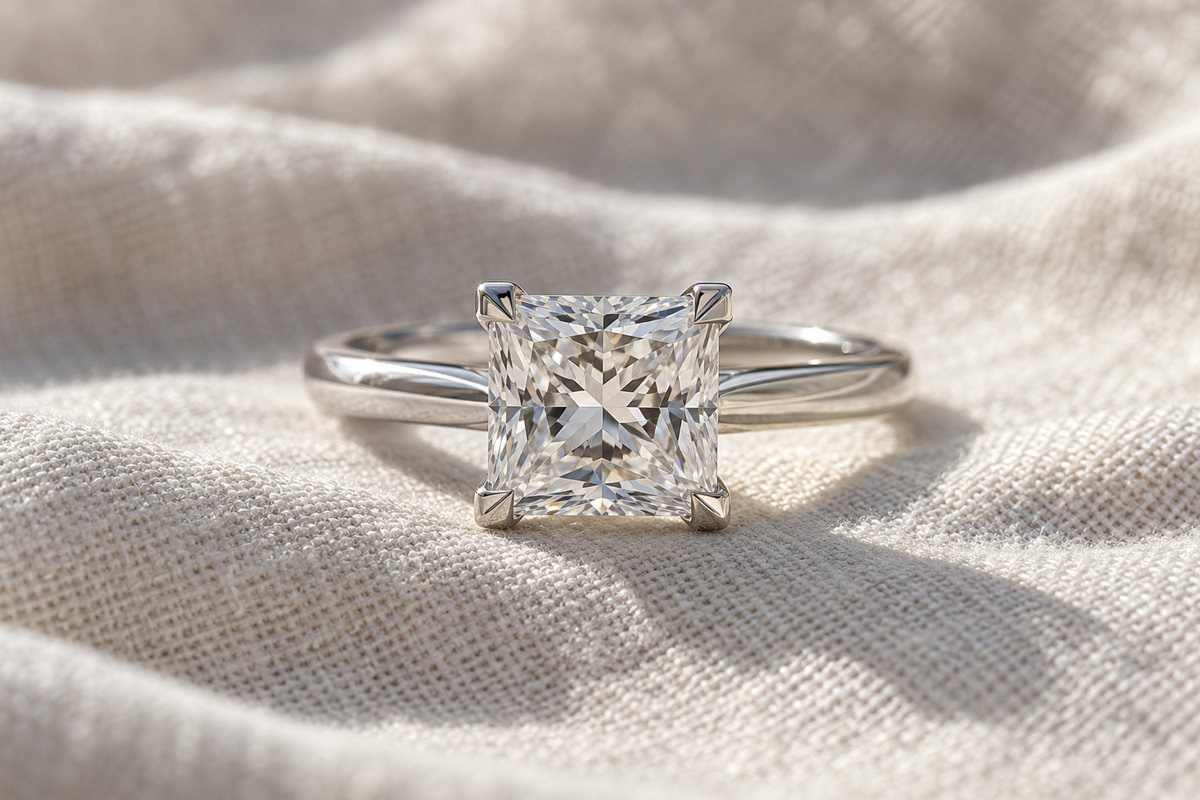
A princess cut diamond ring uses a square (or slightly rectangular) brilliant-style diamond with four sharp corners, and it is one of the best ways to get a bigger-looking stone for the money. Because the shape keeps more of the original rough crystal than a round brilliant, it usually costs less per carat at similar grades. The trade-off is those pointed corners: they are the stone’s weak spot, so the setting matters more than with almost any other shape.
This guide includes a few product links near the end. As an Amazon Associate, Diamond Taire earns from qualifying purchases, at no extra cost to you.
This guide explains what a princess cut actually is, how to judge one when no lab gives it a cut grade, which colour and clarity grades tend to be good value, how to protect the corners, and how lab-grown and natural princess cuts compare. There is a checklist you can take to a jeweller, plus the mistakes buyers most often make.
At a glance
- Value: princess cuts keep more of the rough diamond than rounds, so they usually cost less per carat for the same colour and clarity.
- Size illusion works both ways: much of the weight sits in the deep pavilion, so a princess can face up smaller than an oval or round of the same carat weight. Compare millimetre measurements, not just carats.
- Corners are the risk: GIA notes the corners lie close to a cleavage plane and are very vulnerable to chipping. V-prongs, bezels or partial bezels protect them.
- No lab cut grade: GIA grades cut only on round brilliants, so you judge a princess by its proportions, symmetry and how it looks, ideally with a light-performance image.
- Square or rectangular: GIA suggests a length-to-width ratio no higher than about 1.05 if you want it to read as square.
What is a princess cut diamond?
A princess cut is a square or rectangular diamond faceted in a brilliant style rather than a step style. On a GIA report it appears as a “square modified brilliant”, which separates it from step-cut squares such as the Asscher. Viewed from the side it looks like an upside-down pyramid, with chevron-shaped facets on the pavilion that create a lively, criss-cross sparkle.
It is a young shape compared with the round brilliant. GIA credits Betzalel Ambar and Israel Itzkowitz with creating the modern princess cut in the early 1980s, building on earlier square brilliant experiments such as Arpad Nagy’s “profile cut” from the 1960s and the Quadrillion cut of the 1970s. Facet counts vary from one cutter to another, which is one reason two princess cuts with similar grades can sparkle quite differently.
If you are still deciding between shapes, the overview in Diamond Shapes Explained sets the princess alongside rounds, ovals, cushions and step cuts.
Why a princess cut gives more carat per dollar
Diamond rough very often grows as an octahedron, two pyramids joined at the base. Slice that crystal and a square, pyramid-shaped stone is a natural fit, so the cutter grinds away less material than when cutting a round. Estimates of exactly how much more is kept vary from source to source, but the direction is consistent: a princess retains noticeably more of the rough. Because less weight is lost, the cutter can sell princess cuts for less per carat and still do well.
That saving is real, but read it carefully. Price per carat is lower, yet a princess concentrates weight in its depth, so it can look smaller face-up than a shallower shape of the same weight. GIA’s own buying advice makes this point. The fair comparison is spread (the millimetre measurements on the report) against price, not carat against price.
Princess cut versus other popular shapes
| Shape | Typical price per carat vs round | Face-up size for its weight | Corner risk | Look |
|---|---|---|---|---|
| Round brilliant | Highest | Average | Low (no corners) | Classic, maximum brilliance |
| Princess | Usually lower | Can look smaller (deep pavilion) | High (sharp corners) | Crisp square, criss-cross sparkle |
| Cushion | Usually lower | Average to small | Low (rounded corners) | Soft square, chunky or crushed-ice sparkle |
| Radiant | Usually lower | Average | Lower (trimmed corners) | Rectangular or square, very lively |
| Asscher / square emerald | Usually lower | Can look smaller | Moderate (cut corners) | Step-cut “hall of mirrors” |
Price gaps between shapes move with demand and differ by market, so treat the second column as a general pattern, not a rule.
How to judge a princess cut’s proportions
Because no major lab gives a princess cut an overall cut grade (GIA reports polish and symmetry only), you have to do more of the judging yourself. AGS Laboratories is one of the few labs that has assessed princess cut light performance, and only a small share of stones reach its top grade. For everything else, these are the measurements worth checking.
Depth and table
Princess depth percentages look high compared with rounds, often in the high 60s to mid 70s, because depth is measured across the width of the square rather than its longer diagonal. That is normal. What you want to avoid are extremes. A very deep stone hides weight in its belly and faces up small; a very shallow one can look glassy or leak light. Many princess cuts also have large, flat tables, which can mute fire and show inclusions more easily, so a slightly smaller table and a fuller crown are often a plus.
Ratio and outline
For a square look, GIA suggests a length-to-width ratio no higher than about 1.05. Rectangular princess cuts exist and can be lovely, but they are less common, and some people find them less balanced. Uneven sides are a real fault, so check that the outline looks square to your eye, not just on paper.
Symmetry and light pattern
GIA’s advice is to look for facets that mirror each other left to right and top to bottom, with facet points meeting cleanly. In the face-up view, a good princess shows an even balance of bright and dark areas. Look side-on with a loupe too: the pavilion should slope gently from girdle to point. A steep “bulge” darkens the stone and adds weight you pay for but cannot see.
For a wider explanation of what labs do and do not grade, see how to read a diamond report.
Colour and clarity sweet spots
A well-cut princess is fairly lively, which helps it hide small inclusions, but two quirks matter. First, princess cuts can show body colour from the side and in the corners, so a setting that exposes the full profile reveals more tint. Second, an inclusion that sits at or near a corner is not just a looks issue; it can make an already exposed point more likely to chip.
| Choice | Often good value | Watch for |
|---|---|---|
| Colour in white gold or platinum | Near-colourless grades (the G to J range) are widely chosen by buyers who want a white look without paying for D to F | Lower grades may show warmth at the corners; view the stone side-on as well as face-up |
| Colour in yellow or rose gold | Warmer metal masks some tint, so many buyers go a grade or two lower | Very low grades can look yellow even in yellow gold |
| Clarity | Eye-clean stones in the VS2 to SI1 range are a common value choice | Feathers or cracks near corners or the point; check the plotting diagram |
Grades are only a starting point, so look at the actual stone or high-quality video. The site’s guides to diamond colour and diamond clarity explain each scale in detail.
Protecting the corners: settings that suit a princess cut
GIA’s guidance on chipping is direct: princess cut corners are very vulnerable, and pointed corners are better protected with bezels, partial bezels or V-shaped prongs. It also notes that very thin girdles at the corners raise the risk, and that tension settings place stress on the girdle. Some cutters add a tiny flat facet (a chamfer) at each corner, which GIA notes is believed to improve durability.
| Setting | Corner protection | Light and look | Suits |
|---|---|---|---|
| Four V-prongs (claws folded over each corner) | Good | Shows almost all of the diamond | Most wearers; the classic choice |
| Four standard round claws | Weaker (corners can be exposed) | Open and bright | Only if the claws genuinely cover the points |
| Full bezel | Excellent | Metal rim slightly reduces visible size | Active hands, hands-on jobs |
| Partial bezel | Very good on the covered sides | More open than a full bezel | A balance of security and sparkle |
| Halo with V-prongs | Good, plus some guarding from the halo | Makes the centre look larger | Buyers who want more presence |
| Tension setting | Not advised for a princess | Dramatic, “floating” look | Better kept for rounder shapes |
For side stones, GIA suggests that triangles, trilliants, baguettes and tapered baguettes pair well with a princess, because their straight edges echo its outline. For more on each style, see the site’s guide to choosing the right ring setting.
Lab-grown or natural princess cut?
Lab-grown and natural diamonds are the same material, and a princess cut is graded the same way whichever you choose. The difference is mostly price and long-term value. At the time of writing (October 2026), lab-grown princess cuts sell for a small fraction of the price of natural stones with similar grades, and lab-grown prices have fallen considerably in recent years. Prices change, and they vary by country and retailer, so compare like-for-like listings on the day you buy rather than relying on old figures.
If resale or heirloom value matters to you, natural stones generally hold more of their value, although even natural diamonds usually resell well below retail. If you want the largest, cleanest stone for a fixed budget, lab-grown stretches much further. The trade-offs are covered in full in Lab-Grown or Natural Diamond?.
Who a princess cut suits, and who it may not
- Suits: buyers who like clean, modern geometry; anyone wanting more carat per dollar than a round; people who will choose a protective setting; those pairing a ring with straight-edged wedding bands.
- May not suit: people who are very hard on their hands and do not want a bezel; anyone set on the softest, most romantic outline (a cushion or oval may suit better); buyers who want the largest face-up size per carat, since some other shapes spread wider.
Princess cut diamond ring checklist
- Ask for the grading report and check that the shape reads “square modified brilliant” (or similar) and the measurements match the stone.
- Compare millimetre measurements, not just carat weight, across the stones on your shortlist.
- Check the length-to-width ratio: about 1.05 or below for a square look.
- Avoid extreme depth or very thin girdles at the corners; ask the jeweller to point out the girdle thickness on the report.
- Look at the plotting diagram for inclusions near the corners or the point.
- Ask for a light-performance image (such as an ASET or Ideal Scope image) or view the stone in different lighting.
- View the stone side-on to see whether body colour shows at the corners.
- Choose V-prongs, a bezel or a partial bezel, and confirm that every corner is covered.
- Ask how often the prongs should be checked and whether that service is included.
- Insure the finished ring and keep the report somewhere safe.
Common mistakes to avoid
- Buying on carat alone. A deep princess can weigh more but look smaller than a better-cut stone. Measurements tell the truth.
- Treating a seller’s “ideal” label as a lab grade. For princess cuts, terms like “ideal” or “excellent cut” usually come from the seller, not the lab, unless the report says otherwise.
- Leaving corners exposed. Round claws that sit beside, rather than over, the points leave the most fragile part of the stone unprotected.
- Ignoring corner inclusions. A feather at a corner can be more than cosmetic.
- Choosing a tension setting. GIA cautions that tension settings stress the girdle, which is the last thing a pointed stone needs.
- Skipping prong checks. Bent or worn claws are a common cause of lost or chipped stones. A quick check by a jeweller every so often is cheap insurance.
If you are working to a budget, the combinations in The Best Value Diamond Combinations by Budget show where small grade compromises save the most.
Sources this guide draws on: GIA 4Cs guidance on selecting a princess cut diamond; GIA research notes on protecting diamonds from chipping; AGS Laboratories light-performance grading; industry cutting references on rough yield and princess cut proportions.
Useful tools for this guide
Practical picks for choosing, checking and caring for jewellery. As an Amazon Associate, Diamond Taire earns from qualifying purchases, at no extra cost to you. Prices and availability are set by Amazon and may vary by country.
- Foldable 30x Jeweller’s Loupe
Pocket magnifier for checking stones, settings and hallmarks up close.
View on Amazon - CONNOISSEURS Premium Jewellery Cleaner
Gentle dip cleaner with a brush and tray for diamonds, gold and platinum. Check the label for stones it should not be used on.
View on Amazon - Ring Sizer Measuring Tool Kit (27 pieces)
Sizing rings plus a mandrel, to check a size at home before you buy or resize.
View on Amazon
Frequently asked questions
Are princess cut diamonds cheaper than round?
Usually, yes, per carat at similar colour and clarity. The square shape keeps more of the rough crystal, so less weight is lost in cutting. Remember that a princess can face up a little smaller for its weight, so compare measurements as well as price.
Do princess cut diamonds chip easily?
The corners are the most vulnerable part, and GIA describes them as very prone to chipping because they lie close to a cleavage plane. In a well-made V-prong or bezel setting, with a reasonable girdle at the corners, a princess cut is suitable for everyday wear. Avoid hard knocks and have the prongs checked regularly.
What is the best setting for a princess cut engagement ring?
Four V-prongs are the most popular choice because they cover each corner while showing most of the diamond. A bezel or partial bezel gives even more protection for very active hands. A halo can add presence, but the centre stone’s corners still need proper claws.
Does a princess cut look bigger than a round diamond?
Not necessarily. A princess has a deep pavilion, so for the same carat weight it can look slightly smaller face-up. Its corner-to-corner diagonal, however, is longer than a round’s diameter, which some people read as larger on the hand.
Is a princess cut out of style?
No. It is one of the most established fancy shapes, and GIA notes it appeals to buyers who want something less traditional than a round. Fashion moves between shapes over time, but a well-cut square solitaire is a classic look rather than a passing fad.
What length-to-width ratio is best for a princess cut?
For a square appearance, GIA suggests no higher than about 1.05. Higher ratios give a rectangular princess, which is less common but perfectly valid if you prefer the look.
A princess cut can give you a crisp, modern ring and real savings per carat, as long as you buy on measurements rather than weight, check the corners, and choose a setting that protects them. Get those three things right and the shape will wear well for decades.