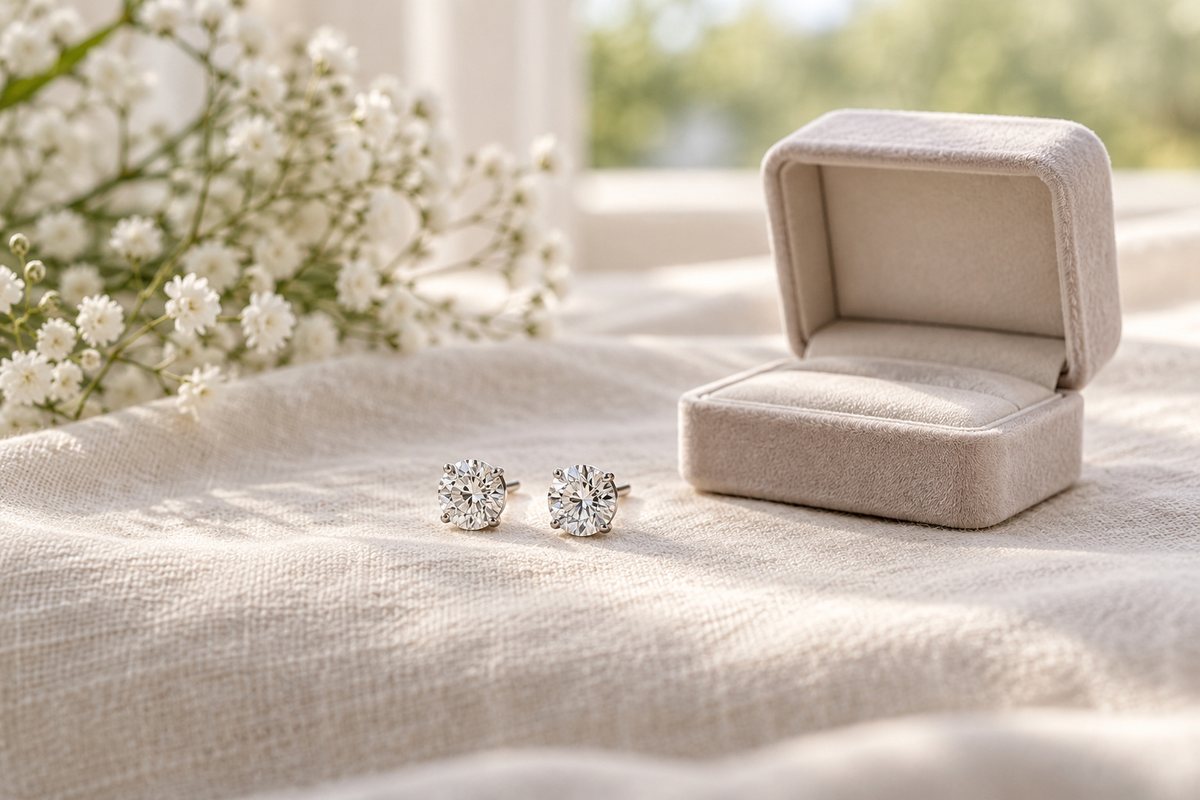
The best diamond earrings for most people are a well-matched pair of studs with secure backs, chosen by total carat weight that suits the wearer’s ears and budget. Before you buy, check three things: how well the two stones match, what kind of back holds them, and whether the stated weight is for the pair or for each earring. Drops and hoops add movement and sparkle, but they put more weight and wear on the piercing and the fittings.
This guide walks through the main earring styles, how total carat weight works on a pair, what “matched” really means, which settings and backs are most secure, how lab-grown and natural diamonds compare for earrings, and a checklist to use before you pay.
At a glance
- Studs are the safest first pair. They suit almost everyone, go with everything and are the easiest to wear every day.
- Total carat weight is for the pair. “1 carat total weight” studs usually mean two stones of about 0.50 carats each.
- Matching matters more than grades. Two stones that look the same side by side beat two higher-graded stones that do not.
- Backs decide security. Screw backs and locking backs hold far better than basic push backs, especially for valuable stones.
- Earrings forgive lower grades. Because they are seen from a distance, you can often choose slightly lower colour and clarity than you would for a ring.
Studs, drops or hoops: choosing a style
Most diamond earrings fall into three broad families. Each suits a different budget, lifestyle and look.
| Style | What it is | Best for | Watch out for |
|---|---|---|---|
| Studs (solitaire) | One diamond per ear, sitting on the lobe | Everyday wear, first diamond jewellery, gifts | Cheap push backs; poorly matched stones |
| Halo or cluster studs | A centre stone ringed by small diamonds, or several small stones grouped | A bigger look for less money | More small stones to check and possibly lose |
| Drops and dangles | Diamonds that hang below the lobe and move | Evenings, extra sparkle from movement | Weight on the piercing; links and jump rings wear |
| Huggies and small hoops | Small hinged hoops that hug the lobe, often pavé-set | Stacking, multiple piercings, low-snag wear | Hinge and catch wear; tiny stones can loosen |
| Larger hoops | Wider hoops set with diamonds on the front, or inside and out | A statement look | Catches on hair and clothing; heavier |
If you are buying a first pair, or a gift for someone whose taste you are not sure of, simple studs are the lowest-risk choice. They are also the style where diamond quality is easiest to compare.
How total carat weight works on earrings
Earrings are almost always sold by total carat weight (often written “ct tw” or “TCW”), which is the combined weight of every diamond in the pair. A pair of “1 carat” studs will usually hold two diamonds of roughly half a carat each, not two 1 carat stones. Sellers who quote weight per earring should say so clearly; if it is not clear, ask.
Because price per carat rises with the size of each stone, two 0.50 carat diamonds cost much less than a single 1 carat diamond of the same quality. That is one reason earrings can feel like good value for the sparkle they give.
What size suits the wearer?
The right size depends on the size of the earlobe, the wearer’s style and how often they will wear them. As a rough guide, very small studs (total weights up to about 0.50 carats) look delicate and suit second piercings and young or minimal wearers; around 0.75 to 1 carat total is a common everyday size; and from about 1.50 carats total upwards studs start to read as a statement. Larger stones add weight, which matters for comfort and for the choice of back.
Shape also changes how big the earrings look. The site’s guide to diamond shapes explains why elongated or square shapes face up differently from rounds of the same weight.
Matching a pair: what really counts
A good pair of diamond earrings looks like a pair. The two stones should appear the same size, the same colour and similarly bright when you look at them side by side. Small differences that would be invisible in a single ring become obvious when two stones sit next to each other on either side of a face.
- Size: compare the face-up millimetre measurements, not just the weight. Two stones of the same carat weight can differ in diameter.
- Colour: ideally within one grade of each other. A mismatch in colour is one of the most noticeable faults in a pair.
- Cut and brightness: stones of similar cut quality and proportions sparkle alike.
- Shape and outline: for fancy shapes such as princess or pear, the outlines and length-to-width ratios should be close.
Which grades make sense for earrings
Earrings are seen at conversational distance and are rarely inspected up close, so most buyers do not need the very top colour and clarity grades. Stones that are “eye clean” (no inclusions visible without magnification) are usually enough. In white metal settings, a near-colourless stone is often a sensible balance; in yellow or rose gold, slightly warmer colours tend to blend in. The site’s guides to diamond colour grades and to the 4 Cs explain the scales in detail.
Cut quality is the grade that is hardest to compromise on, because it drives the sparkle that makes earrings catch the light. Small earring diamonds often come without individual grading reports, so ask what quality range the seller is describing and how it has been checked.
Settings for diamond earrings
The setting holds the diamond on the earring and affects both security and look.
| Setting | Look | Security and wear |
|---|---|---|
| Four-prong (basket) | Classic; shows the most of the diamond, often looks squarer | Secure if prongs are sturdy; check prongs regularly |
| Three-prong (martini) | Rounder outline; stone often sits lower, closer to the ear | Fewer prongs means each one matters more |
| Six-prong | Rounder outline, slightly more metal visible | Extra security for larger stones |
| Bezel | A rim of metal around the stone; modern, clean | Very secure and snag-free, but shows less of the stone |
| Halo | Small diamonds around a centre stone | Bigger look; more small stones to keep an eye on |
For the metal, the same considerations apply as for rings. Platinum and white gold suit colourless stones, and 14k or 18k gold is a common balance of durability and colour. If the wearer has sensitive ears, ask exactly what the posts and backs are made of. The guides to gold karats and platinum versus white gold compare the options.
Earring backs: the part that keeps your diamonds
The back (or closure) is the most overlooked part of diamond earrings, and the most common reason a stud goes missing. Jewellers Mutual’s consumer guidance on earring backs, along with general trade advice, points the same way: the more valuable the stud, the more secure the back should be.
| Back type | How it works | Security | Good to know |
|---|---|---|---|
| Push back (butterfly or friction) | Slides onto a smooth post and is held by tension | Lower | Easy and inexpensive, but loosens over time; check and replace |
| Screw back | Screws onto a threaded post | High | Widely recommended for valuable studs; slower to put on; threads can wear |
| Locking back (such as La Pousette style) | A push-on back with a locking mechanism you squeeze to release | High | Slim and secure; may be fiddly for people with arthritis |
| Lever back | A hinged lever that closes against the hook (for drops) | High | Built into the earring so it cannot be lost separately |
| Hinged hoop or latch | A post or latch that clicks into the hoop | Medium to high | Check the click is firm; hinges wear with use |
If you love a pair that comes with push backs, ask whether the jeweller can fit screw or locking backs instead. Some can, but screw backs need a threaded post, so it is easier to choose them at the time of purchase.
Lab-grown or natural diamonds for earrings?
Lab-grown diamonds have the same chemical and physical properties as natural diamonds, and in earrings the two look identical to the eye. Lab-grown stones usually cost considerably less for the same size and grade, which makes larger, better-matched pairs more affordable. At the time of writing (October 2026) the price gap is wide, but prices change and lab-grown prices have been falling.
The trade-off is resale. Natural diamonds generally have a more established secondary market, while resale for lab-grown stones is limited. Neither should be bought as an investment. If you choose lab-grown, ask for disclosure in writing and, for larger stones, an independent grading report. The lab-grown diamond buyer’s guide covers what to check.
Who suits which earrings
- Everyday wearer, active lifestyle: bezel or four-prong studs with screw or locking backs; huggies are another low-snag option.
- First diamond gift: modest round studs in a classic setting; easy to wear and hard to get wrong.
- Bigger look on a budget: halo or cluster studs, or lab-grown solitaires.
- Special occasions: drops or larger hoops, with lever backs or firm latches.
- Sensitive ears: ask for solid gold, platinum or titanium posts and avoid unknown base metals.
Before you buy: a checklist
- Confirm whether the carat weight is for the pair or for each earring.
- Ask the colour and clarity range for both stones, and whether they were matched.
- Look at both earrings side by side, in daylight if you can, for size and colour match.
- Check the face-up measurements of each stone.
- Ask what type of back is supplied, and whether screw or locking backs are available.
- Confirm the metal of the posts and backs.
- For larger stones, ask for independent grading reports and check the numbers match.
- Check the returns policy and any warranty, especially when buying online.
- Arrange insurance for valuable pairs; the guide to insuring and appraising jewellery explains what to ask.
Common mistakes
- Misreading total carat weight. Expecting two 1 carat stones when the pair totals 1 carat.
- Buying grades instead of a match. Two high-graded stones that look different side by side make a poor pair.
- Keeping weak push backs on valuable studs. This is a leading cause of lost earrings.
- Going too big for the lobe. Heavy studs can droop forward and feel uncomfortable.
- Overpaying for top colour and clarity. In earrings, the difference is rarely visible at normal distance.
- Never checking the fittings. Prongs, posts and backs wear; a quick look every few weeks catches problems early.
Sources this guide draws on: GIA’s 4Cs grading guidance on colour, clarity, cut and carat weight; Jewelers Mutual consumer guidance on types of earring backs; general jewellery trade practice on matching pairs and settings.
Frequently asked questions
What size diamond earrings should I buy?
Around 0.75 to 1 carat total weight is a popular everyday size, while smaller pairs suit minimal styles and second piercings. Consider the size of the earlobe, how often they will be worn and your budget. Larger studs look striking but are heavier and need a secure back.
Does “1 carat diamond earrings” mean each earring?
Usually not. Most sellers quote total carat weight, so a 1 carat pair typically holds two diamonds of about 0.50 carats each. If the listing is not clear, ask before you buy.
What is the most secure back for diamond studs?
Screw backs and locking backs are generally the most secure for valuable studs. Push backs are convenient but can loosen over time, so check and replace them regularly if you use them.
Can diamond earrings be lower colour and clarity than a ring?
Often, yes. Earrings are viewed from further away than a ring, so eye-clean clarity and a near-colourless colour are usually enough. What matters most is that the two stones match each other and are well cut.
Are lab-grown diamond earrings a good choice?
They can be. Lab-grown diamonds look the same as natural diamonds and usually cost much less, so you can afford a larger or better-matched pair. Resale value is limited, so buy them to wear and enjoy rather than as a store of value.
How do I keep diamond earrings clean?
Soak them in warm water with a little mild washing-up liquid, brush gently behind the stone with a soft brush, rinse and dry. The site’s guide to cleaning diamonds safely covers what to avoid.
A beautiful pair of diamond earrings comes down to good matching, sensible grades and a back you can trust. Get those three right and the earrings will be worn and enjoyed for years.