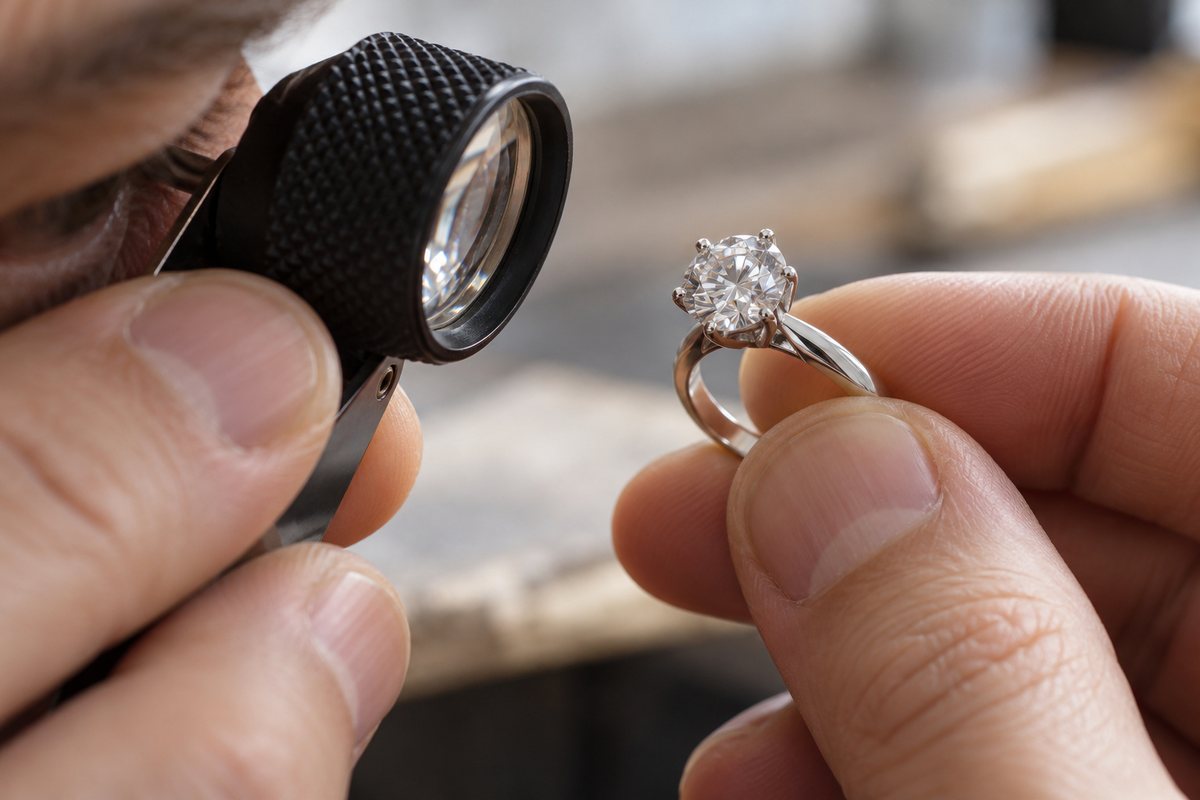
You can catch most jewellery problems at home in a few minutes: look for prongs that are flattened, bent or snagging, listen for a stone that rattles when you tap the ring gently near your ear, check whether the bottom of the band has worn thin, and test that clasps close firmly. If you find any of these, stop wearing the piece and take it to a jeweller before a stone goes missing. A professional check every six to twelve months is a sensible routine for rings worn daily.
This guide gives you a simple home inspection routine for rings, earrings, necklaces and bracelets, explains what each warning sign means, compares the common repairs (re-tipping, re-pronging, replacing a head, re-shanking), and shows how regular checks tie in with insurance.
At a glance
- Prongs wear down quietly. Daily wear rubs metal away from the tips until the stone is held by very little.
- A loose stone is an urgent warning. If a diamond moves, rattles or turns, stop wearing the piece until it is fixed.
- Bands thin at the bottom. Years of contact with hard surfaces can wear a shank thin enough to crack.
- Clasps and links fail too. Bracelets and necklaces are lost through weak clasps and stretched jump rings.
- Checks protect your insurance claim. Some policies expect reasonable care, and records of maintenance help if something goes wrong.
Why jewellery needs checking at all
Gold, platinum and silver are softer than the stones they hold. Every time a ring knocks a door handle, rubs against a steering wheel or sits under a gardening glove, a tiny amount of metal is worn away or pushed out of shape. None of this is visible from one day to the next, which is why stones are so often lost “out of nowhere”.
The aim of a home check is not to repair anything yourself. It is to spot early signs so a jeweller can fix a small problem before it becomes a lost stone or a broken band. The guide to ring settings explains how each type of setting holds a stone, which helps you know what to look at.
How to check your rings at home: step by step
Do this in good daylight, after cleaning the ring so dirt is not hiding anything. A magnifier or the zoom on your phone’s camera helps a lot.
- Clean first. Soak the ring in warm water with a drop of mild washing-up liquid, brush gently and dry. The guide to cleaning diamonds safely covers what to avoid.
- Look at each prong from above and the side. Healthy prongs have rounded tips that sit over the edge of the stone. Worn prongs look flat, thin, short or uneven compared with the others.
- Run a fingertip and a fine cloth over the setting. A prong that catches on fabric or feels sharp may be bent or lifted.
- Do the tap test. Hold the ring close to your ear and tap it gently with a fingernail or a soft tool. A rattle or click suggests a loose stone. Never press or push on the stone itself.
- Look for movement. Under magnification, watch the stone while gently touching the setting. Any shift or turn means it is loose.
- Check small stones. On halo, pavé and channel-set rings, look for gaps, empty seats or stones sitting at an angle.
- Check the band. Look at the underside of the shank. If it looks thin, flattened, misshapen or shows a hairline crack, it needs a jeweller.
- Check the fit. A ring that is now too loose is more likely to be knocked or lost.
Warning signs and what they mean
| What you notice | What it usually means | How urgent? |
|---|---|---|
| Prong tips look flat or thin | Normal wear has removed metal | Soon; book a check |
| A prong catches on clothes | A prong is bent, lifted or rough | Soon; it may lift further |
| Stone rattles or moves | The setting no longer grips the stone | Urgent; stop wearing it |
| A small stone is missing | A pavé bead or channel wall has worn or bent | Urgent; others may follow |
| Band is thin at the bottom | Long-term wear on the shank | Soon; it can crack or bend |
| Hairline crack in the band | Metal fatigue, often at an old solder join | Urgent |
| Ring is out of round | Pressure or knocks have bent the shank | Soon; it can loosen stones |
| Diamond looks dull even after cleaning | Could be a chip, abrasion or a stone that has shifted | Book a check |
Checking earrings, necklaces and bracelets
Earrings
- Check that posts are straight and not bent.
- Make sure backs grip firmly; push backs loosen with time and are cheap to replace.
- For screw backs, check the threads still catch properly.
- Look at prongs on studs just as you would on a ring.
- On hoops and huggies, check the hinge and that the catch clicks shut.
Necklaces and pendants
- Open and close the clasp several times; the spring in a bolt ring or lobster clasp should snap back firmly.
- Check the jump ring that joins the clasp to the chain for gaps.
- Look at the bail (the loop that holds a pendant) for wear where it rubs the chain.
- For strung pearls or beads, look for stretched or fraying thread. The guide to pearls and diamonds covers restringing.
Bracelets
- Test the clasp and any safety catch or figure-eight latch.
- Flex the bracelet gently along its length to feel for stiff or loose links.
- On line or tennis-style bracelets, check every stone’s setting, since each one takes knocks.
Common repairs compared
When you take a piece in, the jeweller will usually recommend one of the repairs below. Re-tipping is the smaller job; replacement is for prongs or settings that are too worn to rebuild. The exact cost varies by metal, number of prongs and region, so ask for a written quote.
| Repair | What it involves | When it’s used |
|---|---|---|
| Tightening | Gently pushing existing prongs back against the stone | A slightly loose stone with prongs in good condition |
| Re-tipping | Adding new metal to the tops of worn prongs | Prong tips are worn but the base is still strong |
| Re-prong (prong replacement) | Removing a damaged prong and building a new one | Prongs are very thin, cracked, broken or worn at the base |
| Replacing the head | Fitting a new set of prongs (the head or crown) to hold the stone | Several prongs are failing, or the setting is badly damaged |
| Re-shanking | Replacing the bottom part or all of the band | The band has worn thin or cracked |
| Resetting small stones | Securing or replacing pavé or channel stones | Small stones are loose or missing |
| Clasp or jump ring replacement | Fitting new findings | Weak springs, gaps or worn loops |
Repairs on platinum can be priced differently from gold because platinum needs higher temperatures and specialist skill. The comparison of platinum and white gold explains how each metal wears: platinum tends to move rather than wear away, while white gold may also need re-plating.
Re-tipping or re-prong: how to decide
The choice depends on how much healthy metal remains. If the prong is strong at the base and only worn at the tip, re-tipping is usually enough. If the prong is thin along its length, cracked or has been re-tipped many times before, a new prong or a new head is usually the longer-lasting fix. Ask the jeweller to show you, under magnification, why they are recommending one or the other.
Questions to ask the jeweller
- Which prongs or stones are worn, and can you show me under magnification?
- Is re-tipping enough, or do the prongs or head need replacing?
- Will the work involve heat near the stone, and is my stone safe with that (some treated or softer gemstones are not)?
- Will the repair change the look of the setting, and will white gold need re-plating afterwards?
- Can I have a written quote and a receipt describing the work, for my insurance records?
- Will the piece stay on the premises, and is it covered by your insurance while you have it?
- Does the repair affect any existing warranty?
How often to check
| Piece | Home check | Professional check |
|---|---|---|
| Engagement and everyday rings | Every few weeks, and after any hard knock | Every 6 to 12 months |
| Earrings worn daily | Monthly | Yearly, or when backs feel loose |
| Necklaces and bracelets | Before each wear for valuable pieces | Yearly |
| Pieces worn occasionally | Before wearing | Every year or two |
Many jewellers offer free or low-cost checks and cleaning, and some warranties require regular inspections to stay valid. Ask what applies to your piece.
The insurance tie-in
Insurance is designed to cover loss and damage, but most policies expect reasonable care, and some specialist jewellery policies or retailer warranties require periodic inspections. Keeping records of checks and repairs, along with an up-to-date valuation and photographs, makes any claim simpler. Policy terms differ widely by insurer and country, so read yours. The guide to insuring and appraising fine jewellery explains what to ask and how often to update a valuation.
Habits that prevent damage
- Take rings off for the gym, gardening, cleaning and heavy lifting.
- Put rings on after hand cream and make-up, not before.
- Store pieces separately so harder stones do not scratch softer ones; see the guide on storing jewellery.
- Never leave rings on the edge of a sink or in a pocket.
- Consider lower-profile settings, such as bezels, for very active hands.
Common mistakes
- Waiting for a stone to feel loose. By then the prongs may already be badly worn.
- Trying to fix prongs yourself. Pliers can crack stones and damage settings; leave it to a jeweller.
- Ignoring small stones. One missing pavé stone often means others nearby are loose.
- Wearing a cracked band. A crack can open suddenly and distort the setting.
- Losing the paperwork. Without receipts, reports and repair records, insurance claims are harder.
- Only checking the centre stone. Bands, clasps and posts fail too.
Sources this guide draws on: general bench-jeweller practice on prong wear, re-tipping and prong replacement; published jeweller guidance on inspection intervals for prong settings; Jewelers Mutual consumer guidance on jewellery care and earring backs.
Frequently asked questions
How do I know if my ring prongs are worn?
Worn prongs look flat, thin, short or uneven compared with the others, and may catch on fabric. If the stone moves or rattles when you tap the ring gently, the prongs are no longer gripping it properly.
How often should prongs be checked?
For a ring worn every day, a quick home check every few weeks and a professional inspection every six to twelve months is a common recommendation. Check straight away after any hard knock.
What is the difference between re-tipping and re-pronging?
Re-tipping adds new metal to the top of a worn prong whose base is still strong. Re-pronging replaces the whole prong when it is too thin, cracked or worn at the base to rebuild.
What should I do if my diamond is loose?
Stop wearing the piece, put it somewhere safe such as a small sealed pouch, and take it to a jeweller as soon as you can. Do not try to press the stone or prongs back yourself.
Does insurance cover a lost stone?
Many jewellery policies do, but terms vary and some expect reasonable care or regular inspections. Check your policy wording and keep records of checks, repairs and valuations.
A few minutes with good light and a magnifier is all it takes to protect jewellery you love. Make the check a habit, act on the warning signs early, and your rings and earrings can stay safe for generations.