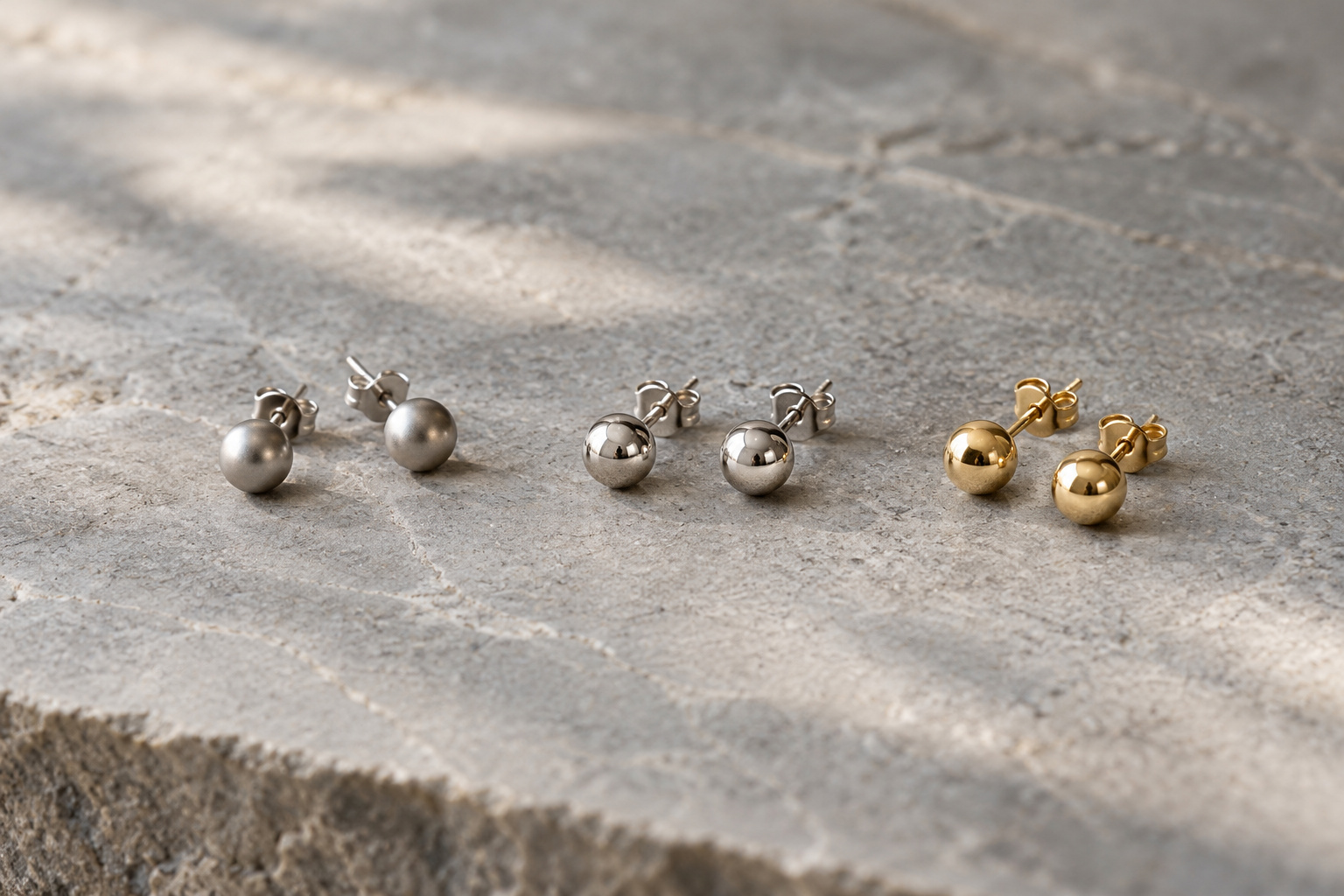
Hypoallergenic jewellery is jewellery made from materials that are less likely than usual to cause a skin reaction, most often because they contain little or no nickel or release very little of it. The word itself is a marketing description rather than a regulated standard in most countries, so it does not guarantee that nobody will react. What you can check is the metal, the alloy and, in some markets, whether the piece meets legal nickel-release limits.
This guide includes a few product links near the end. As an Amazon Associate, Diamond Taire earns from qualifying purchases, at no extra cost to you.
This guide explains what the label does and does not mean, compares the common jewellery metals by how much nickel risk they carry, sets out the European Union’s nickel rules in plain language, and gives you a practical checklist for buying earrings, rings and everyday pieces when your skin is sensitive. It is buyer education, not medical advice.
At a glance
- “Hypoallergenic” is not a legal guarantee. Ask what the metal is, not just whether it is labelled hypoallergenic.
- Nickel is the usual concern. The American Academy of Dermatology names earrings, earring backs and watches as the biggest sources of nickel exposure from everyday items.
- Lower-risk choices include implant-grade titanium, niobium, platinum and high-karat, nickel-free gold.
- The EU limits nickel release from jewellery: 0.2 micrograms per square centimetre per week for anything inserted into a piercing, and 0.5 for items in prolonged skin contact.
- Plating wears off. A coated piece is only as safe as the metal underneath once the coating thins.
What “hypoallergenic” really means on a jewellery label
“Hypo” means “less” or “under”, so hypoallergenic simply means “less likely to cause an allergy”. Neither the EU’s nickel restriction nor the US Federal Trade Commission’s jewellery guides set a definition for the word, and in most markets any seller can use it. One brand may use it for implant-grade titanium; another may use it for plated base metal that has passed no test at all.
That is why the most useful questions are specific: What is the metal? If it is an alloy, what is in it? Is there a coating, and what is underneath? For earrings, are the post and the back made of the same material as the front? A seller who can answer these clearly is giving you far more information than the word “hypoallergenic” ever could.
Why nickel matters
Nickel is widely used in jewellery alloys because it is cheap, hard and helps whiten metals. It is also one of the most common causes of allergic contact dermatitis, a skin reaction where metal touches the skin. Reactions to other metals, such as cobalt, are possible too, which is another reason to ask for the full alloy rather than “nickel-free” alone. If you think you have reacted to jewellery, the American Academy of Dermatology advises seeing a board-certified dermatologist for a proper diagnosis.
Jewellery metals compared by nickel risk
This table summarises how the common metals usually behave. “Usually” matters: alloys vary between makers, so check the specific piece.
| Metal | Nickel risk | Why | Good to know |
|---|---|---|---|
| Implant-grade titanium (ASTM F136, F1295, ISO 5832-3, or commercially pure ASTM F67) | Very low | Titanium and its implant alloys are not nickel-based | Lightweight; can be anodised in colours without coatings |
| Niobium | Very low | An elemental metal used without nickel | Similar to titanium; often used for coloured earrings |
| Platinum (usually 950) | Very low | High purity and very inert | Expensive and heavy; ask what the remaining 5 percent is |
| Yellow gold, 18K and above | Low | Higher gold content leaves less room for other metals | Softer than lower karats; best for earrings and pendants |
| Yellow or rose gold, 14K, nickel-free | Low if confirmed nickel-free | Depends entirely on the alloy | Ask the maker to confirm the alloy contains no nickel |
| White gold | Varies | Some white gold alloys use nickel; others use palladium | Ask whether it is nickel white or palladium white gold |
| Sterling silver (925) | Usually low | Normally alloyed with copper rather than nickel | Plated sterling depends on the plating; silver tarnishes |
| Surgical stainless steel (e.g. 316L, ASTM F138) | Low to moderate | Contains nickel bound in the alloy; release is usually low but not zero | Choose pieces stated to meet EU nickel-release limits |
| Plated or coated base metal | Unknown to high | The base often contains nickel or other alloys | Risk rises as the coating wears |
The American Academy of Dermatology lists surgical-grade stainless steel, 18, 22 and 24 karat yellow gold, sterling silver and platinum among the materials people with nickel allergy can look for. The Association of Professional Piercers, which sets widely used standards for body jewellery, is stricter for fresh piercings: it accepts implant-certified titanium, niobium, platinum, specific steel grades and 14K or higher gold that is nickel- and cadmium-free, and it does not accept gold-plated, gold-filled or vermeil jewellery for initial piercings.
For a wider comparison of how these metals wear, cost and age, see our guide to choosing the right jewellery metal. If you are looking at gold specifically, how to choose the right gold karat explains why higher karats are softer, and what white gold is explains its alloys and rhodium plating.
What the EU nickel rules say
The European Union restricts nickel in jewellery under the REACH regulation (Annex XVII, entry 27). Rather than banning nickel outright, it limits how much nickel an item may release onto the skin, measured with a standard laboratory test (currently EN 1811).
- Post assemblies inserted into pierced ears or other pierced body parts must release less than 0.2 micrograms of nickel per square centimetre per week.
- Items in direct and prolonged contact with the skin, including earrings, necklaces, bracelets, chains, anklets, finger rings and watch parts, must not release more than 0.5 micrograms per square centimetre per week.
- Coated items only comply if the coating keeps nickel release at or below 0.5 for at least two years of normal use.
Two practical points follow. First, an EU-compliant piece can still contain nickel; what is limited is release, which is lower in well-made alloys. Second, these limits apply to items placed on the EU market. Other countries have their own rules, and many have no equivalent limit at all, so the same-looking pair of earrings bought from an overseas marketplace may not have been tested to any standard. Stating EU nickel compliance is one of the more meaningful things a seller can tell you.
What about the US and other countries?
The US Federal Trade Commission’s Jewelry Guides focus on describing metals honestly, for example what may be called sterling, gold or platinum, rather than on nickel release. ASTM International publishes voluntary specifications that the body-jewellery world relies on, such as F136 for implant-grade titanium alloy and F138 for implant steel. Wherever you live, a clear material specification is more reliable than a general label.
Who needs to be most careful
- People with a known nickel allergy, who should regard every unspecified alloy as a risk until the seller confirms otherwise.
- Anyone getting a new piercing, because the first jewellery sits inside freshly pierced skin; this is where the stricter piercing standards apply.
- Wearers of pieces that stay on, such as rings worn around the clock, sleep-in studs and welded permanent jewellery, where contact is constant.
- Buyers of low-cost plated jewellery, where the base metal is rarely stated.
How to buy hypoallergenic jewellery: a checklist
- Ask for the exact metal. “Titanium” is good; “implant-grade titanium, ASTM F136” is better. “Gold” is vague; “14K yellow gold, nickel-free alloy” is useful.
- Check every part. For earrings, confirm the post and the back. For necklaces, check the clasp and jump rings, which are often a cheaper metal than the chain.
- Look for a nickel-release statement. In or from the EU, ask whether the piece complies with REACH nickel limits.
- Be cautious with plating. Ask what is underneath and how thick the layer is. Plated rings and bracelets wear fastest. Our guide to gold vermeil vs gold filled explains how layer types differ.
- Prefer solid metals for daily wear. For a ring worn every day, solid titanium, platinum or a confirmed nickel-free gold alloy is usually a safer bet than plated metal.
- Keep the receipt and listing. If a piece is described as nickel-free and you react, the written description helps with a return.
- Consider a nickel spot test. Home kits that use a chemical called dimethylglyoxime change colour when nickel is released from a surface. They are a screening tool, not a laboratory result.
- Talk to a professional if you react. A dermatologist can identify which metal is involved; a jeweller can sometimes replace posts or re-make a piece in another alloy.
Earrings and rings: specific tips
Earrings are the item most people react to, partly because posts pass through the skin. Studs with titanium, niobium or solid high-karat gold posts are a sensible starting point, and our guide to types of earrings and backs explains which styles leave less metal against the skin. For wedding bands, titanium and platinum are common choices for sensitive skin. Some tungsten carbide rings use nickel as a binder, so ask which binder a tungsten ring uses; our tungsten vs titanium wedding band comparison covers how the two metals differ in wear.
Common mistakes
- Trusting the word alone. “Hypoallergenic” with no metal named tells you almost nothing.
- Assuming “surgical steel” is nickel-free. Most surgical steels contain nickel; what matters is how much is released.
- Forgetting the small parts. A titanium earring with a base-metal back, or a gold chain with a plated clasp, can still cause trouble.
- Assuming all gold is the same. Lower karats and some white gold alloys are more likely to contain nickel than 18K yellow gold.
- Relying on coatings. Clear lacquer, rhodium and gold plating all wear, especially on rings and bracelets.
- Ignoring repeated reactions. If symptoms come back or worsen, stop wearing the piece and see a doctor or dermatologist rather than switching between untested alternatives.
Sources this guide draws on: EU REACH Regulation Annex XVII entry 27 (nickel) as published by the European Chemicals Agency; the EN 1811 nickel-release test standard; the American Academy of Dermatology’s public guidance on nickel allergy; the Association of Professional Piercers’ standards for initial piercing jewellery; ASTM International implant material specifications F136, F67 and F138; and the US Federal Trade Commission’s Jewelry Guides.
Useful tools for this guide
Practical picks for choosing, checking and caring for jewellery. As an Amazon Associate, Diamond Taire earns from qualifying purchases, at no extra cost to you. Prices and availability are set by Amazon and may vary by country.
- Sunshine Polishing Cloths (5 Pack)
Pre-treated cloths that lift tarnish from sterling silver, gold and brass.
View on Amazon - Rosenthal Anti-Tarnish Strips (100 Tabs)
Drop one in each box or pouch to slow tarnish on stored silver.
View on Amazon - KElofoN Travel Jewellery Case
Compact case with ring rolls and earring slots so pieces do not scratch each other.
View on Amazon
Frequently asked questions
What metal is most hypoallergenic for jewellery?
Implant-grade titanium, niobium and platinum are generally considered the lowest-risk metals because they contain little or no nickel. High-karat yellow gold with a nickel-free alloy is another common choice. No metal can be promised to suit every person, so if you have reacted before, ask a dermatologist which metals to avoid.
Is surgical steel hypoallergenic?
Surgical stainless steel contains nickel, but good grades hold it tightly in the alloy and release very little. Many people wear it comfortably, while some very sensitive people still react. Look for steel stated to meet EU nickel-release limits, or choose titanium instead if you know you are sensitive.
Is sterling silver hypoallergenic?
Sterling silver is 92.5 percent silver, usually alloyed with copper rather than nickel, so it is generally low in nickel. Plated or cheaply made pieces may differ, and silver tarnishes, which some people find irritating. Ask the seller to confirm the alloy if you are unsure.
What does nickel-free mean on jewellery?
It should mean no nickel was added to the alloy, although trace amounts can occur in any metal. Like “hypoallergenic”, it is a seller’s claim, so it carries more weight when the specific metal is named and, where relevant, the piece is tested to a standard such as the EU nickel-release limits.
Are hypoallergenic earrings safe for new piercings?
Not automatically. Fresh piercings need jewellery that meets stricter standards; the Association of Professional Piercers accepts materials such as implant-certified titanium, niobium, platinum and nickel-free 14K or higher gold, and excludes plated and vermeil pieces. A professional piercer can advise on suitable initial jewellery.
Choosing jewellery for sensitive skin is mostly about asking better questions. Name the metal, check the hidden parts, be wary of coatings and look for a meaningful nickel standard, and the hypoallergenic label becomes something you can verify rather than simply trust.