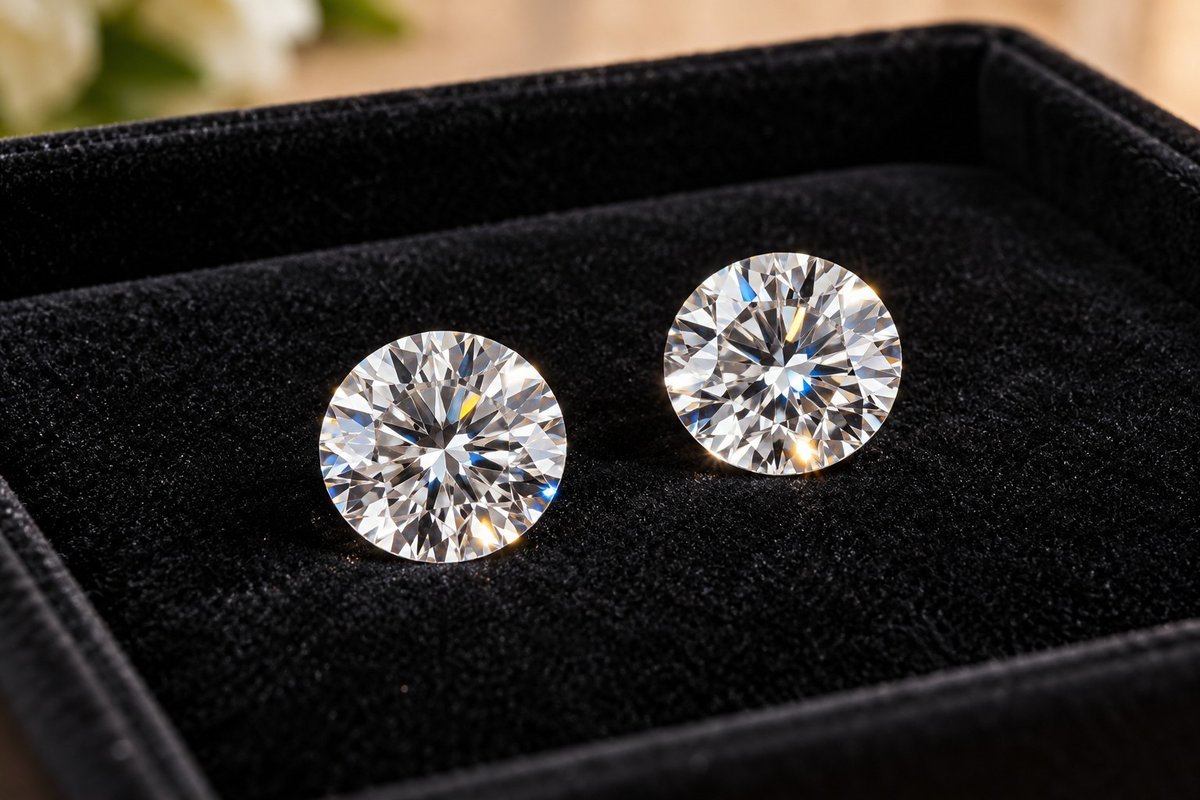
An Excellent cut grade is worth paying for when it comes with proportions that actually deliver more brightness and sparkle, but the label alone does not guarantee that. Many Very Good round diamonds look almost identical to Excellent stones in normal light, while others fall just short for reasons you can see. The useful question is not “Excellent or Very Good?” but “why did this particular stone get the grade it did?”
This guide includes a few product links near the end. As an Amazon Associate, Diamond Taire earns from qualifying purchases, at no extra cost to you.
This guide explains what the GIA cut grade measures on a round brilliant, what usually separates an Excellent from a Very Good, why the actual proportions and light performance matter more than the word on the report, and how to judge fancy shapes that have no GIA cut grade at all. For the anatomy of a cut diamond and how angles shape light, see the companion guide to diamond cut quality, proportions and angles.
At a glance
- GIA gives an overall cut grade only to standard round brilliant diamonds, on a five-step scale: Excellent, Very Good, Good, Fair and Poor.
- The grade weighs seven components: brightness, fire, scintillation, weight ratio, durability, polish and symmetry.
- Stones within the same grade can look noticeably different, so the proportions and an actual look at the stone tell you more than the label.
- A Very Good stone with well-balanced proportions can be better value than an Excellent stone at the edge of its grade; a Very Good stone that misses for a visible reason is not.
- Fancy shapes such as ovals, pears and cushions get no overall GIA cut grade, so you judge them by eye, by video and by polish and symmetry.
What the GIA cut grade actually measures
GIA developed its cut grading system for round brilliants through years of research published in its journal, Gems & Gemology. That research found that the combination of proportions matters more than any single measurement, and that attractive diamonds can be cut across a wider range of proportions than traditional rules suggested. The system groups what it assesses into three areas.
| Area | Component | What it means in plain terms |
|---|---|---|
| Face-up appearance | Brightness | How much white light the diamond returns to the eye |
| Face-up appearance | Fire | The flashes of spectral colour as light disperses |
| Face-up appearance | Scintillation | The sparkle and the pattern of light and dark areas as the stone, the light or the viewer moves |
| Design | Weight ratio | Whether weight is hidden where it adds carats but not visible size, such as a thick girdle or deep pavilion |
| Design | Durability | Whether the design leaves the stone more vulnerable, for example a very thin girdle |
| Craftsmanship | Polish | The quality of the facet surfaces |
| Craftsmanship | Symmetry | How precisely the facets are shaped, aligned and placed |
According to GIA, the overall grade is limited by the weakest components, which is why a stone with lovely light return can still drop to Very Good because of something like a thick girdle or a polish or symmetry grade. GIA also notes that a Very Good polish or symmetry grade can still sit alongside an Excellent overall cut grade when the other factors are strong enough.
GIA’s cut grade applies to round brilliants on its natural diamond reports. Since 1 October 2025, GIA has handled laboratory-grown diamonds differently: rather than a D-to-Z colour grade, a clarity grade and a separate cut grade, qualifying laboratory-grown stones are classified as Premium or Standard. For round brilliants, GIA’s published criteria call for an Excellent cut grade with Excellent polish and symmetry for Premium, and Very Good for Standard. IGI continues to issue colour, clarity and cut grades on its laboratory-grown reports in the usual way. More on how reports differ is in understanding diamond certification.
What usually separates Excellent from Very Good
A stone can land in Very Good for very different reasons, and those reasons are not equally important to how it looks.
| Reason a stone is Very Good rather than Excellent | Can you usually see it? | How much it matters |
|---|---|---|
| Crown and pavilion angles slightly outside the Excellent combination | Sometimes, as slightly less brightness or a less even pattern | Can matter; check images or video |
| Thick or very thick girdle | Not directly, but the stone may face up smaller for its carat weight | Matters for value: you pay for weight you cannot see |
| Very thin girdle | No | Matters for durability, especially in a ring |
| Deep total depth | Often, as a smaller face-up size and possible dark areas | Matters for both looks and value |
| Table slightly large or small | Rarely on its own | Usually minor, depending on the other angles |
| Very Good polish or symmetry | Rarely without magnification | Usually minor |
The pattern is clear: Very Good for a craftsmanship detail you cannot see is very different from Very Good because the stone is cut deep and hides weight. The second is a poorer buy even if the price is lower.
Why the proportions matter more than the label
A grade is a band, not a point. Two Excellent diamonds can differ visibly, and the best Very Good stones can overlap with the lower end of Excellent. GIA’s own research notes that diamonds with different appearances are found within each cut grade, and that personal preference plays a part. Some people prefer a stone that looks bright and crisp; others prefer stronger flashes of colour.
That is why buyers who care about cut look past the grade to the numbers on the report:
- Total depth and table percentage tell you how the stone is proportioned overall.
- Crown angle and pavilion angle work together; the pairing matters more than either on its own.
- Girdle thickness affects both durability and how large the stone looks for its weight.
- Diameter in millimetres compared with carat weight shows whether the stone faces up at a normal size.
The companion guide to cut quality and proportions explains how these measurements shape light. This guide does not repeat that detail; the point here is how to use it in the Excellent versus Very Good decision.
Light performance information
Some reports, imaging tools and sellers provide light performance images, such as reflector-style images that show where a diamond returns light and where it leaks. These are not part of the GIA cut grade, and different tools are not directly comparable, but they can help when two stones carry the same grade. Older AGS reports are also still seen on the resale market; the AGS laboratory closed at the end of 2022, so no new AGS reports are issued, and its 0-to-10 cut scale cannot be compared one-for-one with GIA’s.
Is the top grade worth the extra money?
Cut affects price, and Excellent stones generally cost more than otherwise comparable Very Good stones. The size of that gap varies by size, market and seller, so there is no reliable rule for it; compare real stones at the time you buy. What you can decide in advance is when the premium makes sense.
When Excellent is usually worth it
- The stone is the centrepiece of an engagement ring and sparkle is the priority.
- You are buying without seeing the stone in person and want the grade to narrow the risk.
- The Very Good alternatives you are comparing are Very Good because of depth, girdle or angle issues rather than minor polish or symmetry.
- You expect to resell or upgrade one day and want the more widely accepted description. Note that resale values are uncertain and this is not a reason to treat a diamond as an investment; see do fine diamonds hold their value?
When Very Good is often the smarter buy
- The proportions are close to the Excellent combination and the downgrade comes from something you cannot see, such as polish or symmetry.
- The stone faces up at a normal diameter for its weight.
- The diamond is going into a halo, a pavé setting or a pendant, where surrounding sparkle or viewing distance makes small differences less noticeable.
- Saving on cut lets you meet another priority, such as a larger stone or a better setting, without falling into a poorly cut stone.
Grades below Very Good are a different matter. Good, Fair and Poor round brilliants usually show noticeably less brightness or face up smaller, and they rarely represent good value for a centre stone. The guide to best value diamond combinations shows how cut fits alongside colour, clarity and carat when stretching a budget.
Fancy shapes: no GIA cut grade
GIA does not give an overall cut grade to fancy shapes such as ovals, pears, marquises, cushions, emerald cuts, princess cuts and radiants. Their reports still include polish and symmetry, along with measurements and proportions. Some other laboratories and sellers apply their own cut assessments to fancy shapes, but there is no single agreed standard, so treat any such grade as that organisation’s opinion.
For fancy shapes, judge cut through:
- The face-up look in images or video: is the brightness even, or are there dark or washed-out areas?
- The bow-tie effect in ovals, pears and marquises: some is normal, but a strong, dark bow-tie is a cut issue. See oval diamonds and the bow-tie effect.
- Length-to-width ratio: a matter of taste, but it changes the outline dramatically.
- Depth and table relative to the shape: very deep fancy shapes face up small.
- Polish and symmetry: useful signals of care, though less important than the overall look.
Each shape behaves differently; the guide to diamond shapes covers the characteristics of each.
A worked example
Imagine two round diamonds with the same carat weight, colour and clarity on GIA reports. Stone A is Excellent cut. Stone B is Very Good. Here is how to compare them:
- Find why Stone B is Very Good. Look at its girdle, total depth, angles, polish and symmetry. Suppose its angles and depth sit comfortably in a typical range and its symmetry is Very Good.
- Compare face-up size. If both measure about the same diameter, Stone B is not hiding weight.
- Look at both stones. In person, or by high-quality video under the same lighting, check brightness and the evenness of the sparkle pattern.
- Weigh the price difference against what you see. If you genuinely cannot tell them apart and the gap is meaningful to you, Stone B is a sensible choice.
Now change one fact: Stone B is Very Good because it is cut deep with a thick girdle, and it measures noticeably smaller across. In that case the lower price is buying a stone that looks smaller and may be less bright, and Stone A is the better purchase.
Questions to ask before you choose
- Which component or measurement kept this stone out of Excellent?
- What is the diameter, and is it normal for the carat weight?
- Can I see the stone, or a true-colour video of it, next to the alternative?
- Is the girdle thickness within a normal range for durability?
- For a laboratory-grown stone, which laboratory graded it, and what does its cut assessment mean on that laboratory’s scale?
- For a fancy shape, how strong is any bow-tie or dark area?
Common mistakes
- Treating every Excellent as equal. The grade is a range; proportions and the stone itself still matter.
- Treating every Very Good as a bargain. A deep, thick-girdled Very Good is cheaper for a reason.
- Comparing cut grades across laboratories as if they were the same scale. Each laboratory sets its own standards.
- Expecting a GIA cut grade on a fancy shape. There is none, so judge the stone visually.
- Overpaying for “triple Excellent” without looking. Excellent cut, polish and symmetry together is a good sign, but it does not replace looking at the diamond.
- Letting colour or clarity crowd out cut. Cut has the largest effect on sparkle; the 4 Cs guide explains how the grades interact.
Sources this guide draws on: GIA’s published research on grading cut quality in round brilliant diamonds in Gems & Gemology, GIA’s consumer guidance on its diamond cut grade, GIA’s announcement of its updated laboratory-grown diamond services effective 1 October 2025, IGI laboratory-grown diamond grading reports, and trade press reporting on the closure of AGS Laboratories at the end of 2022.
Useful tools for this guide
Practical picks for choosing, checking and caring for jewellery. As an Amazon Associate, Diamond Taire earns from qualifying purchases, at no extra cost to you. Prices and availability are set by Amazon and may vary by country.
- Foldable 30x Jeweller’s Loupe
Pocket magnifier for checking stones, settings and hallmarks up close.
View on Amazon - CONNOISSEURS Premium Jewellery Cleaner
Gentle dip cleaner with a brush and tray for diamonds, gold and platinum. Check the label for stones it should not be used on.
View on Amazon - Ring Sizer Measuring Tool Kit (27 pieces)
Sizing rings plus a mandrel, to check a size at home before you buy or resize.
View on Amazon
Frequently asked questions
Can you tell the difference between an Excellent and a Very Good cut?
Sometimes, but often not in normal lighting when the Very Good stone has well-balanced proportions. The difference is more likely to be visible when the Very Good grade comes from depth or angle issues. Comparing the stones side by side under the same light is the most reliable test.
Is a Very Good cut diamond good enough for an engagement ring?
Yes, a well-proportioned Very Good round can make a beautiful engagement ring. Check why it missed Excellent and confirm it faces up at a normal size for its weight. If sparkle is your top priority and the budget allows, Excellent narrows the risk.
Do oval or cushion diamonds have a cut grade?
GIA does not give an overall cut grade to fancy shapes, though their reports include polish and symmetry. Some other laboratories and sellers use their own cut assessments. Judge fancy shapes by their face-up look, bow-tie, proportions and outline.
What does triple Excellent mean?
It is a trade term for a round diamond with Excellent cut, Excellent polish and Excellent symmetry on its grading report. It is not a separate GIA grade. It signals careful cutting but does not guarantee one stone will look better than another of the same grade.
Do lab-grown diamonds get cut grades?
It depends on the laboratory. IGI continues to grade cut on laboratory-grown round brilliants. Since 1 October 2025, GIA instead classifies qualifying laboratory-grown stones as Premium or Standard, with Excellent cut criteria for Premium rounds and Very Good for Standard.
The top cut grade is a helpful filter, not a guarantee. Use it to narrow your choices, then let the proportions, the face-up size and your own eyes decide. A carefully chosen Very Good can be a smart buy, and a carefully chosen Excellent is rarely a regret.