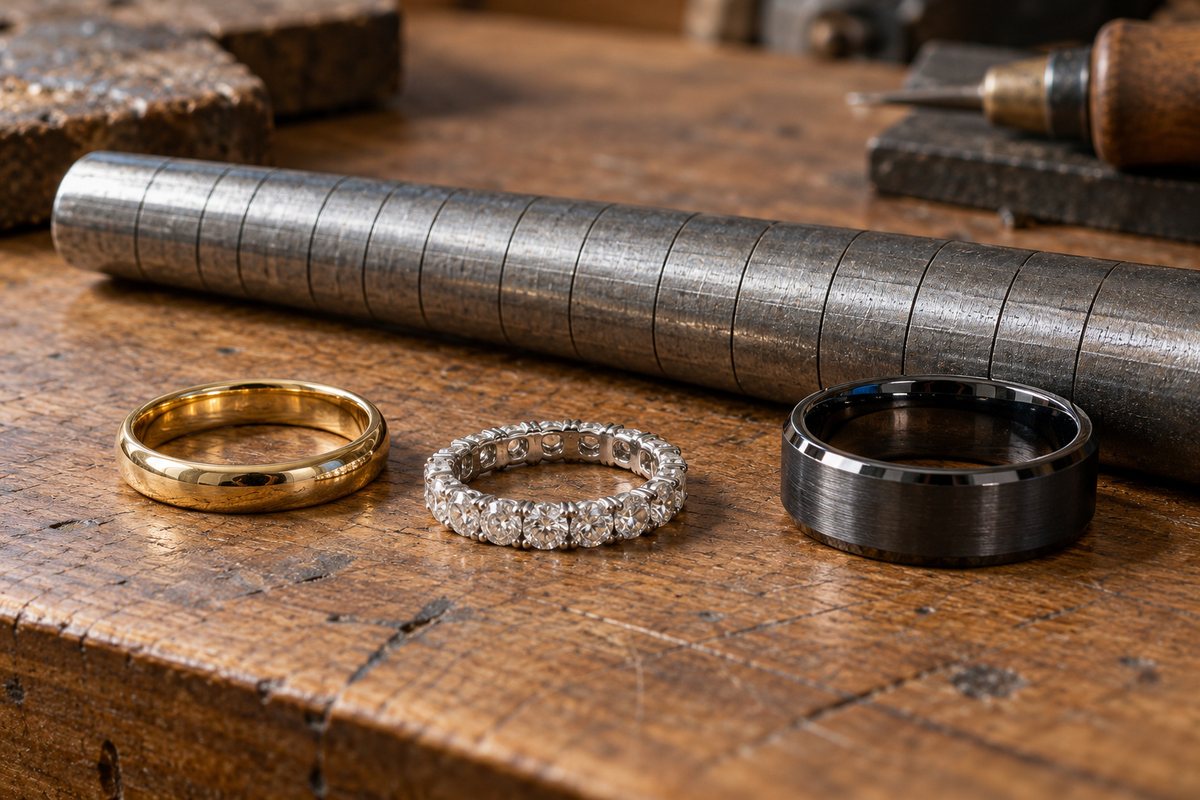
Most plain gold, silver and platinum rings can be resized safely by a skilled jeweller, usually by cutting the band and removing or adding a small piece of metal. Rings that are hard or impossible to resize include full eternity bands, tension-set rings, tungsten, titanium, ceramic and most stainless steel rings, and rings with stones or engraving running all the way around. For those, alternatives such as sizing beads, spring inserts or a replacement ring are usually the safer answer.
This guide helps you work out whether your ring can be resized, how far, and what the risks are, before you hand it over. It covers ring types one by one, a quick decision table, the warning signs that resizing could cause damage, and the alternatives when it can’t be done. If you want to know what resizing usually costs, see the separate guide to ring resizing cost.
At a glance
- Plain precious-metal bands are the easiest. Gold, silver and platinum can usually be cut and rejoined with little trace.
- Stones around the whole band are the hardest. Full eternity and fully channel-set rings usually can’t be resized without unsetting stones.
- Some materials can’t be resized at all. Tungsten, ceramic and most titanium rings have to be replaced in the right size.
- Small changes are safest. On stone-set rings, one or two sizes is often manageable; bigger changes raise the risk of distortion and loose stones.
- Engraving and hallmarks can be lost. Ask before work starts whether they will survive.
How resizing works, and why some rings can’t take it
To make a ring smaller, a jeweller usually cuts out a small section of the shank (the band), closes the gap, solders or welds the join and polishes it. To make it larger, they either stretch the band slightly on a mandrel or cut it and add a new piece of matching metal. Heat, pressure and polishing are all involved, and each of those is where problems can start.
A ring is hard to resize when one of three things is true: the metal cannot be cut and rejoined (tungsten, ceramic); changing the circle would disturb stones or a mechanism that holds them (eternity, channel and tension settings); or the surface would be damaged in a way that cannot be restored (detailed engraving, enamel, some textured finishes).
Can it be resized? Ring types at a glance
| Ring type | Usually resizable? | Main risk or limit |
|---|---|---|
| Plain gold band (yellow, white, rose) | Yes | White gold may need re-plating; rose gold can be hard to colour-match when sizing up |
| Plain platinum band | Yes | Needs a jeweller experienced with platinum |
| Sterling silver | Yes, usually | Thin or cheap silver rings may cost more to resize than to replace |
| Solitaire engagement ring | Yes, within limits | Large changes can distort the head and loosen the stone |
| Half eternity ring | Often, a small amount | Work happens on the plain back; too much change can stress the set stones |
| Full eternity ring | Rarely | No plain metal to cut; stones would need removing and resetting |
| Channel-set or pavé all round | Rarely | Changing the curve can loosen stones along the band |
| Tension-set ring | Usually no | The band’s spring tension holds the stone; resizing changes it |
| Tungsten carbide | No | Too hard to cut and rejoin |
| Titanium | Usually no | Extremely difficult to work; replacement is the normal answer |
| Ceramic, stainless steel, cobalt | No, or very rarely | Cannot be joined like precious metals |
| Engraved band | Sometimes | Engraving near the join can be cut through or polished away |
| Two-tone or mixed-metal | Sometimes | Different metals can leave a visible join |
| Wood, carbon fibre, resin inlays | No | Inlays can’t take heat or be rejoined |
Every ring is different, so treat this as a starting point. A jeweller who can see and measure your ring will give you the real answer.
Ring types that need extra care
Eternity rings
A full eternity ring has stones set all the way around, which leaves no plain section to cut. Resizing usually means removing stones, adding or taking out metal and stones, and resetting them, which is costly and not always possible. Half and three-quarter eternity rings are more flexible because there is a plain back to work on, but only within a small range. If you are still choosing, the comparison of full versus half eternity rings covers this trade-off in detail.
Channel-set and pavé bands
In a channel setting, stones sit in a groove held by the metal walls on either side. Bending the band to a new size changes that groove and can loosen or crack stones. Pavé settings rely on tiny beads of metal over each stone, which can also shift. Small changes on a ring with stones only across the top are often possible; stones running all the way round make it much harder.
Tension settings
In a true tension setting, the band itself squeezes the stone and holds it in place. Changing the size changes that pressure, so most jewellers will not resize these. Many makers advise returning the ring to them, and some offer to make a new band in the right size.
Tungsten, titanium, ceramic and other modern metals
Tungsten carbide and ceramic are very hard and brittle, and cannot be cut and soldered the way gold can. Titanium is extremely difficult to work and in practice is usually treated as non-resizable. Many sellers of these rings offer size exchanges instead, so check the warranty first. The comparison of tungsten and titanium wedding bands explains the pros and cons, including what happens if a ring needs to be removed in an emergency.
Engraved and hallmarked rings
Engraving close to the join can be cut through, and light machine or laser engraving can be polished away. Hallmarks inside the band can also be lost. If either matters to you, ask the jeweller to cut on the opposite side and to tell you before work starts whether re-engraving or re-marking will be needed.
White gold and rose gold
Most white gold is plated with rhodium for its bright white colour, so resizing usually finishes with fresh plating. Rose gold gets its colour from copper, and matching new metal exactly can be tricky when sizing up. The guides to platinum versus white gold and gold karats explain how alloys differ.
Warning signs that resizing could cause damage
- The band is already thin, worn or flattened at the bottom.
- The ring has been resized several times; each resize leaves another join.
- Stones are already loose, or prongs look worn.
- The change needed is large (more than one or two sizes on a stone-set ring).
- The ring is old or antique, with fine detail, enamel or delicate filigree.
- The shank is very narrow, so there is little metal to work with.
- It is a family heirloom whose exact appearance matters more than the fit.
If any of these apply, ask for a careful assessment, and consider whether an alternative to resizing would protect the ring better.
Alternatives when a ring can’t (or shouldn’t) be resized
| Option | What it does | Best for | Drawbacks |
|---|---|---|---|
| Sizing beads (balls) | Two small metal beads soldered inside the band to stop it spinning and sliding | Rings slightly too big; top-heavy solitaires | Can feel odd at first; a permanent addition |
| Spring insert | A small sprung bar inside the band that flexes over the knuckle | Large knuckles, swelling fingers | Needs a wide enough shank; can collect dirt |
| Removable ring guard or adjuster | A clip or soft liner that narrows the inside of the ring | Temporary fixes; non-resizable materials | Less secure; can scratch metal if poorly made |
| Flat-sided or squared-off shank | Reshapes the bottom of the band to stop it rotating | Rings that spin rather than fall off | Changes the feel and look of the band |
| New band or remake | A new shank or a new ring in the right size, keeping the stones | Full eternity, tension and modern-metal rings | Usually the most expensive and slowest option |
| Wear on a different finger | Simply move the ring | Small mismatches | Not right for every ring’s meaning |
Before you resize: a step-by-step check
- Confirm your real size. Measure at the end of the day when fingers are warm, and more than once. The guide to measuring ring size at home explains how.
- Identify the metal and setting. Check the stamp inside the band and note how the stones are held.
- Check for wear. Look at the thickness of the band and the state of the prongs before any work.
- Ask about limits. How many sizes can this ring safely move, and in which direction?
- Ask about stones. Will any need to be tightened, removed or reset, and who is responsible if one is damaged?
- Ask about finish. Will engraving, hallmarks, texture or plating be affected?
- Record the ring. Photograph it and note the stones and any report numbers before you hand it over.
- Check warranty and insurance. Some warranties require work by the original maker, and your insurer may need to know.
Common mistakes
- Resizing in summer or winter extremes. Fingers swell in heat and shrink in cold; measure more than once.
- Going a full size when half a size would do. Smaller changes are kinder to the ring.
- Assuming any jeweller can work on any metal. Platinum and stone-heavy rings need experience.
- Ignoring the original maker. Tension, tungsten and titanium rings are often best handled through the maker’s exchange or warranty.
- Resizing repeatedly. Each resize adds stress; if your size changes often, an insert or adjuster may be better.
- Forgetting the matching band. If an engagement ring and wedding band are worn together, resize them so they still sit well side by side.
Related guide: How Much Does It Cost to Resize a Ring? A Smart Price Guide.
Sources this guide draws on: general bench-jeweller practice on cutting, joining and stretching ring shanks; published jeweller guidance on which ring types can and cannot be resized; manufacturer guidance on tungsten, titanium and tension-set rings.
Frequently asked questions
Can every ring be resized?
No. Most plain gold, silver and platinum rings can, but full eternity rings, tension-set rings, and rings made from tungsten, ceramic or most titanium usually cannot. Rings with stones or engraving all the way around are also difficult.
How many sizes can a ring be resized?
It depends on the ring. Plain bands can often move several sizes, while stone-set rings are safest with a change of one or two sizes. Larger changes can distort the band and loosen stones, so ask a jeweller to assess your ring.
Can an eternity ring be resized?
Half eternity rings can often be resized a small amount because the back is plain metal. Full eternity rings usually cannot without removing and resetting stones, so remaking or replacing the band is common.
Does resizing damage a ring?
Done well, on a suitable ring, resizing leaves little or no visible trace. Risks rise with thin bands, large changes, repeated resizing, stones set around the band and detailed engraving.
What can I do if my ring can’t be resized?
Options include sizing beads, a spring insert, a removable ring guard, a new band that keeps your stones, or a size exchange from the maker. The best choice depends on whether the ring is too big or too small, and by how much.
Can a tungsten or titanium ring be resized?
Tungsten cannot be resized, and titanium is so difficult to work that it is usually treated as non-resizable. Check whether the seller offers a lifetime size exchange.
Knowing what your ring is made of and how its stones are held tells you most of what you need. Ask the right questions first and you can get a comfortable fit without putting a ring you love at risk.