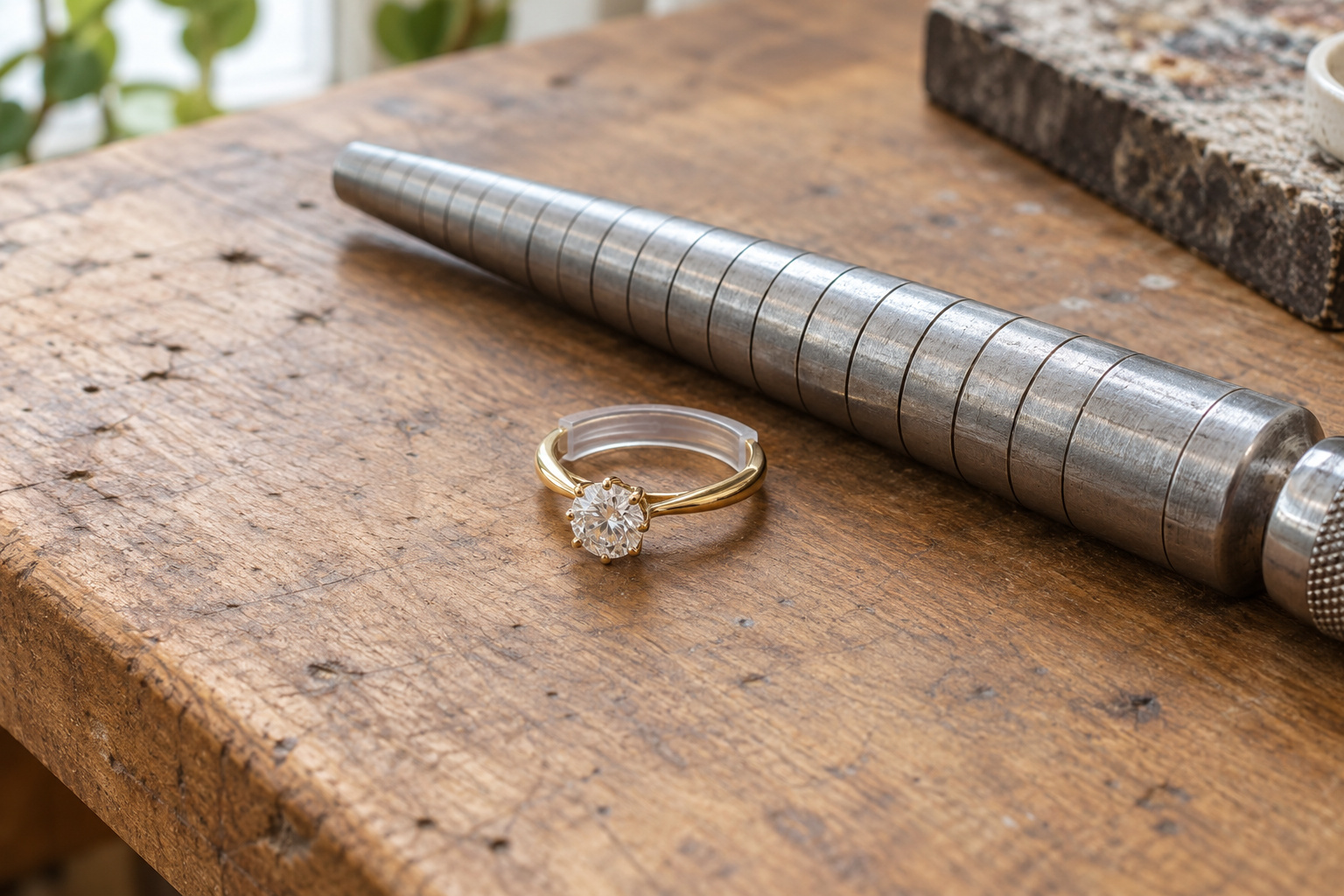
To make a ring smaller you have two routes: add something inside the band that takes up space, or have a jeweller remove metal and close the band to a smaller size. Temporary sizers such as silicone adjusters cost little and come straight off again; jeweller options such as sizing beads, spring inserts or a proper size-down are more secure, and only a size-down actually changes the ring’s measurement.
This guide includes a few product links near the end. As an Amazon Associate, Diamond Taire earns from qualifying purchases, at no extra cost to you.
This guide compares every option side by side, explains which ones suit which metals and settings, and helps you decide whether a quick fix is enough or whether the ring needs to go to the bench. If you already know you want it resized and want to know the price, our guide to what ring resizing costs covers that in detail.
At a glance
- A ring that slides off easily over the knuckle is a real loss risk, not just an annoyance. Fix it before wearing it every day.
- Non-permanent sizers (silicone or plastic adjusters, wraps, tape) suit small gaps, short-term changes and rings that cannot be cut.
- Jeweller fixes without cutting the band (sizing beads, spring inserts, ring guards or sizing bars) suit a ring that fits over the knuckle but spins or slides at the base.
- A true size-down is the right answer when the ring is a full size or more too big and your finger size is stable.
- Eternity rings, tension settings, tungsten, titanium and some ceramic bands limit or rule out normal resizing, so sizers or inserts become the main options.
First, check that the ring really is too big
Fingers change size through the day and with the seasons. They are often slimmer in the morning and in cold weather, and fuller after exercise, in heat or after a salty meal. Before you change anything permanent, wear the ring at different times for a week or two and notice when it feels loose. If the problem is only on cold mornings, a removable sizer may be all you ever need.
It also helps to know your actual size. Our step-by-step guide to measuring your ring size at home explains how to measure accurately, and the ring size chart and converter helps if your ring is marked in a different country’s system. A jeweller’s sizing gauge is still the most reliable check before any permanent work.
Signs that a too-big ring is a loss risk
- It slides over the knuckle with no resistance at all.
- It slips off when your hands are wet, cold or soapy.
- A heavy centre stone keeps rolling to the palm side.
- You catch yourself pushing it back up the finger without thinking.
If any of these apply, treat the fix as urgent. Valuable rings are often lost while swimming, washing up or taking gloves off. If the ring is insured, it is worth checking whether your policy has conditions about wear and care; our guide to insuring and protecting fine jewellery covers the questions to ask.
Non-permanent sizers you can fit yourself
These options sit inside the band, cost little and can be removed without leaving a mark. They are the best place to start if the ring is only slightly loose, if your size changes often, or if the ring cannot be cut.
Silicone or plastic ring adjusters
A soft tube or coil that wraps around the lower part of the band and fills the gap between ring and finger. Most are nearly invisible from above. They come in different thicknesses for different gap sizes. Downsides: they can look bulky on a very thin band, they trap soap and moisture against the skin if not cleaned, and they wear out and need replacing.
Ring wraps and sizing tape
Thin strips placed inside the band. They are useful for a single event or for testing how much tighter you want the ring before committing to anything permanent. Handwashing, moisture and skin oils weaken the hold, so they are not a long-term solution.
Clip-on metal guards
Small metal clips that fit around the inside of the band. They are more durable than silicone but metal rubbing against metal can scratch the inside of the ring over time, particularly on softer metals such as high-karat gold.
Liquid or resin coatings
A clear coating painted inside the band. Retail jewellery guidance generally cautions that these are not ideal for fine jewellery: they can trap moisture and oils, and removing them can scratch the ring. They are best avoided on anything valuable.
Jeweller fixes that do not shrink the band
These are fitted at a jeweller’s bench but leave the band’s actual circumference unchanged. They are particularly useful when your knuckle is wider than the base of your finger, so a ring that fits over the knuckle is always loose below it.
Sizing beads
Two small metal beads soldered inside the lower part of the band, usually one on each side. They reduce the space just enough to stop the ring spinning or sliding, while still letting it pass over the knuckle. They are discreet and generally among the cheaper jeweller options. Some people find them uncomfortable at first, and they need to be in the same metal as the ring.
Spring inserts
A thin, flexible blade fitted inside the band. It compresses as the ring passes over the knuckle and springs back at the base of the finger. Spring inserts suit larger knuckles and slim finger bases best. They need enough space inside the band and suit simpler designs better than intricate ones.
Ring guards and sizing bars
A curved metal liner, sometimes called a horseshoe insert or U-liner, soldered inside the band. It touches more of the finger than sizing beads and gives firmer support. It is noticeable to the wearer but not usually visible from above.
Counter-weight
If the ring is the right size but a heavy centre stone keeps pulling it round, a jeweller can add weight or thickness to the bottom of the band. This balances the ring so the stone stays on top. It suits tall solitaires and elongated shapes such as ovals and marquises.
Hinged shank
Part of the lower band is replaced with a hinge that opens and closes, so the ring goes on without passing over the knuckle at all. It is one of the more involved and expensive options and suits people with a big difference between knuckle and finger base, such as some people with arthritis.
Sizing down: what a jeweller actually does
For most plain or simply set rings in gold, platinum or silver, sizing down means cutting the band at the bottom, removing a small section of metal, closing the gap and soldering or welding it, then reshaping, smoothing and polishing so the join is hard to see. White gold usually needs replating with rhodium afterwards to restore the bright white finish; our guide to white gold explains why.
Sizing down is often simpler than sizing up, because nothing needs to be added. It is permanent, which is the point: the ring is the right size and stays secure without anything inside it. It does mean the ring is only correct for one size, so if your size changes again later, you would need another adjustment.
Rings that are hard or impossible to size down
- Full eternity rings with stones all the way round, because there is no plain section to cut. Our comparison of full and half eternity rings covers this trade-off.
- Tension settings, where the band itself holds the stone under pressure.
- Tungsten, titanium and ceramic bands, which generally cannot be resized in the usual way. See our tungsten vs titanium guide for more.
- Channel-set or pave bands where stones run far down the shank, since cutting and reshaping can loosen them.
- Engraved, patterned or two-tone bands, where a join can interrupt the design.
For these rings, the fixes in the earlier sections are usually the realistic choices. A jeweller can tell you which settings on your specific ring would be put under strain; our guide to ring settings explains how the main styles differ.
Every option compared
| Option | Permanent? | Fitted by | Best for | Main drawback |
|---|---|---|---|---|
| Silicone or plastic adjuster | No | You | Small gaps, seasonal changes, rings that cannot be cut | Wears out; can trap moisture |
| Wrap or sizing tape | No | You | One event, or testing a tighter fit | Loses grip with water and skin oils |
| Clip-on metal guard | No | You | Short-term use on harder metals | Can scratch the inside of the band |
| Sizing beads | Semi (removable by a jeweller) | Jeweller | Ring fits the knuckle but spins at the base | Some people feel them; small adjustment only |
| Spring insert | Semi | Jeweller | Large knuckle, slim finger base | Needs space inside; not every design suits it |
| Ring guard or sizing bar | Semi | Jeweller | Firmer support for a loose ring | Noticeable to the wearer |
| Hinged shank | Yes | Jeweller | Very large knuckle-to-base difference | One of the costlier options |
| Sizing down | Yes | Jeweller | A full size or more too big, stable finger size | Not possible for every ring; permanent |
How to choose: a decision checklist
- Measure properly. Get sized by a jeweller, ideally more than once and at different times of day, so you know how far out the ring is.
- Is the change temporary? Pregnancy, weight changes, medication, seasonal swelling or recovery after an illness can all change finger size for a while. If so, start with a removable adjuster.
- Is the ring loose everywhere or only below the knuckle? Loose everywhere points to sizing down. Loose only below the knuckle points to beads, a spring insert or a guard.
- What is it made of and how is it set? If it is tungsten, titanium, ceramic, a full eternity or tension setting, rule out a standard size-down.
- How valuable or sentimental is it? Heirlooms and antique rings can have thin or repaired shanks. Ask a jeweller to inspect it before any cutting.
- Try a temporary fix first. Wearing an adjuster for a few weeks tells you how much tighter you want the ring and whether a permanent change is really necessary.
- Get a written quote for any jeweller work, listing the method, the metal used and any replating.
Who each route suits
Temporary sizers suit people whose size changes, anyone wearing a borrowed ring for an event, anyone waiting for a jeweller appointment, and rings that cannot be cut. They do not suit a ring that is two or more sizes too big, or very thin bands where the adjuster would be bulky.
Jeweller sizing down suits a ring that is consistently too big, in a resizable metal and setting, worn by someone whose size has settled. It does not suit rings with stones all the way round, rings that may need to grow again soon, or rings that are already thin at the base.
Common mistakes
- Wearing a loose ring “for now”. Many lost rings are lost during exactly this period. Use a cheap adjuster immediately while you decide.
- Sizing down in the cold. Being measured on a chilly morning can lead to a ring that is too tight in summer.
- Using resin coatings on fine jewellery. They can trap moisture and scratch the band when removed.
- Choosing the wrong fix for a big knuckle. Sizing down a ring to fit a slim finger base can make it impossible to get over the knuckle. Beads or a spring insert usually work better.
- Ignoring the stones. Cutting and reshaping the band can stress nearby claws or channel settings. Ask the jeweller to check the setting after the work.
- Skipping paperwork. Photograph the ring and get a receipt describing it before leaving it at any workshop.
- Forgetting the matching band. If you wear an engagement ring and wedding band together, size them together. Both rings need to sit comfortably at the same size.
Sources this guide draws on: Blue Nile’s guide to keeping rings from spinning (for descriptions of sizing beads, spring inserts, sizing bars, hinged shanks and its caution on liquid ring guards), Esslinger’s bench guides on spring ring guards, and general jewellery bench practice on sizing down gold, platinum and silver rings.
Useful tools for this guide
Practical picks for choosing, checking and caring for jewellery. As an Amazon Associate, Diamond Taire earns from qualifying purchases, at no extra cost to you. Prices and availability are set by Amazon and may vary by country.
- Ring Sizer Measuring Tool Kit (27 pieces)
Sizing rings plus a mandrel, to check a size at home before you buy or resize.
View on Amazon - KElofoN Travel Jewellery Case
Compact case with ring rolls and earring slots so pieces do not scratch each other.
View on Amazon - CONNOISSEURS Premium Jewellery Cleaner
Gentle dip cleaner with a brush and tray for diamonds, gold and platinum. Check the label for stones it should not be used on.
View on Amazon
Frequently asked questions
How can I make my ring smaller without resizing it?
Use a removable silicone or plastic adjuster, a ring wrap or a clip-on guard, all of which fit inside the band. For a more secure fit without cutting the band, a jeweller can add sizing beads, a spring insert or a sizing bar. None of these change the ring’s measured size.
Do ring size adjusters damage rings?
Soft silicone and plastic adjusters generally do not damage the metal, though they should be removed and cleaned regularly so soap and moisture do not build up. Metal clip-on guards can scratch the inside of softer metals, and resin coatings can scratch the ring when they are removed.
How much smaller can a ring be made?
It depends on the ring’s design, metal and setting. Simple bands can usually be sized down more than heavily set rings. A jeweller who has inspected the ring is the only person who can give a reliable answer for your piece.
Is it better to size a ring down or use sizing beads?
Size down if the ring is loose everywhere and your finger size is stable. Choose sizing beads if the ring only just fits over your knuckle but spins or slides at the base, because sizing down would make it hard to get on.
Can a tungsten or titanium ring be made smaller?
Generally not by normal resizing. Removable adjusters are the usual option, and some sellers offer a size exchange. Check the seller’s policy before buying a band in these metals.
How do I stop my ring spinning?
Spinning is often caused by a heavy top and a slightly loose fit. Sizing beads, a spring insert or a counter-weight added to the base of the band can all help. If the ring is a full size too big, sizing down may solve it on its own.
A too-big ring is one of the easiest jewellery problems to solve, as long as you solve it before the ring goes missing. Start with a removable sizer, find out exactly how loose the ring is, and then choose the permanent fix that suits both your finger and the ring itself.