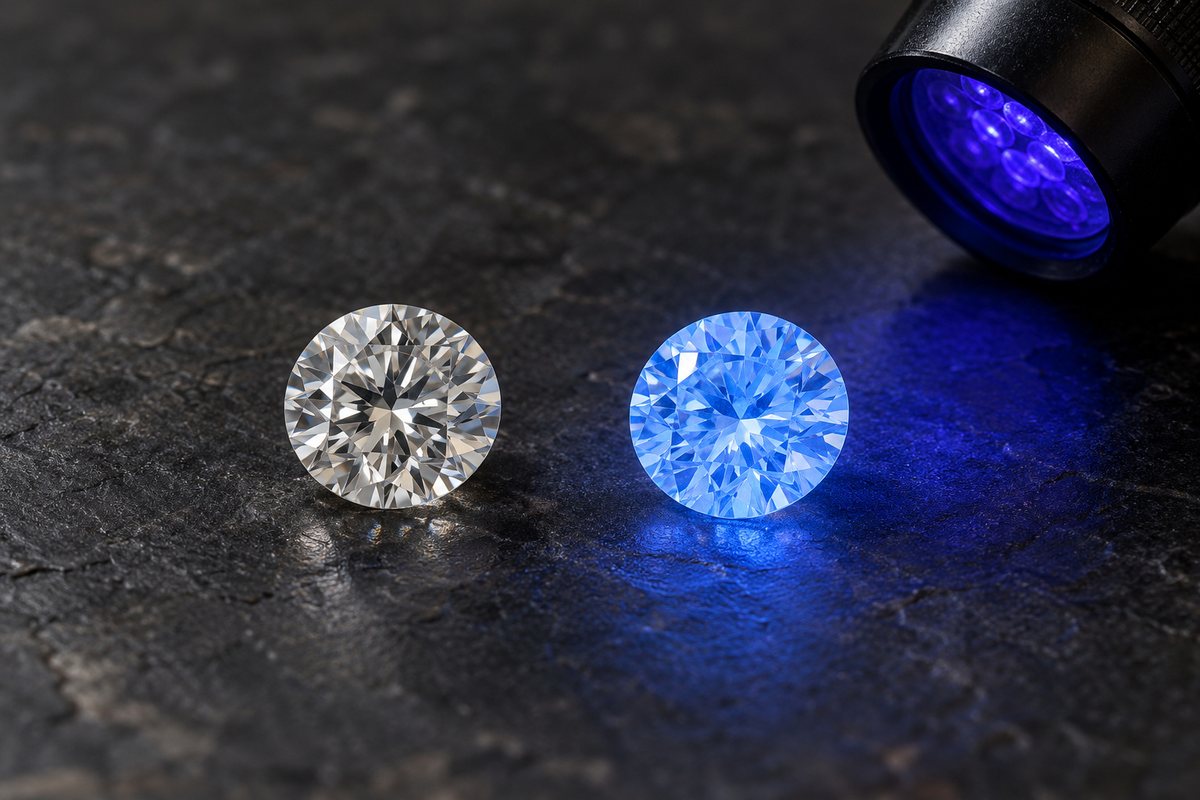
Diamond fluorescence is a glow, usually blue, that some diamonds give off under ultraviolet light such as a blacklight or strong sunlight. For the great majority of diamonds it has no visible effect in normal lighting; GIA reports that only a small share of fluorescent diamonds show enough to affect their appearance. Faint or medium fluorescence is rarely a problem, and strong blue fluorescence can even make a slightly yellowish diamond look whiter, though it often lowers the price of high-colour stones.
This guide explains what fluorescence is, how GIA grades it, how common it is, when it can help or hurt a diamond’s look, how it affects price, what lab-grown diamonds do under UV, and how to decide whether a fluorescent stone is right for you.
At a glance
- It is common. GIA says roughly 25% to 35% of the diamonds it grades show some fluorescence, and more than 95% of those glow blue.
- It is graded on a five-step scale. None, Faint, Medium, Strong and Very Strong, recorded on every GIA diamond grading report.
- It rarely changes how a diamond looks. GIA’s research found visible effects mainly in stones with Strong or Very Strong fluorescence.
- It can help or hurt. Blue glow can offset a faint yellow tint, but in rare cases strong fluorescence combined with tiny structural defects can look hazy.
- It affects price more than appearance. Strong fluorescence is often discounted, especially in the top colour grades, which can be a money-saving opportunity.
What diamond fluorescence is
Fluorescence is the visible light some materials emit while they are exposed to ultraviolet (UV) radiation. In diamonds it is usually caused by trace elements and defects in the crystal, most commonly linked to nitrogen. When the UV source is removed, the glow stops.
You will not normally notice it. Indoor lighting contains little UV, so most fluorescent diamonds look exactly like non-fluorescent ones in a home or office. The glow becomes visible under a blacklight, and sometimes subtly in bright daylight, which contains UV.
How common is it?
According to GIA’s 4Cs guidance, about 25% to 35% of diamonds submitted to its laboratory show some fluorescence, and in more than 95% of those the colour is blue. Yellow, white and other colours occur but are rare. GIA adds that only around 10% of the fluorescent diamonds it sees show enough fluorescence to affect appearance.
How GIA grades fluorescence
Every GIA Diamond Grading Report includes a fluorescence description. The lab compares the stone’s reaction to long-wave UV against master stones and records the strength, plus the colour when it is anything stronger than faint.
| GIA grade | What it means | Typical visible effect in normal light |
|---|---|---|
| None | No detectable reaction to long-wave UV | None |
| Faint | A very weak glow | None; not visible without UV equipment |
| Medium | A clear but moderate glow under UV | Almost never visible |
| Strong | A bright glow under UV | Usually none; can slightly improve the look of warmer colours; occasionally contributes to haziness |
| Very Strong | An intense glow under UV | Most likely to show any effect, positive or negative; worth viewing in person |
Other laboratories use similar wording, though not always identical, and some report “Negligible” or “Slight” instead. The guide to reading a diamond grading report explains where fluorescence appears and how labs differ.
When fluorescence helps
Blue is the complementary colour of yellow. In diamonds with a faint yellow tint, typically in the lower near-colourless and faint colour grades, blue fluorescence can partly cancel out that warmth when the stone is in daylight, so it faces up looking a little whiter.
GIA’s research supports this. A 1997 GIA study found that, viewed face-up, strongly blue fluorescent diamonds were generally perceived to have a better colour appearance. A larger GIA study published in Gems and Gemology in 2021 found that colour was noticeably affected mainly in stones with Strong to Very Strong blue fluorescence, and that increasing UV made fluorescent stones appear less saturated in colour. For a buyer looking at, say, an I or J colour diamond, medium to strong blue fluorescence can be a genuine plus. The site’s guide to diamond colour grades explains where those grades sit.
When fluorescence can hurt
The concern most buyers have heard about is that fluorescent diamonds look “milky”, “oily” or hazy. The research suggests this is rare and is mostly caused by something else. GIA’s 2021 study attributed haziness mainly to light scattering from structural defects inside the diamond, not to fluorescence on its own. It found that fluorescence alone did not noticeably reduce transparency, but that strong fluorescence combined with light-scattering defects did increase apparent haziness, and it detected minor contrast loss in some strongly fluorescent stones.
GIA’s consumer guidance puts the hazy case in perspective: fewer than 0.2% of the fluorescent diamonds it sees look hazy or oily. In very high colour grades (D to F) there is also no yellow tint for blue fluorescence to offset, so some buyers prefer those stones without fluorescence, even though most people cannot see a difference.
Fluorescence and price
Fluorescence usually affects price more than it affects appearance. Because many buyers have heard that fluorescence is bad, diamonds with Strong or Very Strong fluorescence are often priced lower than otherwise similar stones with None or Faint, and the discount tends to be largest in the highest colour grades. In lower colour grades, where blue fluorescence can improve the look, the price difference is usually smaller, and in some cases there may be none at all.
The exact difference varies by seller, market, carat weight and colour, and prices change, so it is best to compare like with like: the same shape, weight, colour, clarity and cut, with only the fluorescence different. For a fuller picture of how the value factors interact, see the guide to what drives a diamond’s price.
Where fluorescence tends to make sense
| Colour range | Faint or Medium fluorescence | Strong or Very Strong fluorescence |
|---|---|---|
| D to F (colourless) | Usually fine; may cost a little less | Often discounted; view in person to rule out haziness |
| G to H (near-colourless, upper) | Usually fine | Can be good value if the stone is clear and bright |
| I to K (near-colourless, lower; faint) | Fine | Often a plus: may face up whiter in daylight |
| L and below | Fine | Can help appearance; judge each stone on how it looks |
Lab-grown diamonds and fluorescence
Lab-grown diamonds can fluoresce too, but their behaviour often differs from natural diamonds because they grow under different conditions and contain different trace defects. Many show weak or no reaction to long-wave UV, while some show fluorescence in colours other than the typical blue, and some grown by the HPHT method can show phosphorescence (a glow that continues briefly after the UV light is switched off). Laboratories use fluorescence colours and growth patterns under specialised UV imaging as one of several clues to tell lab-grown from natural diamonds.
For a buyer, the practical advice is the same: check the report, view the stone in normal lighting and judge it on how it looks. The guide to CVD versus HPHT diamonds explains the two growth methods, and the lab-grown diamond buyer’s guide covers disclosure and grading.
Who should consider a fluorescent diamond, and who shouldn’t
A good fit if: you are shopping in the G to K colour range and want to stretch your budget; you are happy to check the stone in person or with good-quality video; you care more about how a diamond looks than how its report reads.
Possibly not for you if: you are buying a D to F diamond and want the top of the market in every respect; you may want to resell to buyers who discount fluorescence; or you cannot see the stone before buying and the seller will not confirm that it is clear and bright.
How to decide: a step-by-step check
- Read the report. Note the fluorescence strength and colour alongside the colour grade.
- Match fluorescence to colour. In lower near-colourless grades, medium to strong blue is often neutral or helpful. In D to F, weigh the discount against any personal preference.
- Look in several lights. View the diamond in daylight, indoor light and, if possible, under a UV torch so you know what you are buying.
- Check for haziness. For Strong and Very Strong stones, ask the seller to confirm the stone is transparent and bright, not milky. Compare it next to a non-fluorescent stone if you can.
- Compare like with like. Price the same stone specification with and without fluorescence so you know the real saving.
- Keep cut first. A well-cut stone with fluorescence will usually look better than a poorly cut stone without it.
- Get the return terms. Especially online, make sure you can return the stone if it does not look right in person. The guide to buying a diamond online safely has a full checklist.
Common mistakes
- Rejecting every fluorescent diamond. Most look identical to non-fluorescent stones and may cost less.
- Assuming fluorescence causes haziness. Haze is rare and mainly linked to structural defects, not fluorescence alone.
- Paying a premium for “None” in a lower colour grade. In I or J colour, blue fluorescence may actually help.
- Judging only under a blacklight. A strong glow under UV says little about how the diamond looks at dinner or at work.
- Ignoring the colour of the fluorescence. Blue is the norm; unusual colours are worth asking about.
- Forgetting resale. Some buyers in the second-hand market discount strong fluorescence, so factor that in if resale matters.
Sources this guide draws on: GIA’s 4Cs consumer guidance on diamond fluorescence; the GIA study “Measurement and Characterization of the Effects of Blue Fluorescence on Diamond Appearance” (Gems and Gemology, Summer 2021); the 1997 GIA fluorescence study by Moses and colleagues; GIA grading report terminology.
Frequently asked questions
Is diamond fluorescence bad?
Usually not. Most fluorescent diamonds look the same as non-fluorescent ones in normal lighting, and blue fluorescence can make slightly yellowish diamonds look whiter. A very small share of strongly fluorescent stones look hazy, so view Strong and Very Strong stones before you buy.
Does fluorescence lower a diamond’s value?
It can lower the price, particularly for Strong or Very Strong fluorescence in the highest colour grades. In lower colour grades the effect on price is usually smaller. The difference varies by market and changes over time.
What does “Medium Blue” fluorescence mean on a GIA report?
It means the diamond shows a moderate blue glow under long-wave UV light. In normal lighting it is almost never visible and rarely affects appearance.
Can you see fluorescence in sunlight?
Sometimes, in strong fluorescent stones, because daylight contains UV. Usually it shows as a slightly whiter or bluish look rather than an obvious glow. Indoors you are unlikely to notice it.
Do lab-grown diamonds have fluorescence?
Some do. Many show little reaction to long-wave UV, while others fluoresce in colours other than blue, and some show a brief afterglow called phosphorescence. Labs use these patterns as one clue when identifying lab-grown stones.
Is fluorescence the same as a treatment?
No. Fluorescence is a natural property caused by trace elements and defects in the diamond. It is not something added to the stone, and it does not change with time or wear.
Fluorescence is one of the most misunderstood lines on a diamond report. Treat it as a factor to check rather than a fault to avoid, look at the stone in real light, and you may find a beautiful diamond for less money.