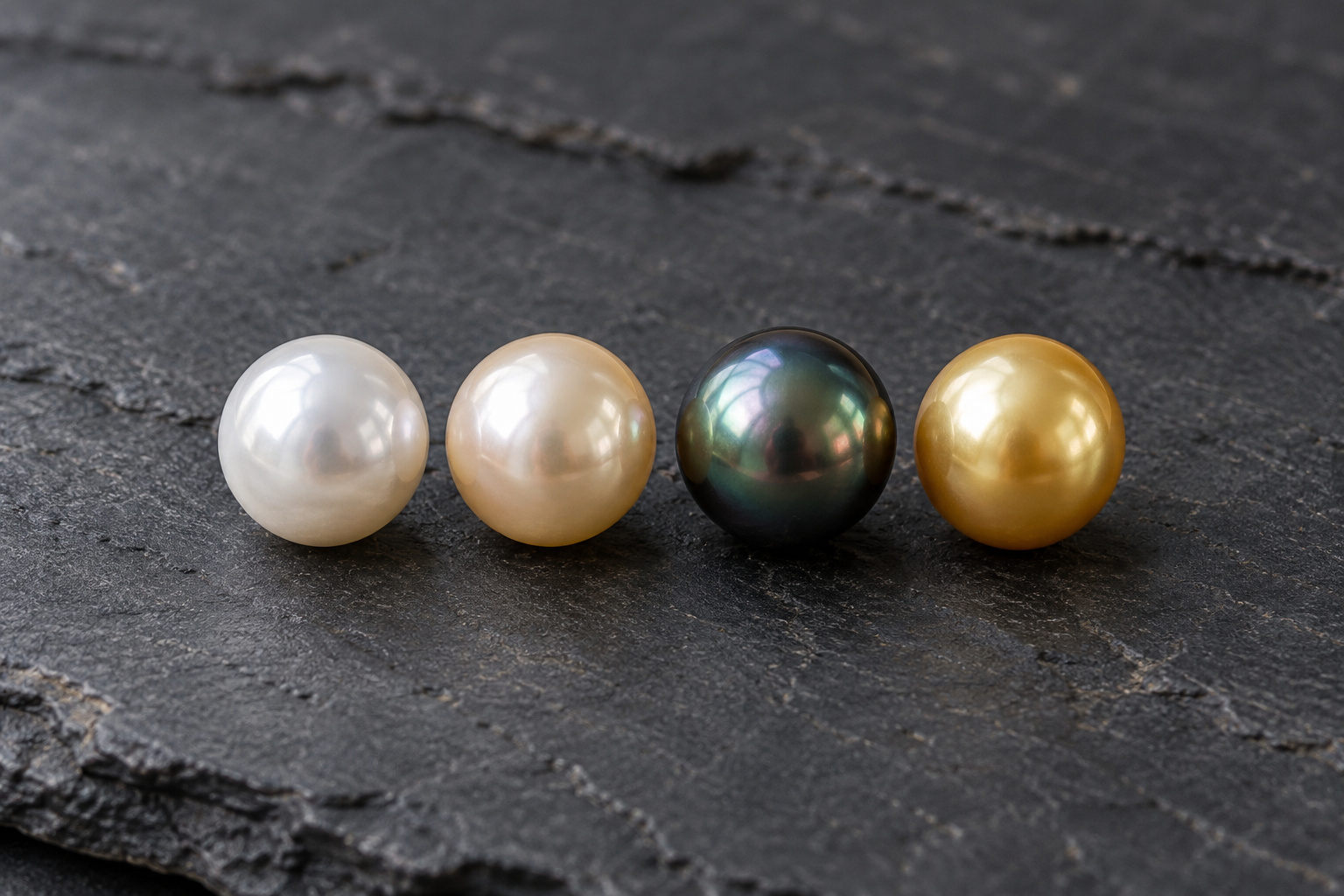
There are four main types of cultured pearl sold in jewellery today: freshwater, Akoya, Tahitian and South Sea. They differ in the mollusc that grows them, where they are farmed, their size, colour and lustre, and therefore their price. Alongside them sit two rarer groups worth knowing, natural pearls and keshi pearls, plus imitations that are not pearls at all.
This guide includes a few product links near the end. As an Amazon Associate, Diamond Taire earns from qualifying purchases, at no extra cost to you.
This guide goes one level deeper than a quick list. It compares every type side by side, explains how each one is formed and why that affects durability, decodes the trade names you will see on listings (Edison, keshi, baroque, peacock), and finishes with a simple way to match a pearl type to your budget, wardrobe and the person who will wear it.
At a glance
- Freshwater pearls are generally the most affordable real pearls, with the widest range of shapes and soft natural colours.
- Akoya pearls are the classic small, round, white pearl with a sharp, mirror-like lustre.
- Tahitian pearls are naturally dark, from grey and silver to green and aubergine, and are usually 8 to 14 mm.
- South Sea pearls are the largest, in white, silver and gold, and typically the most expensive of the four.
- Natural pearls are rare and can only be confirmed by a laboratory; almost everything on sale is cultured.
First, how pearls are classified
Pearls are sorted in three ways, and listings often mix them up. Knowing which is which makes shopping far easier.
- By origin: natural (formed with no human help) or cultured (a farmer starts the process by inserting a bead, tissue or both). Imitation pearls are manufactured beads with a pearly coating.
- By water: freshwater pearls grow in mussels in lakes, rivers and ponds; saltwater pearls grow in oysters in the sea.
- By culturing method: bead-nucleated pearls grow a layer of nacre over a bead, while non-bead (tissue-nucleated) pearls are made almost entirely of nacre.
If you are not yet sure whether a pearl is genuine at all, our guide on how to tell if pearls are real covers safe home checks and when a laboratory report is worth paying for.
The main types of pearls compared
This table brings together the figures in GIA’s comparison of the major cultured pearl types. Sizes are typical ranges, and individual pearls can fall outside them.
| Type | Mollusc | Main origins | Typical size | Colours | Lustre | How it is cultured | Relative price |
|---|---|---|---|---|---|---|---|
| Freshwater | Hyriopsis mussels | Mainly China | 6 to 12 mm (Edison type larger) | White and soft pastels: pink, peach, lavender, purple | Soft and satiny to bright | Traditionally tissue-nucleated, so mostly solid nacre; bead-nucleated increasingly common | Generally the most affordable |
| Akoya | Pinctada fucata oyster | Japan, Vietnam, China | Mostly 6 to 9 mm | White, often with rose overtones; rare natural blue-grey | Sharp, mirror-like | Bead-nucleated | Mid-range to high |
| Tahitian | Pinctada margaritifera (black-lipped oyster) | French Polynesia | 8 to 14 mm | Charcoal, grey, silver, green, brown; peacock, cherry and aubergine overtones | Bright to satiny | Bead-nucleated | Mid-range to high |
| South Sea | Pinctada maxima (silver-lipped and gold-lipped oysters) | Australia, Indonesia, the Philippines | Roughly 8 to 18 mm | White, silver, champagne to deep gold | Soft, satiny glow from thick nacre | Bead-nucleated | Typically the highest |
Each type in more detail
Freshwater pearls
Freshwater pearls come mainly from farmed mussels in China, which leads global production. Because many are grown from tissue alone, they are often almost entirely nacre, which makes them resistant to the peeling that can affect thin-coated pearls. They come in everything from near-round to baroque and flat “coin” shapes, and in natural pastel colours as well as white. Quality has risen steadily, and GIA’s market reporting notes that bead-cultured freshwater pearls are now widely available, with some reaching sizes comparable to Akoya.
Edison pearls are a type of bead-nucleated freshwater pearl. They are larger than typical freshwater pearls, often from about 9 or 11 mm to over 15 mm, with strong colour and lustre. GIA’s 2026 Tucson market report noted rising Edison prices but described them as still much cheaper than saltwater pearls. “Edison” is a trade name for this type rather than a separate species.
Akoya pearls
Akoya pearls are the pearl most people picture: small, round, white and very shiny. They are grown in the Pinctada fucata oyster in Japan, Vietnam and China. Most are 6 to 9 mm; larger Akoya pearls are rarer and command more. Their sharp lustre and close matching make them the traditional choice for a graduation or wedding strand. Because they are bead-nucleated, nacre thickness varies, so it is worth asking about it.
Tahitian pearls
Tahitian pearls grow in the black-lipped oyster around the islands of French Polynesia. Their colours are natural, which surprises many buyers: charcoal, grey and silver body colours, often with green, rose or purple overtones. The “peacock” overtone, green with rose or purple, is among the most sought after. Large, round, smooth Tahitian pearls are rare, which is why many pieces use drops, circled pearls or baroque shapes.
South Sea pearls
South Sea pearls are grown in the largest pearl oyster, Pinctada maxima, in Australia, Indonesia and the Philippines. The silver-lipped variety produces white and silver pearls, and the gold-lipped variety produces golden ones. Thick nacre gives them a soft, glowing lustre rather than a mirror shine. Size and rarity put them at the top of the price range for cultured pearls.
Rarer types: natural, keshi and non-nacreous pearls
Natural pearls
A natural pearl forms when an irritant enters a mollusc and is coated with nacre without any human involvement. They are rare, usually small and irregular, and much historic royal jewellery was made from them. Most pearls on the market are cultured unless they are specifically described as natural, and only laboratory X-ray examination can tell natural from cultured. Any natural pearl offered for sale should come with a report from a recognised laboratory.
Keshi pearls
“Keshi” is the trade name for small, non-bead pearls that form as a by-product of culturing, for example when the oyster rejects the inserted bead but the tissue goes on producing nacre. According to GIA research, they are classed as cultured, not natural, even though no bead remains. They are solid nacre, often with irregular shapes and strong lustre, and GIA’s 2026 market report described supply of saltwater keshi as limited.
Non-nacreous pearls
Some molluscs produce pearls without the layered nacre of oyster and mussel pearls. Conch and melo pearls are examples. They lack pearly lustre but can show a shimmering “flame” pattern on the surface. They are collector stones rather than everyday jewellery pearls.
Imitation pearls
Glass, shell or plastic beads coated to look like pearls are imitations. “Shell pearls” fall in this group, as they are made from ground or shaped shell with a coating. In the US, the Federal Trade Commission’s Jewelry Guides require cultured pearls to be described as cultured and imitations to be clearly identified, and similar consumer rules exist elsewhere.
Shapes and colours: what the words mean
Pearls are rarely perfectly round, and rounder generally costs more within the same type. Common shape terms include round, near-round, oval, button (flattened on one side), drop, semi-baroque and baroque (clearly irregular). Circled pearls have rings around their surface. Baroque pearls are often far cheaper for their size and are popular for modern, relaxed designs.
Yes, pearls can be many different colours naturally. Colour is described in three parts: the body colour (the main colour), the overtone (a translucent colour that seems to float over the surface) and orient (a shimmer of several colours). Some pearls are dyed or otherwise treated to change colour. A laboratory report states whether treatment is detected, and a reputable seller will tell you if colour has been altered.
How quality is judged across all types
GIA’s pearl description system uses seven value factors that apply to every type:
- Size, measured in millimetres across the pearl.
- Shape, from round to baroque.
- Colour, including body colour, overtone and orient.
- Lustre, the brightness and sharpness of reflections.
- Surface, how clean the skin of the pearl is from spots and blemishes.
- Nacre, the thickness and quality of the pearly layers over any bead.
- Matching, how well pearls in a strand or pair agree with each other.
Good lustre usually matters more to how a pearl looks when worn than a millimetre or two of size. A smaller pearl with bright, sharp reflections often looks better than a larger dull one.
Which pearl type suits whom
| If you want | Consider | Why |
|---|---|---|
| A first real pearl on a modest budget | Freshwater | Real nacre, durable, widest price range |
| A classic white wedding or graduation strand | Akoya | Round, sharp lustre, close matching |
| Large pearls without saltwater prices | Edison freshwater | Bigger sizes at lower cost than South Sea |
| A dramatic dark pearl | Tahitian | Natural dark colours and overtones |
| A statement or heirloom piece | South Sea | Largest size, thick nacre, white or gold |
| An artistic, one-of-a-kind look | Keshi or baroque pearls | Irregular shapes, strong lustre |
Think about the wearer too. Pearls are soft compared with gemstones, so rings and bracelets take more knocks than earrings and pendants. Thick-nacre or solid-nacre pearls are better choices for frequent wear. For pairing pearls with diamonds and choosing protective settings, see our guide to wearing pearls and diamonds together, and for pearl studs and drops, our overview of types of earrings explains which backs and styles hold best.
Before you buy: a pearl-type checklist
- Confirm the type and origin. The listing should say freshwater, Akoya, Tahitian or South Sea, and cultured or natural.
- Ask for the size in millimetres, as a range for strands (for example, 7 to 7.5 mm).
- Ask about treatment. Is the colour natural? Have the pearls been dyed or otherwise treated?
- Ask about nacre for bead-nucleated pearls, especially Akoya. Thin nacre can wear through.
- Look at lustre in normal light. Photos and videos taken in daylight are more honest than studio lighting.
- Check the matching of a strand or pair in a photo where all pearls are visible.
- Check the stringing and fittings. Good strands are knotted between pearls and have a secure clasp.
- Request a report for high-value pieces, and always for anything sold as natural.
- Keep paperwork for insurance; our guide to insuring and appraising jewellery explains what an appraiser needs.
Common mistakes
- Assuming dark pearls are dyed. Tahitian pearls are naturally dark. Ask, rather than assume either way.
- Assuming freshwater means fake or low quality. Freshwater pearls are real cultured pearls, and the best ones rival saltwater pearls in looks.
- Buying on size alone. Lustre and surface often matter more to how a pearl looks than size.
- Calling a pearl natural without proof. Natural origin needs a laboratory report.
- Treating “shell pearls” as pearls. They are imitations, however attractive.
- Storing pearls with harder jewellery. Diamonds and metal scratch nacre; our guide on how to store jewellery covers soft, separate storage.
Prices for pearls vary widely by type, size and quality, and change with supply, so this guide compares relative price rather than quoting figures. If you are building a collection over time, our guide to building a jewellery collection that lasts suggests where pearls fit.
Sources this guide draws on: GIA’s comparison of pearl types and its pearl description system (the GIA 7 Pearl Value Factors), GIA research on non-bead cultured (keshi) pearls, GIA’s Gems and Gemology report on the 2026 Tucson pearl market, and the US Federal Trade Commission’s Jewelry Guides on pearl descriptions.
Useful tools for this guide
Practical picks for choosing, checking and caring for jewellery. As an Amazon Associate, Diamond Taire earns from qualifying purchases, at no extra cost to you. Prices and availability are set by Amazon and may vary by country.
- Gemstones of the World by Walter Schumann (5th edition)
A classic illustrated reference to more than 1,900 gemstones.
View on Amazon - Foldable 30x Jeweller’s Loupe
Pocket magnifier for checking stones, settings and hallmarks up close.
View on Amazon - KElofoN Travel Jewellery Case
Compact case with ring rolls and earring slots so pieces do not scratch each other.
View on Amazon
Frequently asked questions
What are the four main types of pearls?
The four main types of cultured pearls are freshwater, Akoya, Tahitian and South Sea. Freshwater pearls grow in mussels, mainly in China; the other three are saltwater pearls grown in different species of oyster. They differ in size, colour, lustre and price.
What is a cultured pearl?
A cultured pearl is a real pearl whose growth was started by a pearl farmer, who inserts a bead and a piece of tissue, or tissue alone, into a mollusc. The mollusc then coats it with nacre over months or years. Unless a pearl is specifically described as natural, it is almost certainly cultured.
What is the difference between Akoya and freshwater pearls?
Akoya pearls are saltwater, bead-nucleated pearls known for their round shape and sharp, mirror-like lustre, mostly 6 to 9 mm. Freshwater pearls grow in mussels, come in more shapes and soft natural colours, and are often solid nacre. Freshwater pearls are generally more affordable.
Which type of pearl is the most valuable?
Among cultured pearls, South Sea pearls typically command the highest prices because of their size and rarity, followed by fine Tahitian and Akoya pearls. Fine natural pearls with laboratory reports can be worth far more than any cultured pearl. Within every type, quality factors such as lustre and surface affect value greatly.
Can pearls be different colours naturally?
Yes. Freshwater pearls occur naturally in pastel pinks, peaches and lavenders, Tahitian pearls in greys, greens and purples, and South Sea pearls in white, silver and gold. Some pearls are dyed or treated, so ask the seller whether the colour is natural.
Once you know the four main types and the rarer ones around them, pearl shopping becomes much simpler: choose the type that suits the look and budget, then judge lustre, surface and matching within it. That is how you end up with pearls that look beautiful for decades.