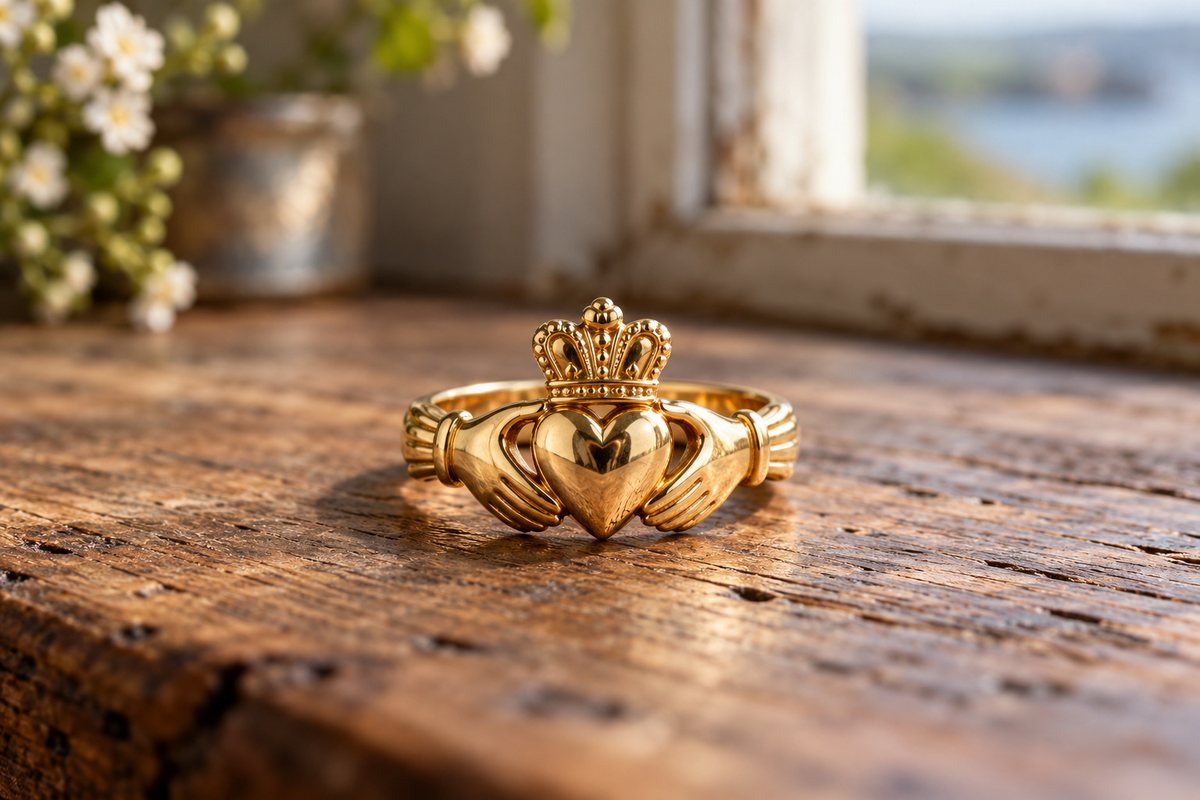
The Claddagh ring is a traditional Irish ring showing two hands holding a crowned heart: the hands stand for friendship, the heart for love and the crown for loyalty. How you wear it is said to show your relationship status, with the right hand and an outward-facing heart traditionally meaning you are single, and the left hand with the heart turned inward meaning you are married. The design comes from the Galway area on Ireland’s west coast and dates back to around 1700.
This guide includes a few product links near the end. As an Amazon Associate, Diamond Taire earns from qualifying purchases, at no extra cost to you.
This guide gives a clear “which hand, which way” chart, separates documented history from the legends, explains how people in Ireland actually treat the “rules”, and shows how to choose the right metal, size and a properly hallmarked ring.
At a glance
- Meaning: hands for friendship, heart for love, crown for loyalty.
- Single: right hand, heart pointing out towards your fingertips.
- In a relationship: right hand, heart pointing in towards your wrist.
- Married: left hand (usually the ring finger), heart pointing in. Many guides use left hand, heart out for engaged.
- History: the National Museum of Ireland dates the earliest examples to around 1700 and notes that the design is often credited to Galway goldsmith Richard Joyce; the wearing customs are of uncertain origin.
What does the Claddagh ring mean?
Each part of the design carries a meaning, and together they describe a relationship built on all three:
| Symbol | Meaning | What it says |
|---|---|---|
| Two hands | Friendship | A bond given freely, hand in hand |
| Heart | Love | Affection offered to the other person |
| Crown | Loyalty | Faithfulness and commitment |
The “hands holding a heart” design belongs to a much older family of rings. The National Museum of Ireland points out that it resembles the fede ring, a clasped-hands ring symbolising friendship that goes back to Roman times. The crowned heart is what makes the Claddagh distinctive.
Where the name comes from
The Claddagh (An Cladach in Irish) was an Irish-speaking fishing village just outside the old city walls of Galway. According to the National Museum of Ireland, the ring style became associated with the village from the mid-nineteenth century, although it was worn more widely across the region, from the Aran Islands through Connemara. The village itself had thatched cottages and an elected “King of the Claddagh”; it was declared an unhealthy area in 1927 and its traditional houses were demolished in the years that followed.
How to wear a Claddagh ring: which hand and which way
This is the part most people search for. The most widely used version of the custom, as set out by Irish jewellers, looks like this:
| Your status | Hand | Heart points | What it signals |
|---|---|---|---|
| Single | Right | Out, towards the fingertips | Your heart is open |
| In a relationship | Right | In, towards the wrist | Your heart is taken |
| Engaged | Left | Out, towards the fingertips | Promised, about to marry |
| Married | Left (ring finger) | In, towards the wrist | Committed for life |
A simple way to remember it: heart pointing in means your heart is taken; pointing out means it is not yet, or not yet fully, given. Moving to the left hand marks a formal commitment.
Be aware that versions differ. The National Museum of Ireland gives a simpler three-way custom (right hand out for not yet in love, right hand in for a romance, left hand for married) and states plainly that the origin of these traditions is uncertain. The “engaged” position in particular varies between sources. If someone gives you a Claddagh with a particular meaning in mind, it is worth asking which version they follow. If you are also choosing wedding or engagement rings, our guide to which hand a wedding ring goes on explains how customs differ by country.
Wearing it as a gift, a friendship ring or for heritage
Plenty of people wear a Claddagh simply as a symbol of Irish heritage, friendship or family. Irish jewellers themselves note that many owners wear it in whichever direction they like. In Ireland it is a common gift between friends, from parents to children and between partners, and it is also used as an engagement or wedding ring. If you want a ring to mark a commitment that is not an engagement, it overlaps with the idea of a promise ring.
The history: what is documented and what is legend
The Claddagh’s story is told in many shops and tourist guides, often blending fact and folklore. Here is what holds up and what does not.
What the records support
- Date: the National Museum of Ireland dates the earliest examples of the style to around 1700.
- Galway makers: its collection includes rings marked by Galway goldsmiths, including Austin French (around 1770 to 1800), Andrew Robinson (around 1800 to 1830) and James Sealy (before 1850).
- Richard Joyce: the design is often credited to Richard Joyce, a Galway goldsmith. A Galway jeweller’s history records that he left Galway in 1675, was captured off the North African coast, was freed in 1689 and returned home, and that later silverwork by him bears his initials and the anchor used for Galway.
- Wider use: a 1905 article in the Journal of the Galway Archaeological and Historical Society, cited by the museum, describes the ring being worn across a large area of the west of Ireland.
The legends
- The captive goldsmith: the best-known story says Joyce was enslaved by Algerian corsairs, sold to a goldsmith who taught him the craft, made the first ring in captivity and gave it to his sweetheart on his return. The museum presents this as a legend, and the details of the ring’s creation cannot be proven.
- Margaret Joyce: another tale says a ring like the Claddagh was dropped into the lap of Margaret Joyce, said in some versions to be by an eagle, rewarding her for charity work such as building bridges in Connacht.
The honest version: the ring is a genuine Galway tradition with surviving examples from the eighteenth century onwards, and the romantic origin stories are folklore. Both can be enjoyed for what they are.
What do Irish people think of the Claddagh?
A common question online is whether wearing one outside Ireland is a bit “touristy”. There is no survey on this, so treat any confident answer with care. What is clear is that Claddagh rings are still made, hallmarked and bought in Ireland, are given as family gifts and wedding rings, and are widely worn by people of Irish descent around the world. Most people will simply read it as a heritage or friendship ring, and few expect you to follow the wearing rules strictly.
How to choose a Claddagh ring
Metal
| Metal | Look | Everyday wear | Good to know |
|---|---|---|---|
| Sterling silver | Bright white, classic | Fine, but softer; detail can wear over years | Tarnishes; easy to polish; lowest cost |
| 9 carat gold | Paler yellow | Harder, good for daily wear | Popular in Ireland and the UK; more affordable than higher karats |
| 14 or 18 carat gold | Richer yellow, or white or rose | Good; 18 carat is a little softer | Higher gold content costs more |
| Platinum | Naturally white | Very durable | Less common for Claddagh designs; highest cost |
For more on how gold karats differ in colour, hardness and cost, see our gold karat guide. If you are choosing silver, our guide to tarnish explains why metals discolour and what that means for daily wear.
Size and fit
Claddagh rings often have a wide front with the hands, heart and crown, and a narrower band at the back. A wider ring can feel tighter, so many people go up slightly. Measure carefully using our ring size chart and converter, since sizes are labelled differently in Ireland and the UK (letters) compared with the US (numbers) and Europe (circumference). Resizing a Claddagh is usually possible (our guide to ring resizing costs explains what affects the price), but ask whether it can be done without distorting the hands on the shank.
Hallmarks and quality
A hallmark is an official mark confirming the precious metal content of an item after independent testing. Ireland has its own official assay office, based at Dublin Castle, and Irish makers send rings there to be tested and hallmarked. A hallmark gives you independent proof that a ring sold as gold or silver really is that metal and fineness.
- Ask whether the ring is hallmarked and by which assay office.
- Look for the fineness mark (for example 375 for 9 carat gold, 585 for 14 carat, 750 for 18 carat, 925 for sterling silver).
- Check the detail: crisp fingers, a clean heart and a symmetrical crown suggest careful casting and finishing.
- Check the weight: very light, hollow-feeling rings may dent more easily.
Claddagh buying checklist
- Decide what it is for: heritage, friendship, relationship, engagement or wedding.
- Choose the metal for your budget and how often you will wear it.
- Pick a style: traditional, with a gemstone heart, or a modern or Celtic-knot band.
- Measure your size on the finger you will wear it, allowing for a wider front.
- Ask about hallmarking and the fineness mark.
- Check that the detail is sharp and the ring is not too thin.
- Confirm resizing and returns before you pay.
- If it is a gift, include a note on how the giver hopes it will be worn.
Common mistakes
- Wearing it the “wrong way” by accident. Heart pointing in towards the wrist means taken. If you are single and want to signal it, point the heart out.
- Treating the rules as law. The customs vary and their origin is uncertain; wear it in a way that is meaningful to you.
- Believing every origin story. The legends are charming but not documented history.
- Buying unmarked “gold” or “silver”. A hallmark or reliable fineness stamp protects you.
- Ordering your usual size in a wide design. Wider fronts fit more snugly.
- Choosing very thin silver for daily wear. Fine detail on soft metal wears down over time.
Sources this guide draws on: National Museum of Ireland, Claddagh rings in its folklife collections; Encyclopaedia Britannica on the Claddagh ring; published histories and wearing guides from two Irish jewellers; standard hallmarking fineness numbers.
Claddagh ring FAQs
Which way should a Claddagh ring face if you are single?
On your right hand with the heart pointing out towards your fingertips. That traditionally signals your heart is open. When you are in a relationship, turn it so the heart points towards your wrist.
Can you buy a Claddagh ring for yourself?
Yes. Some people say it is unlucky unless it is a gift, but this guide found no historical basis for that belief. Many people buy their own as a heritage piece.
Can men wear a Claddagh ring?
Yes. Claddagh rings have long been worn by men and women, and heavier men’s designs and plain bands are widely made. The wearing customs are the same.
Is the Claddagh ring a wedding ring?
It can be. The National Museum of Ireland notes it was used as a marriage and betrothal ring, and many couples still choose matching Claddagh bands. For a married wearer, it is worn on the left hand with the heart pointing in.
What is the difference between a Claddagh and a fede ring?
A fede ring shows two clasped hands, a symbol of friendship and agreement that dates back to Roman times. The Claddagh adds the heart and crown, turning a friendship symbol into one of love, friendship and loyalty together.
Wear it your way
The Claddagh ring has lasted for three centuries because its message is simple: love, friendship and loyalty. Use the chart if you want your ring to say something specific, choose a hallmarked ring in a metal that suits your life, and enjoy both the history and the legends for what they are.
Useful tools for this guide
Practical picks for choosing, checking and caring for jewellery. As an Amazon Associate, Diamond Taire earns from qualifying purchases, at no extra cost to you. Prices and availability are set by Amazon and may vary by country.
- Foldable 30x Jeweller’s Loupe
Pocket magnifier for checking stones, settings and hallmarks up close.
View on Amazon - CONNOISSEURS Premium Jewellery Cleaner
Gentle dip cleaner with a brush and tray for diamonds, gold and platinum. Check the label for stones it should not be used on.
View on Amazon - Ring Sizer Measuring Tool Kit (27 pieces)
Sizing rings plus a mandrel, to check a size at home before you buy or resize.
View on Amazon